
The yellow rock method is a calm, child-focused communication strategy that sits between total emotional shutdown and genuine collaboration. Use it whenever you must stay in contact with a high-conflict or narcissistic co-parent but cannot afford to be emotionally vulnerable. Two things make it worth learning immediately: courts and custody evaluators consistently interpret emotionally regulated, task-focused messages as evidence of parental capacity, and conflict-management research shows that redirecting to factual questions collapses escalation loops before they start.
- What it is: Brief, factual, polite, and document-ready communication with just enough warmth to avoid looking cold on paper.
- When to use it: Any situation where contact is legally required or child-welfare demands it, but full emotional openness would put you at risk.
- Two proof points: Family-court credibility (neutral records are harder to weaponize) and conflict-management effectiveness (factual pivots deny the drama that fuels escalation).
Table of Contents
- How does Yellow Rock differ from Gray Rock?
- What is the Yellow Rock method, exactly?
- How do you practice Yellow Rock step by step?
- What phrases actually reduce escalation?
- Why does Yellow Rock often suit Highly Sensitive People?
- What do therapists and legal experts say about Yellow Rock?
- When is Yellow Rock the wrong tool?
- Key Takeaways
- Why Yellow Rock deserves more credit than it gets
- Unmaskedcare helps you prepare before you hit send
- Useful sources and when to get professional help
How does Yellow Rock differ from Gray Rock?
Gray Rock aims to make you so boring that a manipulative person loses interest entirely. You give one-word answers, show zero emotion, and offer nothing to react to. Yellow Rock keeps that same protective boundary but adds a thin layer of civil warmth, a polite greeting, a neutral close, enough to read as cooperative in a courtroom or to a custody evaluator.
Yellow Rock pros and cons
- Pro: Reads as cooperative and child-focused in court records.
- Pro: Reduces the risk that a judge interprets your silence as hostility or parental alienation.
- Pro: Easier for Highly Sensitive People (HSPs) to sustain without self-betrayal.
- Con: The warmth can occasionally be misread as an invitation to escalate, especially by someone skilled at manipulation.
- Con: Requires more deliberate word choice than Gray Rock; you have to calibrate tone carefully.
Gray Rock pros and cons
- Pro: Maximum emotional protection; almost nothing to react to.
- Pro: Simpler to execute under acute stress.
- Con: Can appear hostile or disengaged in written records, which a skilled attorney can use against you.
- Con: Emotionally costly for HSPs; sustained suppression often leads to burnout.
| Dimension | Yellow Rock | Gray Rock |
|---|---|---|
| Tone | Polite, neutral, mildly warm | Flat, minimal, disengaged |
| Court readability | Strong; signals cooperative parenting | Riskier; can read as hostile |
| Safety suitability | Moderate; not for physical danger | Better for acute threat situations |
| Emotional presence | Controlled warmth, not suppression | Full emotional suppression |
| HSP sustainability | Higher; preserves some authenticity | Lower; burnout risk is real |
What is the Yellow Rock method, exactly?
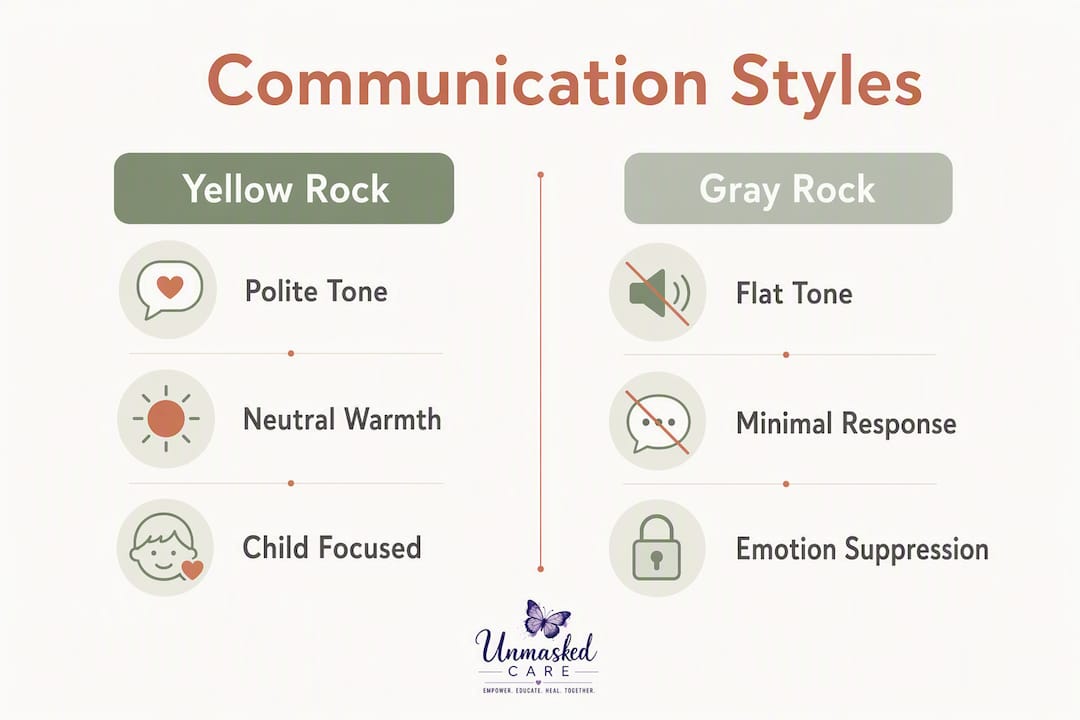
Yellow Rock grew out of the Gray Rock concept as practitioners noticed a gap: Gray Rock protected people emotionally but sometimes hurt them legally. The term “Yellow Rock” emerged in co-parenting communities to describe a slightly warmer tone that signals cooperation without opening the door to manipulation. Think of the color yellow as a signal: not the cold gray of a stone wall, not the open warmth of sunlight, but something in between.
A working definition: Yellow Rock communication is a structured, emotionally regulated style in which every message stays brief, factual, polite, and child-centered, written as if a judge will read it.
The core principles practitioners use:
- Brief: Keep messages to 1–5 sentences. No backstory, no explanations.
- Factual: Stick to logistics, dates, times, and child-related information only.
- Polite: Open and close with neutral, civil language.
- Child-focused: Every sentence should connect to the child’s needs, not the adult conflict.
- Document-ready: Write nothing you would not want a custody evaluator to read aloud in court.
How do you practice Yellow Rock step by step?
The method only works when you build a consistent routine around it. Improvising under stress is where most people slip.
- Pause before you type. When a provocative message arrives, wait at least 10 minutes before drafting a reply. Emotional flooding produces emotional responses; the pause breaks that cycle.
- Extract only the logistics. Read the message once and pull out the single piece of child-related information that actually requires a response. Ignore everything else.
- Draft in three parts: polite opening, one-to-three factual sentences, polite close. Nothing more.
- Read it as a judge would. Ask: does this message show a cooperative, child-focused parent? If yes, send. If not, edit.
- Save the record. Screenshot or log every exchange in a dedicated app or file before closing the thread.
Sample scripts for common triggers
Scheduling change request: “Hi [name], I can accommodate the schedule change. [Child] will be ready for pickup at 5 PM on Saturday. Please confirm.”

School communication: “Hi [name], [Child]'s teacher sent home a permission slip for the field trip on March 14. Please sign and return it by March 10.”
Medical decision: “Hi [name], [Child]'s pediatrician recommends a follow-up appointment next week. I have availability Tuesday or Thursday afternoon. Please let me know which works.”
Accusation in a message: Poor response: “That is completely untrue and you know it. I have always been the one who shows up for [child] and you have the nerve to say…” Yellow Rock response: “Hi [name], I want to keep our focus on [child]'s needs. Is there a specific logistics question I can help with today?”
Pro Tip: Draft your reply, then wait 10 minutes and read it again before sending. Anything that sounds defensive, explanatory, or emotional gets cut. What remains is your Yellow Rock message.
What phrases actually reduce escalation?
The language you choose under pressure determines whether the exchange stays task-focused or spirals. These lines are designed to be copied and adapted.
Neutral openings:
- “Hi [name],”
- “Good morning,”
- “Following up on [child]'s schedule,”
One-line factual bodies:
- “Pickup is confirmed for [day] at [time].”
- “The appointment is scheduled for [date]. I will send the summary afterward.”
- “I am not able to discuss that topic here. If you have a question about [child]'s logistics, I am happy to help.”
Polite closes:
- “Thank you.”
- “Please let me know if you have questions about [child]'s schedule.”
- “I hope [child] has a great week.”
Strategic redirect phrases (for when the conversation drifts into conflict):
- “Let’s keep our focus on what [child] needs this week.”
- “That’s outside what I can help with here. Is there a scheduling question I can answer?”
- “I’ll need to refer that to our attorneys. Regarding [child]'s pickup time…”
Dos and don’ts
- Do use the child’s name to anchor every message to their needs.
- Do set clear boundaries around what topics you will address in writing.
- Don’t explain your reasoning or justify your decisions inside the message.
- Don’t respond to accusations, insults, or emotional bait.
- Don’t use sarcasm, even mild sarcasm; it reads poorly in court records.
- Don’t attempt to educate or correct the other person; experienced practitioners are clear that adding explanations inside a Yellow Rock message undermines the entire method.
Why does Yellow Rock often suit Highly Sensitive People?
Gray Rock asks you to suppress every emotional response, which sounds manageable until you realize HSPs process stimuli more deeply than most people. Sustained suppression does not just feel uncomfortable for an HSP; therapists note it can cause genuine burnout and a form of self-betrayal that makes recovery harder.
Yellow Rock gives HSPs a way out of that bind. The mild warmth in the communication is not emotional openness; it is a controlled, strategic choice that lets you stay authentic enough to function without exposing your actual emotional state to someone who will use it against you. You are not pretending to feel nothing. You are choosing what to show.
Practical self-care while using Yellow Rock:
- Debrief after every difficult exchange. Write in a private journal or talk to a trusted friend. The feelings you did not put in the message need somewhere to go.
- Use templates. Pre-written scripts remove the cognitive load of word choice under stress. Adapt them once, then reuse.
- Schedule therapist check-ins. A therapist familiar with trauma-informed counseling can help you process the emotional residue that Yellow Rock communication produces over time.
- Limit response windows. Decide in advance that you will only check and reply to co-parenting messages once or twice a day. This prevents the hypervigilance loop.
What do therapists and legal experts say about Yellow Rock?
That framing matters legally. Courts and custody evaluators read communication records as evidence of parenting capacity. Consistent, neutral, child-focused messages build a record that is genuinely difficult to weaponize in a custody dispute.
From a conflict-management standpoint, the mechanism is straightforward. Redirecting to factual, logistical questions strips the interaction of the emotional charge a high-conflict person needs to sustain an argument. No drama means no escalation loop.
US co-parenting legal considerations:
- Involve your attorney early. Structured, child-focused messages reduce the volume of routine exchanges your attorney needs to review, which lowers legal costs. But if the other parent refuses to communicate in good faith, escalate to attorney-mediated channels rather than continuing to engage directly.
If you are concerned about how your communication history looks to a court, Unmaskedcare’s credibility and belief resources address exactly that concern.
When is Yellow Rock the wrong tool?
Yellow Rock maintains contact. That is its defining feature and its central limitation.
Stop using Yellow Rock and escalate immediately when:
- There is a credible threat of physical violence. Practitioners are explicit that Yellow Rock is inappropriate during imminent physical danger; No Contact or law enforcement involvement is the only appropriate response.
- The other parent is using your polite messages as evidence of reconciliation or consent in court filings.
- Stalking or surveillance behavior has begun or intensified.
- Coercive control is escalating despite reduced emotional engagement.
- A child is reporting abuse or expressing fear about exchanges.
When to switch strategies:
- Gray Rock or No Contact: When any communication, however neutral, provides material for harassment or legal manipulation.
- Attorney-mediated communication: When direct messages are being distorted or used as evidence in ways your attorney needs to manage.
- CPS or law enforcement: When a child’s safety is at immediate risk. Document everything first, then report.
Check Unmaskedcare’s co-parenting with a narcissist guide for a fuller breakdown of when to escalate and how to document safely. If you are unsure whether a pattern of behavior crosses into a smear campaign, that resource explains the distinction clearly.
Key Takeaways
The Yellow Rock method works because it gives you a communication style that is simultaneously protective, court-credible, and sustainable enough for long-term use in high-conflict co-parenting.
| Point | Details |
|---|---|
| Core definition | Brief, factual, polite, child-focused messages written as if a judge will read them. |
| Yellow Rock vs. Gray Rock | Yellow Rock adds civil warmth to improve court readability; Gray Rock is safer under acute physical threat. |
| HSP suitability | Yellow Rock reduces burnout risk by avoiding total emotional suppression while keeping communications safe. |
| Legal discipline | Preserve every record, avoid admissions, and use documented co-parenting apps for court-admissible timestamps. |
| Unmaskedcare support | Unmaskedcare’s AI Decoder and message templates help you prepare Yellow Rock responses and identify manipulation before you reply. |
Why Yellow Rock deserves more credit than it gets
Most conversations about managing narcissistic relationships treat Gray Rock as the gold standard and Yellow Rock as a softer, less disciplined version of it. That framing gets it backwards.
Gray Rock is a crisis tool. It works when you need to disappear emotionally for a short period. But in a co-parenting situation that will last years, possibly decades, Gray Rock’s emotional flatness creates its own problems: it can read as parental disengagement, it is exhausting to maintain, and for HSPs it often causes more psychological damage than the conflict it was meant to prevent.
Yellow Rock is the long-game strategy. The warmth is not weakness; it is precision. You are giving the other person just enough civil engagement to satisfy a court’s expectation of cooperative parenting, while giving them nothing that feeds the conflict. The method works because it refuses the narrative entirely without appearing to refuse it.
The hardest part is not the language. It is the internal discipline of writing a polite, child-focused message when you are furious, frightened, or exhausted. That is where preparation matters more than willpower. Pre-written templates, a 10-minute pause rule, and a therapist who understands high-conflict dynamics are not optional accessories to Yellow Rock. They are what make it work in practice rather than just in theory.
Unmaskedcare helps you prepare before you hit send
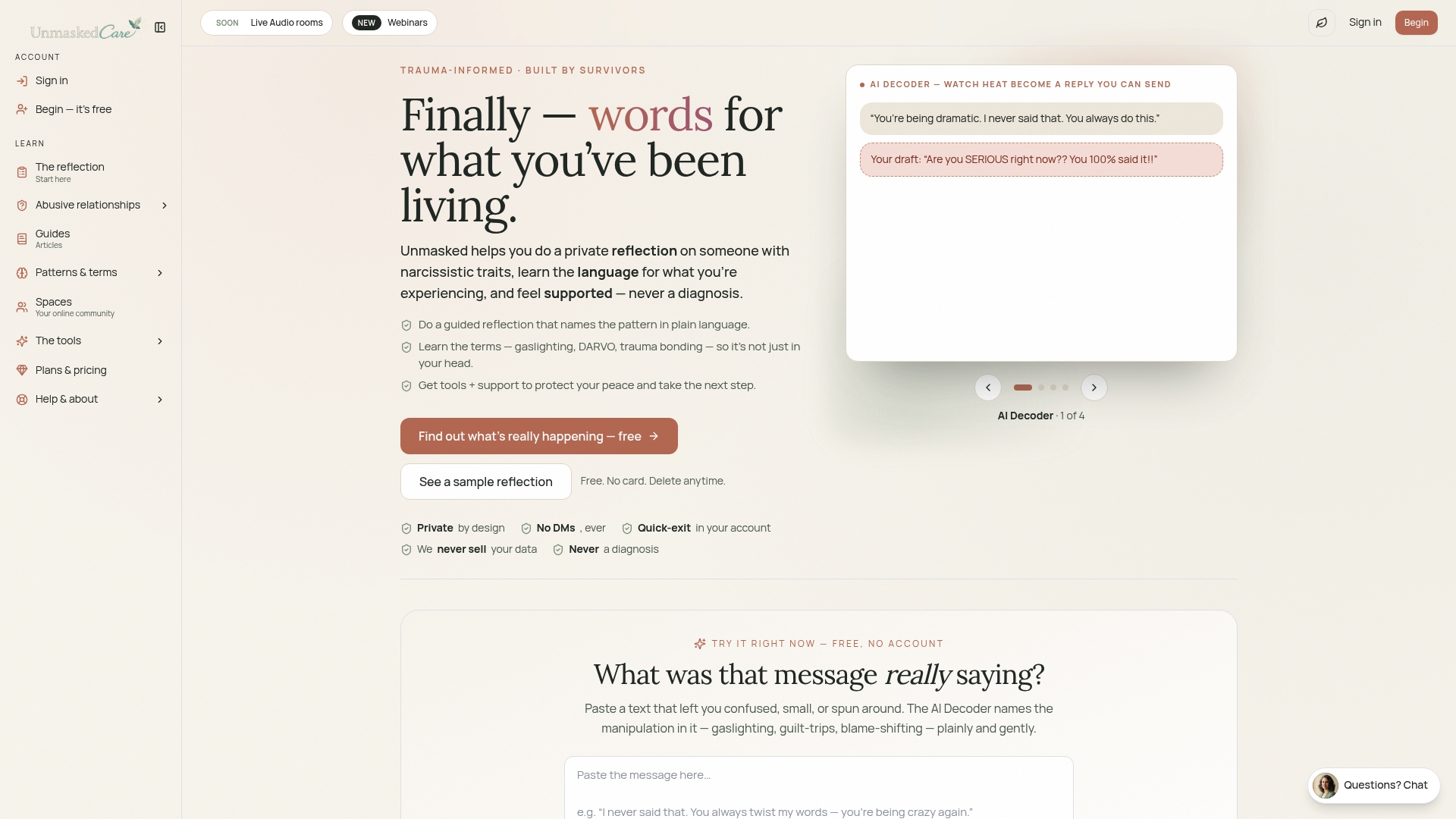
Knowing the Yellow Rock method and executing it under pressure are two different things. Unmaskedcare’s AI Decoder lets you paste in a message from a high-conflict co-parent and get a plain-language breakdown of the manipulation tactics at work, so you can respond to what is actually being said rather than reacting to how it made you feel. The platform also includes message templates built for co-parenting exchanges, an evidence file feature that logs communications with timestamps, and a therapist directory if you need professional support alongside the tools.
Unmaskedcare is not a substitute for legal advice or emergency services. If you are in immediate danger, contact law enforcement. For everything between crisis and calm, explore the full feature set and see which tools fit where you are right now.
Useful sources and when to get professional help
- Using the Yellow Rock Method in High Conflict Co-Parenting — TalkingParents: Practical five-principle breakdown and guidance on documented messaging apps.
- Narcissistic Abuse Resources — Unmaskedcare: Curated library of plain-language guides on abuse patterns and recovery.
If your situation involves physical threats, escalating control, or a child’s safety, contact a family law attorney or call 911. For ongoing emotional support and communication strategy, a therapist who specializes in high-conflict relationships or narcissistic abuse is the most effective next step alongside any self-help tool.