
The fastest way to protect yourself is to send a one-line neutral reply or nothing at all. That’s it. Before you type a single word, know that short, factual replies are what experts recommend when contact is unavoidable — and silence is always a valid choice.
Here are three replies you can copy right now:
- Boundary: “I won’t respond to messages like this.”
- Factual confirmation: “Received. I’ll follow up by Thursday.”
- Co-parenting logistics: “Pick-up is at 3 PM at the school. That works for me.”
Nothing more. No explanation, no apology, no context.
Pro Tip: Before you hit send, put your phone down for at least 60 seconds. Psychologists recommend this cooling-off pause to prevent reactive replies that feed the cycle. Then mute the conversation so the next ping doesn’t pull you back in.

Table of Contents
- Why do short, neutral replies reduce manipulation?
- What are the core strategies for dealing with narcissistic messages?
- Ready-to-copy replies for the most common situations
- How do you recognize narcissistic texting tactics?
- When is it unsafe to reply, and what should you do?
- How do you preserve text evidence and get agreements in writing?
- How should you draft a reply when you need help?
- When should you contact a therapist, lawyer, or crisis service?
- Key Takeaways
- The part most advice skips
- Unmaskedcare helps you reply safely and document what matters
- Useful sources and U.S. crisis resources
Why do short, neutral replies reduce manipulation?
Short replies work because they cut off the fuel source. Narcissistic behavior is driven partly by what psychologists call narcissistic supply — the emotional reactions, arguments, and attention that confirm the sender’s power over you. A long, emotional response hands that over freely. A one-line reply, or no reply at all, removes it.
The cycle typically looks like this:
- Provocative text arrives (accusation, guilt-trip, fake crisis)
- You send an emotional or lengthy reply
- The narcissist escalates, twists your words, or plays victim
- You defend yourself, which restarts the loop
Breaking that loop means changing your output, not trying to change theirs.
Two patterns show up constantly in these exchanges. DARVO (Deny, Attack, Reverse Victim and Offender) flips accountability so you end up defending yourself against accusations you didn’t make. Hoovering pulls you back in after distance with apologies, promises, or manufactured urgency. Both tactics depend on your engagement. Remove the engagement, and the tactic loses traction.
When you switch to brief, neutral replies, escalation often gets worse before it gets better. More texts, more urgency, more drama. That spike is not a sign the approach is failing.
Sit with that. The escalation is the proof.
What are the core strategies for dealing with narcissistic messages?
No contact is the most protective option whenever it’s genuinely available. When contact is necessary — co-parenting, shared workplace, ongoing legal proceedings — Grey Rock or low contact are the practical alternatives.
Grey Rock
You become as uninteresting as a grey rock: flat, boring, emotionally inert. Replies are short, factual, and stripped of anything that could be used as leverage. No opinions, no feelings, no explanations.
- Do: “Noted.” / “That works.” / “I’ll be there at 6.”
- Avoid: Explaining why, defending your choices, or asking questions that invite more conversation.
No Contact
A full stop on communication. No replies, no reading receipts, no checking their profile. This is the strongest boundary and the most effective long-term strategy, but it requires that contact is genuinely optional.
Low Contact
A structured middle ground: you respond only to specific, necessary topics (children’s schedules, legal matters) and ignore everything else. Set a rule for yourself — reply only once per day, only to logistical questions, only in writing.
Explicit boundary statements
Sometimes a clear, written statement is necessary before going low contact. Keep it short and non-negotiable.
- Do: “I’ll only discuss matters related to the children by text.”
- Avoid: Explaining your reasoning or inviting a debate about the boundary.
Getting commitments in writing
Experts recommend converting verbal agreements into short, dated written confirmations immediately after any conversation. This prevents gaslighting and creates an objective record. A follow-up text like “Just confirming: you’ll return the kids by 6 PM Sunday” takes ten seconds and closes the loop.
| Strategy | Best for | Key rule |
|---|---|---|
| No Contact | No shared obligations | Zero replies; block if needed |
| Grey Rock | Required contact (co-parenting, work) | One-line factual replies only |
| Low Contact | Ongoing legal or family matters | Respond only to specific topics, in writing |
| Explicit boundary statement | Establishing new communication rules | One sentence, no debate |
| Written confirmation | Any verbal agreement | Send immediately after the conversation |
Ready-to-copy replies for the most common situations
The rule before every script: avoid JADE — don’t Justify, Argue, Defend, or Explain. Every word you add beyond the bare minimum becomes material for the next manipulation. Keep your voice flat and your message short.
Deflecting bait
When a text is designed to provoke an argument or emotional reaction:
- “I’m not going to engage with this.”
- “Noted.”
- (No reply)
Setting a boundary
When the message crosses a line you’ve already stated:
- “I won’t respond to messages like this. Please keep communication to [topic].”
- “I’ve said what I have to say on this.”
Refusing engagement
When they push for a reaction after you’ve already replied:
- “I have nothing to add.”
- “This conversation is over for me.”
Co-parenting logistics
Keep it purely transactional. Getting co-parenting agreements in writing protects you from later claims that arrangements were never made.
- “Drop-off is Friday at 5 PM at the agreed location. Please confirm.”
- “I’ll need the medical form by Wednesday. Please send it to my email.”
Responding to hoovering
Hoovering tactics include apologies, promises to change, and fabricated crises designed to pull you back. The correct response is almost always no response.
- (No reply)
- “I’m not in a position to revisit this.”
- “I hope you’re well. I won’t be responding further.”
Responding to guilt-tripping or love-bombing
- “I understand you feel that way.”
- “I’ve heard you.”
That’s the whole message. No reassurance, no counter-argument.
Pro Tip: Write your first draft, then delete everything that isn’t a direct answer to a logistical question. What’s left is usually what you should send. If nothing’s left, don’t send anything.
How do you recognize narcissistic texting tactics?
Naming the tactic in your own head before you reply changes everything. It shifts you from reacting emotionally to choosing deliberately. Here are the patterns that show up most often:
-
Gaslighting: “I never said that.” / “You’re remembering it wrong.” / “You’re being paranoid.” The goal is to make you doubt your own perception. Understanding gaslighting helps you recognize it before it lands. Your reply: “I have our previous messages. I’ll go by what’s written.”
-
Baiting: A provocative statement or accusation designed to pull you into an argument. Often phrased as a question or a complaint. Your reply: “Noted.” or no reply.
-
Love-bombing: Sudden warmth, compliments, or declarations of affection after a period of conflict or distance. Feels good; it’s a setup. Your reply: “I appreciate that. I’m keeping communication to [specific topic] for now.”
-
Hoovering: Innocent-seeming check-ins, fake crises, or mutual-friend relays after you’ve created distance. The most common mistake is responding empathetically to a fabricated emergency, which re-opens the door. Verify any alleged crisis independently before responding. Your reply: No reply, or “I hope that gets resolved.”
-
DARVO: They deny something happened, attack your character for bringing it up, then reframe themselves as the victim. Understanding DARVO makes it easier to spot the pivot. Your reply: “I’m not going to debate this.”
-
Playing victim: Exaggerated suffering designed to trigger your guilt and pull you into caretaking. Your reply: “I’m sorry you’re going through that.” Full stop.
-
Urgency manufacturing: “I need an answer RIGHT NOW.” Artificial deadlines create pressure to respond before you’ve thought it through. Your reply: “I’ll get back to you when I can.” Then take your time.
The common thread across all of these: they need your emotional reaction to work. A flat, brief reply is a defense against all of them simultaneously.
When is it unsafe to reply, and what should you do?
If messages contain threats, describe where you are or where you’ve been without your knowledge, or escalate to demands for immediate contact, stop replying. When messages threaten your safety or show stalking behavior, evidence collection and professional support take priority over any communication strategy.
- Stop replying immediately. Do not send a final message explaining why.
- Screenshot everything before blocking, including timestamps and the sender’s number or profile.
- Export the thread if your phone allows it, or email screenshots to yourself with the date in the subject line.
- Mute and block on all platforms: phone, email, social media.
- Contact local law enforcement if messages contain explicit threats, describe your location, or include threats to harm themselves as leverage.
- Call the National Domestic Violence Hotline at 1-800-799-7233 (available 24/7) or text “START” to 88788 if you’re in an unsafe situation or need guidance on next steps.
- Contact a domestic violence advocate before a restraining order filing — they can help you organize your evidence chronologically, which courts require.
A pattern of threatening or monitoring messages can support a restraining order application. Courts look for a documented pattern, not a single incident, so preserving every message matters even when the individual texts seem minor.
One important note: safety is the absolute priority. No communication strategy, however well-crafted, is worth attempting when physical safety is at risk. Escalation and threats require disengagement and professional support, not a better script.
How do you preserve text evidence and get agreements in writing?
Written records prevent gaslighting and protect you in legal proceedings. The habit of converting verbal agreements into short written confirmations is one of the most practical things you can do.
Backing up your messages:
- Screenshot every relevant exchange, making sure the timestamp, sender name, and your phone number are visible in the frame.
- Email screenshots to yourself immediately, with a date-stamped subject line (“Text thread backup — March 14, 2026”).
- On iPhone, use a third-party app like iMazing to export full SMS threads with metadata. On Android, SMS Backup & Restore does the same.
- Print a paper copy and store it somewhere the other person cannot access.
Sample confirmation phrasing:
After any verbal conversation, send a text like:
- “Just confirming what we agreed: [specific detail]. Please let me know if I’ve got anything wrong.”
- “Following up on our call — you said you’d [action] by [date]. I’ll plan accordingly.”
Short, factual, dated. Experts recommend keeping these confirmations minimal and focused on objective facts rather than emotional summaries.
Pro Tip: Lawyers and family court judges look for three things in text evidence: a clear chronology, consistent copies (screenshots that haven’t been edited), and context that shows a pattern rather than a single incident. Organize your screenshots in date order before any legal consultation.
How should you draft a reply when you need help?
The staged drafting workflow below keeps you from sending something reactive. Use it every time a message triggers a strong emotional response.
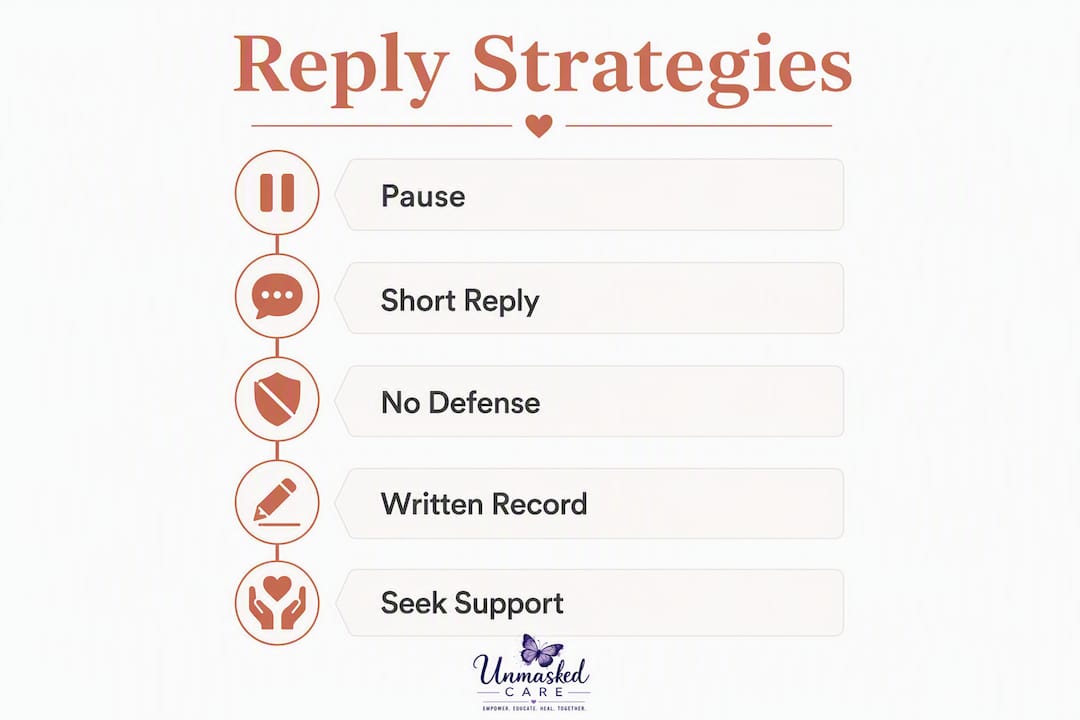
- Pause. Put the phone down. Wait at least 60 seconds, ideally longer. This cooling-off period reduces emotional replies that feed manipulative dynamics and restores your sense of agency.
- Draft offline. Write your response in a notes app, not directly in the message thread. Distance from the send button matters.
- Run a manipulation check. Read your draft and ask: does this justify, argue, defend, or explain anything? If yes, cut it. Does it contain emotional language the other person could screenshot and use? Cut that too.
- Use the AI Decoder. Unmaskedcare’s AI Message Decoder analyzes the incoming message and helps you name the tactic being used — gaslighting, baiting, DARVO, hoovering — before you decide how to respond. That clarity changes the reply you write.
- Shorten to one line. Whatever remains after the manipulation check, cut it in half again. The goal is a reply that conveys only what’s necessary.
- Decide whether to send. Sometimes the right answer after all this is still silence. That’s a valid outcome of the workflow.
- Save to your evidence file. If the incoming message or your reply is relevant to an ongoing situation, save both to Unmaskedcare’s evidence file feature before closing the thread.
Unmaskedcare’s full feature set also includes pre-built reply templates, a searchable therapist directory, and community forums for people navigating the same dynamics. These are support tools, not emergency services. If you’re in immediate danger, call 911 or the National Domestic Violence Hotline first.
Pro Tip: Batch your message reviews. Check the thread once in the morning and once in the evening rather than responding to every ping in real time. Muting notifications is an underused but effective tactic that restores control over when you engage — and it removes the pressure to reply immediately, which is often exactly what the other person is counting on.
When should you contact a therapist, lawyer, or crisis service?
Self-managed strategies work for many situations, but some require professional support. Seek help when:
- Messages are causing significant anxiety, sleep disruption, or fear
- You’re unsure whether a situation qualifies as abuse or stalking
- Children are involved and custody arrangements are being manipulated
- You need a restraining order or legal documentation
- You feel unsafe at any point
Mental health support: Look for a trauma-informed therapist with experience in narcissistic or emotional abuse. Before your first session, bring a short chronology of the communication pattern, two or three representative message examples, and a brief description of how the situation is affecting your daily life. Unmaskedcare’s therapist directory is searchable by specialty and location.
Legal support: A family law attorney can advise on restraining orders, custody modifications, and how text evidence is used in court. Bring organized, printed screenshots with timestamps and a written timeline.
Crisis resources: The National Domestic Violence Hotline (1-800-799-7233) connects you with trained advocates around the clock. Local domestic violence organizations can help with safety planning, shelter referrals, and court accompaniment.
You don’t need to be in physical danger to reach out. Psychological abuse is real, and professional support is appropriate long before a situation becomes physically threatening.
Key Takeaways
The single most protective thing you can do when a manipulative text arrives is pause, then reply with one neutral sentence or nothing at all.
| Point | Details |
|---|---|
| Short or no reply wins | One-line factual replies remove emotional fuel; silence is always valid when contact isn’t required. |
| Name the tactic first | Identifying gaslighting, DARVO, or hoovering before replying shifts you from reacting to choosing. |
| Get everything in writing | Convert verbal agreements into short, dated confirmation texts immediately to prevent gaslighting. |
| Safety overrides strategy | If messages contain threats or stalking behavior, stop replying, document everything, and contact authorities. |
| Unmaskedcare supports the process | The AI Message Decoder, evidence file, and therapist directory help you draft safe replies and document patterns. |
The part most advice skips
Most articles on this topic treat the reply itself as the whole problem. Write the right words, they say, and you’ll be fine. That framing misses something important.
The reply is the last five percent of the work. The other ninety-five percent is what happens before you type anything: recognizing the tactic, resisting the pull to defend yourself, and managing the physical stress response that a single text from the wrong person can trigger in under a second. No script survives contact with that level of activation unless you’ve done the internal work first.
What actually helps long-term isn’t a better vocabulary of neutral phrases. It’s building enough distance from the dynamic that the texts stop landing with the same force. That distance comes from consistent boundaries, reduced contact, and usually some form of professional support — a therapist who understands trauma bonding, a support community where you don’t have to explain the basics, or simply a structured tool that helps you see the manipulation clearly before you respond to it.
The Grey Rock method works. No contact works better when it’s available. But neither of them works reliably if you’re still in the grip of the emotional cycle every time a notification appears. The scripts in this article are a starting point, not a destination.
One more thing worth saying plainly: escalation after you set a boundary is not a sign you did it wrong. It’s often the opposite. The person who has relied on your emotional responses for months or years will push harder when those responses stop coming. That pressure is uncomfortable and sometimes frightening. It is also, in most cases, temporary.
Unmaskedcare helps you reply safely and document what matters
Knowing what to say is one thing. Having a tool that helps you see the manipulation clearly before you respond is another.
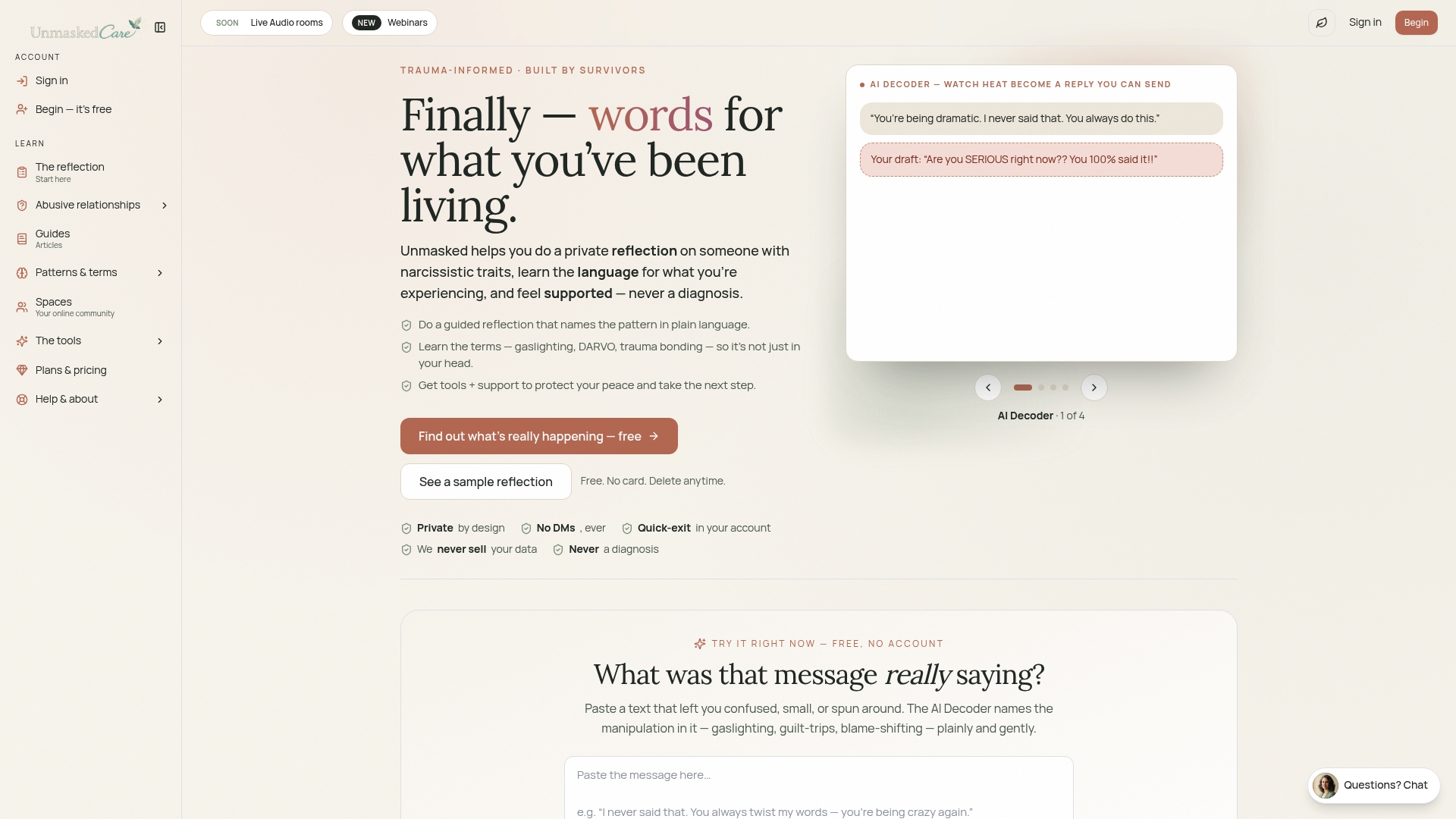
Unmaskedcare was built specifically for people navigating narcissistic and borderline dynamics — not as a generic wellness app, but as a structured workspace for exactly this kind of situation. The AI Message Decoder reads the incoming message and names what’s happening: gaslighting, DARVO, hoovering, love-bombing. That single step of naming it changes the reply you write. The evidence file stores your screenshots and confirmations in a privacy-protected space, organized and ready if you ever need them for legal purposes. Pre-built reply templates give you a starting point when you’re too activated to think clearly, and the therapist directory connects you with specialists who understand this specific kind of abuse.
Free access covers the educational library, community forums, and live audio rooms. Paid tiers unlock the AI Decoder, personalized reflections, and the evidence file. Start with the free AI Decoder at unmaskedcare.com/decode and see what the message you just received is actually doing.
Unmaskedcare is not a substitute for emergency services or legal counsel. If you’re in immediate danger, call 911 or the National Domestic Violence Hotline at 1-800-799-7233.
Useful sources and U.S. crisis resources
Crisis and safety resources:
Psychology and clinical references:
- What Is Hoovering? Signs and How to Handle It — Cleveland Clinic overview of hoovering, escalation, and response strategies
- Narcissistic Hoovering: Signs and How to Respond — Simply Psychology’s clinical breakdown of hoovering tactics
- Hoovering: Definition, Signs, and Coping Tips — Psych Central on recognizing and coping with hoovering behavior
- Narcissistic Hoovering — Verywell Mind on hoovering tactics and disengagement
- 10 Phrases to Disarm a Narcissist — Verywell Mind on written agreements and neutral phrasing
Unmaskedcare resources:
- Grey Rock method explained — when and how to use it
- Setting boundaries with a narcissist — practical templates
- Red-flags checklist — printable pattern identifier
- Narcissistic abuse recovery resources — curated support directory
This article provides general educational information, not professional legal, medical, or psychological advice. Confirm your specific situation with a qualified professional or primary source.