
If someone is trying to hoover you, the safest first move is to stop responding and protect your contact channels immediately. Do not reply, do not explain yourself, and do not attempt to get closure. Any response, even a firm “leave me alone,” signals that the attempts are working. The moment you suspect hoovering, take these steps:
- Stop all replies. Silence is not weakness. It removes the feedback loop the other person depends on.
- Block or mute every channel. Phone, email, social media, and any messaging apps you share.
- Screenshot and save contacts silently. Do not respond to create a record. Save what arrives, note the date and time, and store it somewhere secure.
- Alert one or two trusted people. Tell them to expect contact and to give nothing away.
- Use a short script if contact is unavoidable. Something like: “I’m not in a position to discuss this. Please don’t contact me again.” Say it once, then return to silence.
If you are in immediate danger, call 911. For crisis support, the 988 Suicide & Crisis Lifeline (call or text 988) and the National Domestic Violence Hotline (1-800-799-7233) are available around the clock.
Pro Tip: Before you block, take a screenshot of the most recent messages with timestamps visible. This takes thirty seconds and could matter later if the situation escalates.
Key Takeaways
No-contact is the most effective hoovering response, and the practical work is defending that decision in the moments of pressure that follow.
| Point | Details |
|---|---|
| Stop responding immediately | Any reply, including a refusal, signals that the attempts are working. |
| Document silently | Screenshot with timestamps and store securely without engaging. |
| Protect shared systems | Block all channels, change shared passwords, and harden social media privacy. |
| Use structured tools | Unmasked Care’s AI Decoder and evidence file help you act from clarity, not confusion. |
| Escalate when safety is threatened | Call 911 for immediate danger, 988 for crisis support, or 1-800-799-7233 for domestic violence advocacy. |
Table of Contents
- What is hoovering in a relationship?
- Common hoovering tactics and the red flags to watch for
- Why hoovering works and why the urge to reply feels so strong
- Step-by-step hoovering response plan
- Handling hoovering when no-contact isn’t possible
- How to preserve evidence and when to escalate
- Rebuilding after hoovering attempts
- How Unmasked Care’s tools support your hoovering response
- The Unmasked Care team’s perspective on hoovering
- Unmasked Care: structured support for resisting hoovering
- Sources
What is hoovering in a relationship?
Hoovering is a pattern of manipulative behaviors used to pull someone back into a relationship or dynamic after a separation or period of distance. The name comes from the Hoover vacuum brand: the person doing it is trying to suck you back in. It is not a clinical diagnosis. As Psych Central notes, hoovering is a descriptive term, commonly associated with certain behavioral patterns but not itself a medical condition. This article is educational and does not constitute a diagnosis of any individual.
Hoovering tends to appear after a discard or a period of conflict, when the other person senses they are losing access to you. The tactics can look like affection, urgency, or concern, which is exactly what makes them hard to identify in the moment.
Three terms often get confused:
| Behavior | When it typically appears | Core intent |
|---|---|---|
| Hoovering | After separation or discard | Re-establish access and control |
| Love-bombing | Early in a relationship or after conflict | Create intense attachment quickly |
| Breadcrumbing | During distancing or ambiguity | Maintain low-level interest without commitment |
Love-bombing and breadcrumbing can both appear inside a hoovering attempt. A hoovering campaign might open with love-bombing (intense affection, grand promises) and then shift to breadcrumbing (occasional texts, a social media like) if the initial push fails. The difference is the context: hoovering is specifically about re-entry after you have created distance.
Common hoovering tactics and the red flags to watch for
According to the Cleveland Clinic, hoovering tactics range from subtle probes to extreme measures, including faking a medical crisis to force a response. Knowing what each tactic looks like in practice makes it far easier to label it and resist it.
Love-bombing. A sudden flood of affection, gifts, or declarations after a period of silence. “I’ve never loved anyone the way I love you. I can’t sleep. Please just talk to me.” The intensity is the signal, not the sentiment.

Fake remorse. An apology that centers the person giving it, not the harm caused. “I’m so sorry I hurt you. I’ve been a mess without you. I need you to forgive me so I can move forward.” Notice who the apology is actually about.
Future-faking. Promises of change that are specific enough to sound real. “I’ve already booked a couples therapist. I found an apartment closer to you. Everything will be different.” Future-faking is a tactic, not a plan.
Feigned crisis. A sudden emergency that requires your involvement. “I’m in the hospital. I just need to hear your voice.” Crises that appear precisely when contact has stopped deserve scrutiny.
Third-party contact. When direct access fails, the person may route through friends, family members, or mutual acquaintances, sometimes called flying monkeys. “Your sister called me. She’s worried about you too.” Warn your close contacts in advance and give them a simple script: “I’m not able to pass along messages. Please contact them directly.”
Gaslighting alongside re-entry. Gaslighting often accompanies hoovering, reframing the separation as your overreaction. “You’re being so dramatic. We were fine until you decided to blow everything up.”
Red flags that require immediate safety steps:
- Repeated contact after you have explicitly asked for none
- Showing up at your home, workplace, or regular locations
- Threats, even ones framed as concern (“I don’t know what I’ll do without you”)
- Smear campaigns: telling mutual contacts that you are unstable or dangerous
- Escalating frequency or intensity after initial attempts fail
That last pattern, an escalation after no-contact begins, is predictable. Holding the boundary without engaging typically leads to a decline in attempts over time, though the initial surge can feel alarming.
Pro Tip: When a message arrives, ask one question before anything else: “Is this about a genuine, time-sensitive need that only I can address?” If the answer is no, it is a probe. Treat it as data, not an obligation.
Why hoovering works and why the urge to reply feels so strong
Simply Psychology describes hoovering as a calculated attempt to restore control and access to attention or validation, typically following a devaluation or discard phase. The person doing it is not necessarily acting from love. They are acting from a need to re-establish something they feel they have lost.
Understanding that does not make the pull to respond any weaker. The urge to reply is not a character flaw. It is a nervous-system response, the same one that makes you reach for your phone when it buzzes. Attachment bonds do not dissolve the moment a relationship becomes harmful. The brain keeps scanning for safety signals from the person it bonded with, and a message from that person can feel, briefly, like relief.
There is also the “potential” trap. People often respond not to who the other person has been, but to who they might become. A promise of therapy, a tearful apology, a moment of genuine-seeming warmth, and the brain starts calculating whether this time might be different. That calculation is not irrational. It is human. But it is also the exact mechanism hoovering exploits.
Psychology Today makes a point worth sitting with: closure is rarely available from someone who relies on manipulation. Responding to get closure almost always extends the cycle rather than ending it.
Pro Tip: When the impulse to respond hits, try a grounding cue first: name five things you can see right now. This interrupts the autonomic response and gives you a few seconds of choice. Write down what triggered the urge and the time, privately. Over weeks, that log becomes a pattern map.
Step-by-step hoovering response plan
The guidance below follows a safety-first sequence: immediate, short-term, and ongoing. Psychology Today is clear that even a single response, including a refusal, can signal that the attempts are effective. The goal is to remove that signal entirely.
Immediate steps (right now)
- Do not reply. Close the message without responding.
- Block or mute every channel: phone, email, social media, and any shared apps.
- Screenshot the contact with timestamps visible, then store it in a secure location.
- Tell one trusted person what is happening and ask them not to share your information.
- Change shared passwords for streaming services, smart home devices, or any accounts the person may still access.
Next 24–72 hours
- Audit your digital footprint. Set social media profiles to private. Remove location data from posts.
- Prepare a one-line script for any channel you cannot fully block (a work email, for example): “I’m not able to engage with personal matters here.”
- Contact your building manager or HR if there is a risk of in-person contact at home or work.
- Review your safety plan with a trusted friend or, if relevant, a domestic-violence advocate.
Ongoing
- Maintain the block. Unblocking “just to check” restarts the cycle.
- Harden social media privacy. Remove mutual followers if necessary, and consider a temporary name change on platforms.
- Use a co-parenting app if you share children. Apps like OurFamilyWizard or TalkingParents keep communication factual and timestamped.
- Set and maintain boundaries. If you need guidance on setting boundaries with a narcissist, structured frameworks help reduce the emotional cost of each decision.
Pro Tip: The gray rock method is useful when full no-contact is not possible. Respond only to factual, necessary questions. Keep replies short, flat, and boring. Give nothing emotional to work with.
Handling hoovering when no-contact isn’t possible
Some situations make full no-contact impractical. That does not mean you are without options.
Co-parenting. Limit all communication to child-related logistics only. Short, factual, and unemotional. “Pickup is at 3 PM Saturday.” Not “I hope we can make this work for the kids.” The second sentence opens a door. A dedicated co-parenting app keeps the record clean and removes the emotional texture that hoovering feeds on. Unmasked Care’s co-parenting guide covers this in more depth.
Shared housing. If you are still living with the person, physical safety comes first. Contact a domestic-violence advocate before making any move, since leaving a shared home can sometimes increase risk in the short term. A safety plan developed with a professional is worth the time.
Workplace contact. Speak to HR confidentially. You do not need to share every detail. “I’m experiencing unwanted personal contact from someone and I need to know my options.” Most HR departments have protocols for this. If the person works in the same building, ask about schedule adjustments or a point of contact for communication.
Flying monkeys: when friends and family are used as messengers. Give your close contacts a simple script and ask them to use it consistently:
- “I’m not in a position to pass along messages or updates. Please reach out to them directly.”
- “I care about you, but I can’t be in the middle of this.”
The goal is not to alienate your support network. It is to close the indirect channel without drama. Brief them once, clearly, and let them know you are okay. If a mutual friend keeps relaying messages despite your request, limit what you share with that person going forward.
Pro Tip: If family members are being used to reach you, consider sending them a short, calm message that explains you are taking space and that you are safe. It removes the “welfare check” pretext the other person may be using to justify the contact.
How to preserve evidence and when to escalate
Silent documentation is the standard. Responding to a message, even to say “stop contacting me,” can weaken a no-contact boundary and provide evidence that the attempts are reaching you. Save what arrives without engaging.
Evidence-preservation checklist
- Screenshot every contact with the timestamp and sender information visible.
- Note the date, time, platform, and content in a private log immediately after.
- Save voicemails without returning the call. Most phones allow you to export audio files.
- Preserve physical evidence (letters, notes, gifts left at your door) in a bag with a note of when and where you found it.
- Store everything in a secure location the other person cannot access. Unmasked Care’s privacy evidence file feature keeps records encrypted and organized. A password-protected folder on a device they have never touched also works.
- Do not delete anything, even contacts that seem minor. Patterns matter in legal contexts.
When hoovering escalates to threats, stalking, or violence, the situation requires more than documentation.
| Escalation trigger | Recommended action |
|---|---|
| Explicit threats (verbal, written, or implied) | Contact local police; file a report even if no action is taken yet |
| Showing up at home, work, or regular locations | Request an emergency protective order |
| Repeated contact after a clear cease-and-desist | Consult a family law or civil attorney |
| Threats of self-harm used to compel response | Call 988; do not go to them alone |
| Physical contact or property damage | Call 911 immediately |
If you are unsure whether what you are experiencing qualifies as stalking or harassment, call the National Domestic Violence Hotline at 1-800-799-7233. Advocates there can help you assess the situation and connect you with local legal resources. For mental health crisis support, 988 is available by call or text, 24 hours a day.
Rebuilding after hoovering attempts
Recovery is not a single decision. It is a sequence of small, repeatable actions that gradually reduce reactivity and rebuild a sense of safety. Practitioners who work with abuse survivors often describe healing as a nervous-system project rather than a willpower project. The goal is not to feel nothing when a message arrives. It is to build enough internal stability that the message no longer controls what you do next.
A practical roadmap:
- Stabilize first. Consistent sleep, meals, and physical safety matter more than insight at this stage. Routines create predictability, and predictability calms the nervous system.
- Reduce reactivity. Grounding exercises (the five-senses check, slow breathing, cold water on the wrists) interrupt the automatic response before it becomes a reply. Practice them when you are calm so they are available when you are not.
- Reconnect with trusted people. Isolation is one of the lasting effects of manipulative relationships. Rebuilding one or two genuine connections is more useful than a large social network.
- Guard the re-entry points. Loneliness, anniversaries, and stress are the moments when the urge to re-engage is strongest. Name them in advance and have a plan for each.
For structured recovery exercises, Unmasked Care’s healing resources and the narcissistic abuse recovery library offer guided reflection prompts and practical frameworks you can work through privately.
Journal prompts to start with:
- What did I feel the last time I received contact? Where did I feel it in my body?
- What did I want to happen when I imagined replying?
- What actually happened the last time I did reply?
These are not rhetorical questions. Writing the answers, even briefly, builds the self-observation muscle that makes future boundary-keeping easier.
If professional support is part of your plan, Unmasked Care’s therapist directory connects you with clinicians who specialize in narcissistic and borderline abuse. Structured therapy, particularly approaches that address trauma responses, can accelerate the nervous-system work significantly. For a broader look at inclusive counseling approaches, The Therapy Canvas offers practical guidance on what to look for in a therapist.
Pro Tip: When the urge to check their social media or re-read old messages hits, treat it the same way you treat the urge to reply. Note the time, note what triggered it, and do something physical instead: a short walk, cold water, or even just standing up. The urge passes. The data you collect about your own patterns is genuinely useful.
How Unmasked Care’s tools support your hoovering response
Knowing a message is likely hoovering and feeling certain about it are two different things. That gap is where manipulation lives. Unmasked Care’s tools are built specifically to close it.
The AI Decoder. Paste a message you have received and the Decoder analyzes the language for manipulation patterns, including love-bombing, future-faking, and DARVO. It names what it finds in plain language, which helps reduce the emotional charge of re-reading a message repeatedly trying to figure out if it is genuine. Access the free AI Decoder directly, no subscription required to start.
The red-flags checklist. A printable red-flags checklist that covers the most common hoovering tactics. Useful to share with a trusted friend who is trying to understand what you are experiencing, or to work through privately when you are second-guessing yourself.
The privacy evidence file. Paid tiers include an encrypted evidence file where you can log contacts with timestamps, upload screenshots, and organize records by date. This is particularly useful if the situation may eventually involve legal steps.
Structured reflection prompts. Rather than staring at a blank journal page, Unmasked Care’s guided reflections walk you through specific questions about what happened, how it felt, and what boundary would have helped. The output is a written report you keep privately.
- Quick use case: Receive a suspicious message. Paste it into the Decoder. Get a plain-language analysis in under a minute. Decide from clarity, not confusion.
- Longer use case: Build a timestamped evidence file over weeks, then share it with a lawyer or advocate if escalation becomes necessary.
Pro Tip: Use the Decoder before you decide whether to respond, not after. Once you have replied, the dynamic has already shifted. The tool is most useful as a pause-and-check step, not a post-mortem.
The Unmasked Care team’s perspective on hoovering
Most articles on hoovering focus on recognition, and recognition matters. But there is a subtler problem that gets less attention: the moment after you recognize it.
You know it is hoovering. You can name the tactic. And you still feel the pull. That gap between knowing and doing is not a failure of understanding. It is the nervous system doing exactly what it was conditioned to do. The relationship trained you to respond. Untraining that takes repetition, not insight alone.
The conventional advice, “just go no-contact,” is correct but incomplete. No-contact is a decision you make once and then defend dozens of times, often in moments of stress, loneliness, or manufactured urgency. The practical work is in those moments, not the initial decision. That is why tools that help you pause, name what is happening, and act from a grounded place matter more than another list of tactics to memorize.
There is also something worth saying about the closure myth. Many people respond to hoovering not because they want the relationship back, but because they want an ending that makes sense. That ending is rarely available from someone who relies on manipulation. Psychology Today puts it plainly: pursuing closure through engagement typically extends the cycle. The closure you are looking for has to be built internally, not extracted from the other person.
If you are in a situation where your safety is at risk, please reach out now. Call 988 or 1-800-799-7233. You do not need to be in immediate physical danger to deserve support.
Unmasked Care: structured support for resisting hoovering
Recognizing a hoovering attempt is one thing. Having a structured place to process it, document it, and decide what to do next is another.
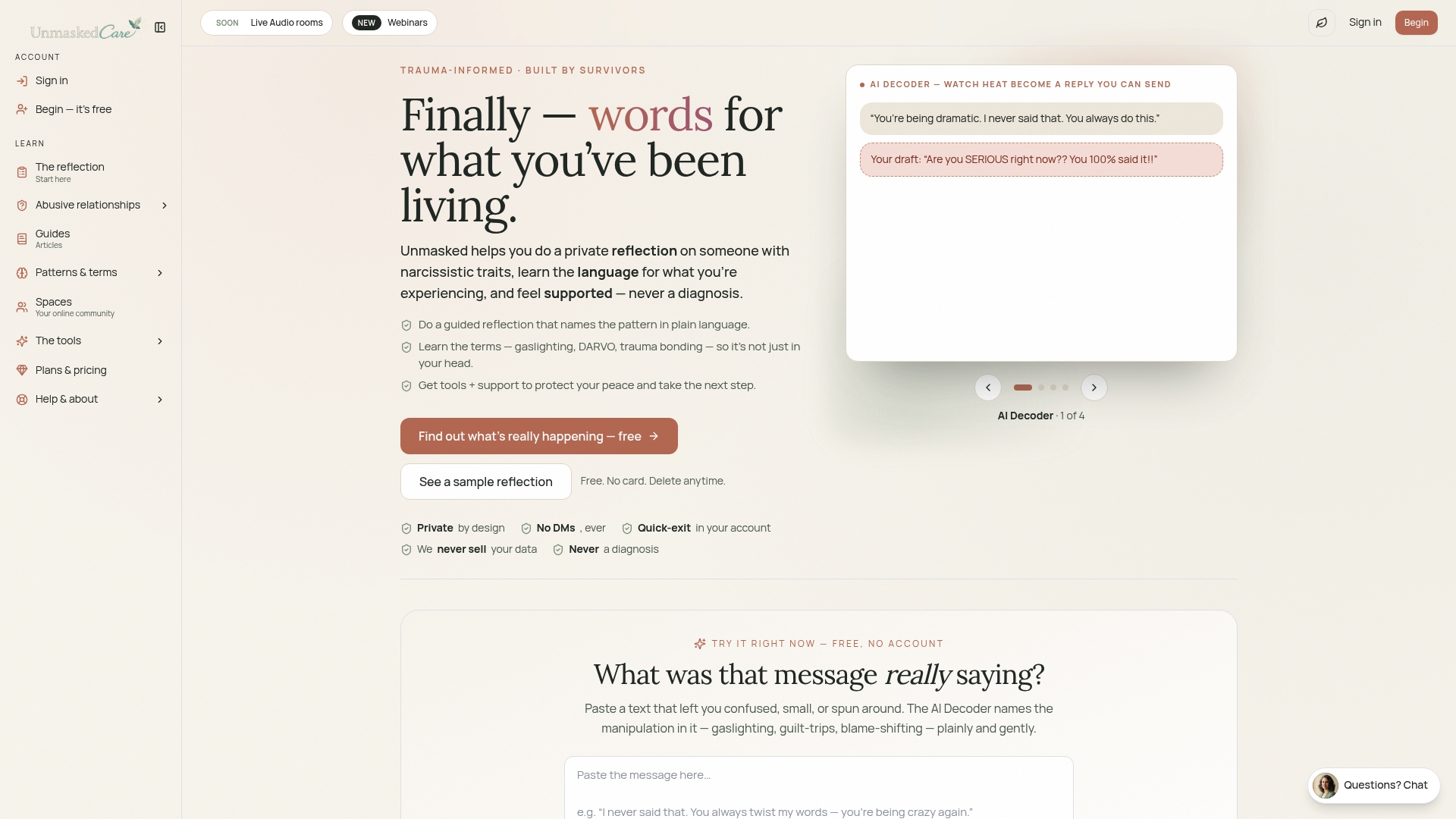
Unmasked Care was built for exactly this situation. The free AI Decoder analyzes messages for manipulation patterns in plain language, so you are working from clarity rather than second-guessing. The full features include a privacy-first evidence file, guided reflection reports, a printable red-flags checklist, and co-parenting communication templates, all in one place, with no data shared without your consent.
Free access covers the Decoder and the educational library. Paid tiers unlock the evidence file, personalized reports, and deeper analysis tools. If cost is a barrier, gifting options are available.
Start with the free Decoder at Unmaskedcare and see what the message actually says.
Sources
- Hoovering: Definition, Signs, and Coping Tips | Psych Central
- What Is Hoovering? 7 Signs and How To Handle It | Cleveland Clinic (Health)
- Hoovering: When narcissists try to pull you back in | Psychology Today (blog)
- Narcissistic Hoovering: Signs & How to Respond | Simply Psychology
FAQ
What is a hoovering response? A hoovering response is how you react when someone uses manipulative tactics to pull you back into a relationship after separation. The recommended response is no contact: stop replying, block all channels, and document attempts silently.
How do I know if someone is hoovering me? Common signs include sudden intense affection after a period of silence, apologies that center the other person’s feelings, manufactured emergencies, promises of specific change, and contact routed through mutual friends. If the outreach appears precisely when you have created distance, treat it as a probe.
Should I respond to explain myself? No. Explaining yourself, even once, confirms that the attempts are reaching you. It also rarely produces the outcome you hope for. Silence is the clearest boundary.
What if I have to stay in contact because of children? Limit communication to child-related logistics only. Use a dedicated co-parenting app to keep records factual and timestamped. Keep messages short and unemotional. Unmasked Care’s co-parenting guide covers this in detail.
Is hoovering a sign that someone has a personality disorder? Hoovering is a behavioral pattern, not a diagnosis. This article is educational and does not diagnose any individual. If you are concerned about your situation, speak with a qualified mental health professional.
What do I do if the hoovering escalates to threats or stalking? Contact local police and file a report. If you are in immediate danger, call 911. For support and guidance, call the National Domestic Violence Hotline at 1-800-799-7233. Document every contact silently before escalating.
Can hoovering happen years after a relationship ends? Yes. Hoovering can occur months or years after separation, particularly during life transitions (a new relationship, a move, a public milestone) that the other person becomes aware of.
What is the “extinction burst” in hoovering? When no-contact begins, attempts often intensify before they stop. This escalation is predictable. Holding the boundary without engaging typically leads to a decline in attempts over time, though the surge can feel alarming in the moment.
How is hoovering different from genuine reconciliation? Genuine reconciliation involves consistent behavioral change over time, not a single intense gesture. Hoovering tends to be sudden, intense, and timed to moments when you have created distance. It often disappears or shifts tactics if the initial approach fails.
This article is general information, not a substitute for advice from a qualified doctor. Consult a qualified healthcare professional about your own circumstances before acting on anything here.