
When a flying monkey contacts you, the safest immediate reply is: “I’m not going to discuss this.” Say it once. Repeat it if they push. That’s the whole strategy in one line.
If you need something ready to copy right now:
- In person: “I’m not getting into this with you.”
- Text or DM: “This isn’t something I’m discussing. Take care.”
- Group chat: Leave the group, or mute and don’t respond.
- Phone call: “I have to go.” Then hang up.
Immediate next steps: block or mute the contact, document the interaction with a screenshot and timestamp, and stop sharing personal details with anyone connected to the narcissist until you know who is safe.
Table of Contents
- What are flying monkeys, and why do they show up?
- How do you know if someone is acting as a flying monkey?
- What to say to flying monkeys: scripts by channel
- How to set and enforce boundaries that actually hold
- When does this become a safety issue?
- Is it ever worth trying to reach a well-meaning flying monkey?
- How Unmaskedcare tools help you prepare and protect yourself
- Key Takeaways
- What actually shifts things
- Unmaskedcare: tools built for exactly this situation
- Useful sources and U.S. resources
What are flying monkeys, and why do they show up?
The term comes from The Wizard of Oz, where the Wicked Witch sends winged minions to do her bidding. In real life, flying monkeys in narcissistic abuse are people a narcissist recruits, knowingly or not, to extend their control. They carry messages, gather information, spread false narratives, and pressure you to reconcile, often while believing they’re simply helping.
There are two distinct types, and the difference matters for how you respond:
- Well-meaning contacts: A parent, mutual friend, or sibling who genuinely thinks they’re mediating. They’ve absorbed the narcissist’s version of events and believe they’re helping you both. They’re not malicious, just misinformed.
- Active campaigners: Someone who knows the situation is one-sided and participates anyway. They relay your private details back, defend the narcissist reflexively, and may escalate pressure when you don’t comply.
Picture a group text where your ex’s sister forwards your message to your ex within minutes of receiving it. You never told her it was private. She thought she was “keeping the peace.” That’s a well-meaning flying monkey doing real damage. An active campaigner would have screenshotted it and sent it with commentary.
Understanding which type you’re dealing with shapes everything, from whether engagement is worth attempting to how tightly you lock down your information.

How do you know if someone is acting as a flying monkey?
Behavioral signs are usually more telling than gut feeling alone. Watch for these patterns:
- They relay messages from the narcissist without being asked.
- They repeat details back to you that you only shared with the narcissist.
- They defend the narcissist reflexively, even when presented with direct evidence of harm.
- They pressure you to reconcile, forgive, or “move on” in ways that serve the narcissist’s access to you.
- They ask probing questions about your living situation, finances, or new relationships.
Ask yourself these diagnostic questions: Did this person know something I only told the narcissist? Do they consistently take the narcissist’s side regardless of what I say? Have they ever acknowledged that the narcissist might be wrong about anything?
That last question is particularly useful. Asking a contact whether they think the narcissist is ever wrong can reveal how deeply they’ve accepted the narcissist’s narrative. A “they’re never wrong” response, or visible discomfort at the question, is a strong signal.
Pro Tip: Watch for pattern and directionality, not just single events. One awkward conversation proves nothing. A repeated pattern of information flowing from you to the narcissist through the same person is a clear sign of a conduit relationship.
What to say to flying monkeys: scripts by channel
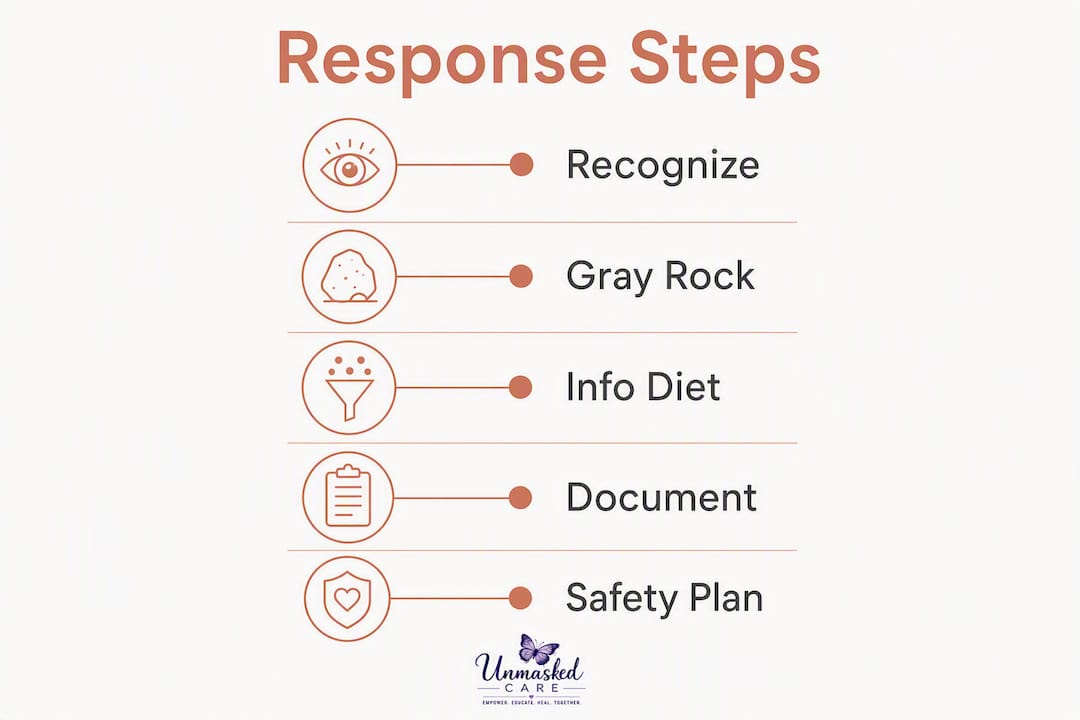
The core approach has three parts: gray rock (brief, neutral, non-emotional replies), an information diet (share nothing personal), and repeated boundary statements (same words, no escalation). Together, they deprive the narcissist of emotional data and often cause flying monkeys to lose interest.
Scripts by channel
In person:
- “I’m not discussing this.”
- “I hear you. This isn’t something I’m going to get into.”
- “I need to go.” (Then leave.)
Text or SMS:
- “This isn’t something I’m discussing. Hope you’re well.”
- “I’m not going to respond to messages about [name]. Take care.”
Group chat:
- Leave silently, or send once: “I’m stepping back from this group.” Then leave.
Social media DM:
- Don’t reply. Archive or delete. Block if the contact persists.
What invites escalation vs. what shuts it down
Therapists consistently recommend against emotional responses because they supply the narcissist with validation and fuel the campaign. Long explanations, corrections, and arguments all signal that you’re still engaged, which is exactly what keeps the cycle running.
| Approach | What you do | Likely outcome |
|---|---|---|
| Engage | Explain, defend, correct the record | Flying monkey reports back; narcissist escalates |
| Gray rock | Brief, neutral reply; repeat if pushed | Contact loses interest; information flow dries up |
| Escalate | Threaten, argue, expose publicly | Conflict intensifies; you become the “proof” of the narcissist’s story |
Gray rock is the default. Escalation is only appropriate when safety is at risk and you’re involving authorities, not when you’re venting.
How to set and enforce boundaries that actually hold
Boundaries without consequences are just requests. Here’s how to make them stick:
- State the boundary once, clearly. “I won’t discuss [name] with you.” One sentence. No justification.
- Repeat it if they push. Same words. No new information. “As I said, I’m not discussing this.”
- Take action if they continue. End the call, leave the room, block the number, or exit the group.
Sample messages for specific situations
Group text with mutual contacts: “I’m not going to be part of conversations about [name]. I’m muting this thread.”
Family member acting as a conduit: “I care about you, and I’m not able to talk about [name] with you right now. If that changes, I’ll let you know.”

Mutual friend asking questions: “I’m keeping things private for now. Thanks for understanding.”
Privacy checklist: lock down your information diet
Information functions as weaponized currency in these dynamics. Cutting the supply reduces harm.
- Remove or restrict social media posts visible to mutual contacts.
- Leave shared groups or mute them so you stop appearing active.
- Stop sharing your location, schedule, or relationship status with anyone in the narcissist’s orbit.
- Assume anyone might be co-opted until they’ve demonstrated otherwise, especially during high-conflict periods.
- Keep your support circle small and vet it carefully.
When does this become a safety issue?
Gray rock and information diets handle most flying monkey contact. But when behavior crosses into stalking, threats, or coordinated harassment, the situation requires a different response entirely.
Evidence checklist: what to save and how
- Screenshots of messages, with timestamps visible.
- Voicemails saved to a secure location (not just your phone’s voicemail inbox).
- Written notes of in-person incidents: date, time, location, exact words used, any witnesses.
- Emails, saved to a folder outside your main inbox or forwarded to a private account.
Store everything in a location the narcissist cannot access. A private cloud folder, a USB drive kept somewhere secure, or a platform with a private evidence file all work. Documentation improves outcomes significantly if you later need to involve law enforcement or an attorney.
Clear signals to escalate
- You receive explicit threats, in any format.
- Someone is monitoring your location or movements.
- Harassment is repeated, coordinated, and involves multiple people.
- You feel physically unsafe.
What to do when you reach that point
- Contact local law enforcement and bring your documentation.
- Call the National Domestic Violence Hotline at 1-800-799-7233 (available 24/7).
- Consult a family law or domestic violence attorney about protective orders.
- Contact a domestic violence advocate through your local shelter or the hotline for safety planning support.
If you’re in a divorce or custody situation where the narcissist is using flying monkeys to gather information or apply pressure, legal counsel familiar with high-conflict narcissistic dynamics can make a significant difference in how that evidence is used.
Is it ever worth trying to reach a well-meaning flying monkey?
Sometimes. The decision depends on three factors: your relationship history with that person, how independently they think, and whether the emotional cost is worth the likely outcome.
Use this checklist before attempting outreach:
- Do you have a genuine relationship with this person that predates the narcissist’s influence?
- Have they ever disagreed with the narcissist, even privately?
- Can you have this conversation without it being reported back?
- Are you emotionally regulated enough to stay brief and non-reactive?
If most answers are yes, a short, factual outreach can work. Keep it simple:
“I wanted to talk to you directly. I’m not comfortable with [specific behavior]. I’d like us to stay in contact, but I need that to stop. Can we agree on that?”
Then wait. Most flying monkeys who have fully accepted the narcissist’s story won’t update their beliefs quickly, and presenting facts often triggers defensiveness rather than reflection. That’s not a failure on your part. It’s the nature of the dynamic.
Stop signs that mean you should disengage:
- They report the conversation back to the narcissist.
- They dismiss your boundary or argue against it.
- They become hostile or start defending the narcissist’s behavior toward you.
- You feel worse after every interaction.
When any of these appear, treat this person the same as an active campaigner: gray rock, information diet, and distance.
How Unmaskedcare tools help you prepare and protect yourself
Knowing what to say is one thing. Practicing it under pressure, decoding incoming messages before you react, and storing evidence safely are where most people get stuck. Unmaskedcare is built specifically for this.
- AI Decoder: Paste a message from a flying monkey or the narcissist and get a plain-language breakdown of the manipulation tactic being used, including patterns like DARVO, gaslighting, and guilt-tripping. This helps you respond from clarity rather than confusion.
- Reflection worksheets: Structured prompts that help you articulate what happened, identify the tactic, and draft a short, calm response before you send anything.
- Private evidence file: A secure, in-platform space to store screenshots, notes, and timestamps, separate from your regular devices and inaccessible to anyone else.
- Therapist directory: A searchable list of trauma-informed therapists who specialize in narcissistic and borderline abuse, useful when the situation escalates beyond what self-help tools can address.
A practical use case: preparing for a difficult family event
Say a holiday gathering is coming up and you know flying monkeys will be present. Before the event, use the reflection worksheets to draft two or three gray-rock responses for the scenarios most likely to come up. Run them through the AI Decoder to check whether your phrasing might invite escalation. After the event, log any incidents in the private evidence file with timestamps while the details are fresh.
Pro Tip: When using the evidence file, export a copy to a separate secure location periodically, such as an encrypted folder or a trusted person’s email. A single storage point is a single point of failure if your account access is ever compromised.
Key Takeaways
The most effective flying monkeys response combines gray rock scripts, a strict information diet, and documented boundaries, with escalation to legal or advocacy resources when threats appear.
| Point | Details |
|---|---|
| Use gray rock immediately | Reply with “I’m not discussing this” and repeat it without adding new information. |
| Cut the information supply | Stop sharing personal details with anyone in the narcissist’s orbit until you know who is safe. |
| Document everything | Save screenshots and timestamped notes in a private, secure location from the first incident. |
| Escalate when safety is at risk | Contact law enforcement, the National Domestic Violence Hotline (1-800-799-7233), or an attorney when threats or stalking occur. |
| Unmaskedcare supports each step | The AI Decoder, private evidence file, and therapist directory give you tools to practice, document, and find professional help. |
What actually shifts things
The conventional advice is to “stay calm and set boundaries.” That’s true, but it misses something important: the hardest part isn’t knowing what to say. It’s tolerating the guilt that comes after you say it.
Flying monkeys are effective precisely because they arrive wearing familiar faces. A parent. A childhood friend. Someone you trusted. When you go gray rock on them, it can feel like you’re the cold one, the difficult one, the person who “won’t just talk about it.” That guilt is the mechanism. It’s designed to pull you back into engagement, which feeds the narcissist’s campaign.
What survivors consistently describe as the turning point isn’t a perfect script. It’s the moment they stopped needing the flying monkey to understand. You don’t need them to agree that the narcissist was wrong. You don’t need them to apologize. You need them to stop having access to your life, and that’s a boundary you can enforce regardless of whether they ever get it.
Grief is part of this. Therapists who work with proxy abuse describe recovery as involving genuine loss, not just tactical adjustment. Some of these relationships won’t survive the boundary. That’s a real cost, and it’s worth naming rather than glossing over with “you deserve better.” You might deserve better and still grieve the loss. Both things are true.
If you’re wondering why no one seems to believe you, that’s not a sign you’re wrong. It’s a sign the campaign is working as intended.
Unmaskedcare: tools built for exactly this situation
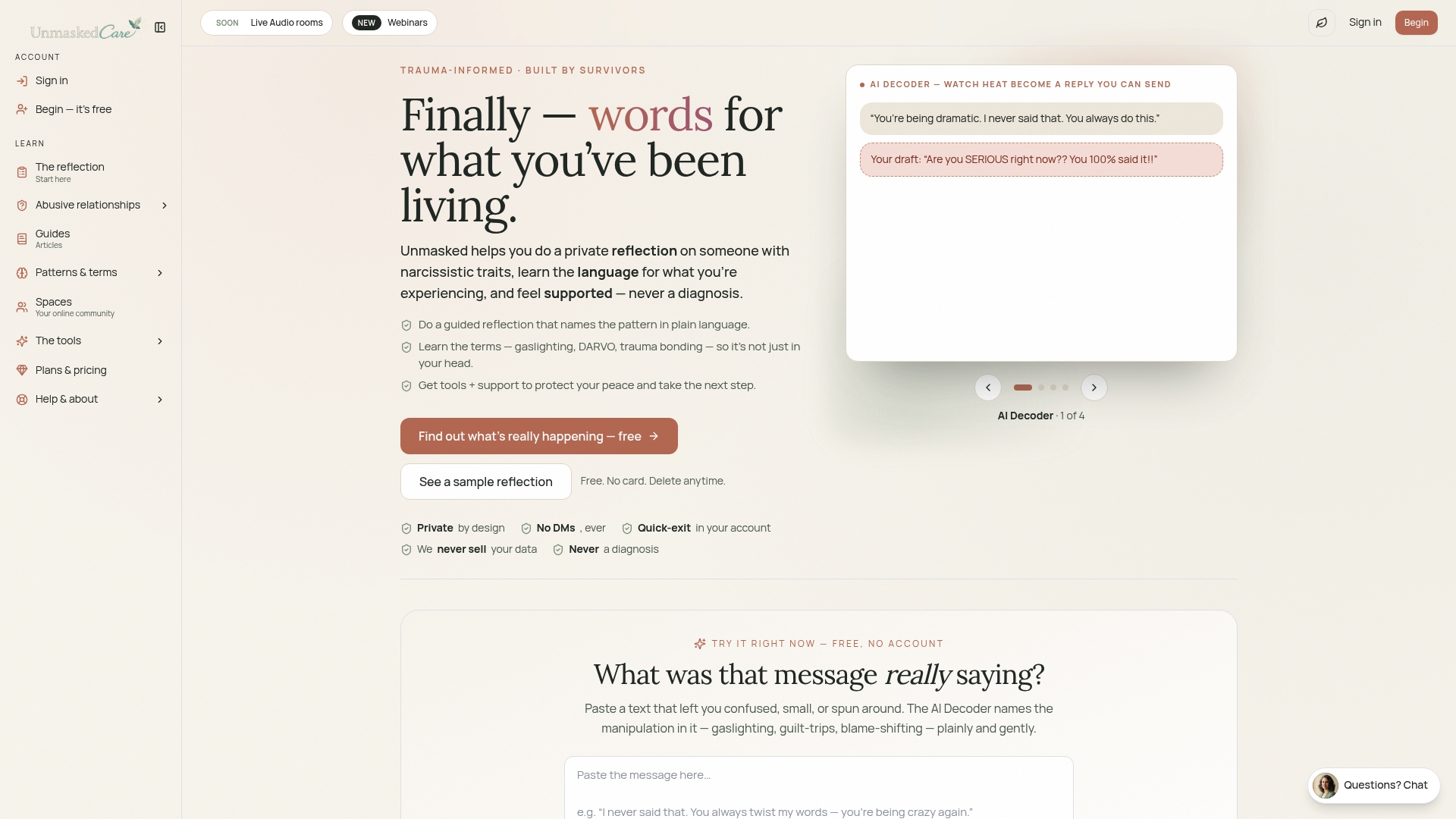
Most resources tell you what flying monkeys are. Unmaskedcare gives you somewhere to actually work through it. The AI Decoder identifies the specific manipulation tactic in a message before you respond, so you’re not reacting blind. The private evidence file keeps your documentation secure and organized. The therapist directory connects you with specialists in narcissistic and borderline abuse when the situation calls for professional support.
You can start with the free tools, including the community forums and educational guides, and upgrade when you need the deeper analysis features. No long intake forms, no waiting room. If you’re in the middle of a difficult situation right now, the AI Decoder is the fastest place to start.
Useful sources and U.S. resources
- Narcissists and Flying Monkeys — Verywell Mind: Therapist-reviewed guidance on emotional non-reactivity and no-contact as self-protection.
- Flying Monkeys: How Narcissists Weaponize Your Support System — Annie Wright, LMFT: Practitioner-level guidance on documentation, safety planning, and escalation.
- 3 Tips to Protect Yourself from a Narcissist’s Flying Monkeys — Psychology Today: Practical advice on information diets and vetting your support circle.
- Flying Monkeys in Narcissistic Abuse — Simply Psychology: Thorough overview of recruitment patterns and protective strategies.
- Best Resources for Narcissistic Abuse Recovery — Unmaskedcare: Curated reading list and tool directory for ongoing recovery support.