
If you’re recovering from narcissistic abuse, the single most useful thing you can do this week is book a 15–20 minute consultation with a licensed, trauma-informed therapist who explicitly lists EMDR, IFS, CPT, or somatic work on their profile. This one filter cuts through hundreds of generic listings and gets you to someone who already speaks your language.
Here’s what to do in the next 48 hours:
- Book a consultation call. Look for a therapist offering a free or low-cost 15–20 minute consult. Treat it as a two-way interview, not an audition.
- Confirm state licensure. If you want telehealth, check whether the clinician is licensed in your state or participates in PSYPACT, which allows cross-state telepractice among participating states.
- Start capturing evidence privately. Save messages, notes, and incidents in a secure, private file before memory fades or access disappears.
- Join a vetted peer support resource. While you wait for a clinical slot, Unmaskedcare’s community forums and live audio rooms give you a structured, moderated space to process what’s happening.
Table of Contents
- Where can you find a therapist who treats narcissistic abuse?
- How do you choose the right therapist for narcissistic abuse?
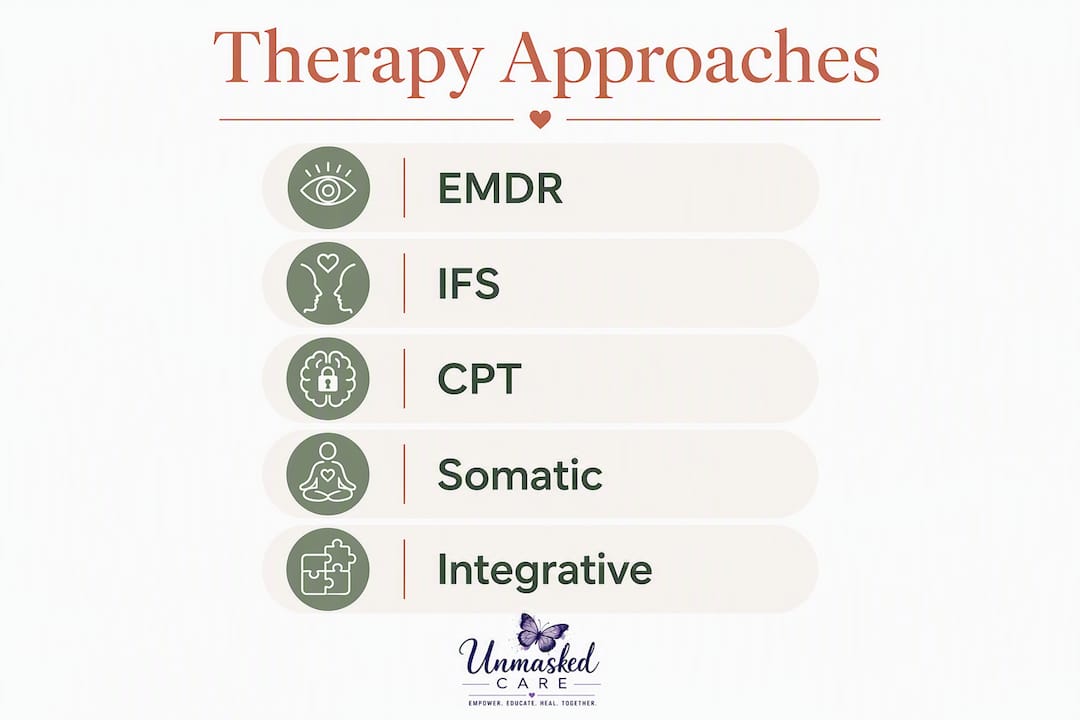
- Which therapy approaches actually help you recover from narcissistic abuse?
- What does telehealth cost, and how long before you see progress?
- What can you do if you can’t access therapy right now?
- Key Takeaways
- What most people get wrong about finding the right therapist
- Unmaskedcare can help you start right now
- Useful sources
Where can you find a therapist who treats narcissistic abuse?
Most general therapy directories are a starting point, not a destination. The key is knowing which filters to apply and which profile signals actually matter.
Unmaskedcare’s therapist directory is built specifically for survivors of narcissistic and borderline abuse. Profiles are organized around relational trauma specialization, so you’re not sifting through generalists. Start there, then cross-reference with broader directories if you want more options.
For broader searches, Psychology Today, GoodTherapy, TherapyDen, and Zocdoc all let you filter by specialty. On any of these platforms, apply these filters in order: trauma-informed care, then specific modalities (EMDR, IFS, CPT, somatic), then telehealth availability and states served. A profile that lists “trauma” without naming a modality is a yellow flag. A profile that lists EMDR or IFS with explicit mention of relational or narcissistic abuse is what you’re looking for.
BetterHelp offers faster access to licensed therapists and can work as a bridge while you wait for a private-practice slot, though its matching algorithm doesn’t filter by narcissistic abuse specialization specifically. Use it with the questions in the next section to screen your match.
Beyond directories, referral sources that often know the right clinicians include primary care physicians, OB/GYNs, intimate partner violence advocates, and family law attorneys when safety or custody issues are involved. Community mental health centers are worth calling directly; some have trauma specialists on staff and sliding-scale fees.
Unmaskedcare’s find-a-therapist page is the fastest route to a curated list of clinicians who already understand the narcissistic abuse cycle and won’t need you to explain why you stayed.
Pro Tip: On a consultation call, ask the therapist directly: “Have you worked with clients who experienced gaslighting or trauma bonding?” A specialist answers immediately with examples. A generalist pauses, then gives a textbook definition. That pause tells you everything.
How do you choose the right therapist for narcissistic abuse?
The credential list matters, but so does what happens in the first five minutes of a call. Here’s how to screen effectively.

The credential checklist
Look for these on any profile before you book a consult:
- State licensure at the master’s or doctoral level: LCSW, LPC/LPCC, LMFT, PsyD, or PhD.
- Trauma-informed language in the bio, not just the specialty tags.
- Explicit mention of narcissistic or relational abuse experience, not just “relationship issues.”
- Named modalities: EMDR, IFS, CPT, sensorimotor, or somatic therapy.
- Telehealth states served and PSYPACT participation if you need cross-state access.
- Transparent fees, sliding scale availability, and supervision status for early-career clinicians.
Specialized certifications like the Certified Narcissistic Abuse Treatment Clinician (NATC) credential signal specific training in gaslighting, trauma bonding, and DARVO. They’re a strong signal but not mandatory. Practical markers of fit, including stated experience with these dynamics and transparent fee and licensure information, matter just as much.
Questions to ask on the consultation call
Ask these directly. A good therapist welcomes them.
- “What is your experience treating people who’ve been through gaslighting or trauma bonding?”
- “Which modalities do you use for relational trauma, and how do you decide which to use first?”
- “How do you pace disclosure? Do you follow the client’s lead or use a structured protocol?”
- “What states do you provide telehealth to, and are you PSYPACT-authorized?”
- “What is your cancellation policy and how do you handle crisis situations between sessions?”
Survivors benefit most when a therapist already understands these dynamics from the first contact. It reduces the re-traumatization that comes from repeatedly explaining or defending what happened to you.
Red flags to watch for
- Dismisses or minimizes gaslighting concerns (“That sounds like a communication problem.”)
- Suggests couples therapy or reconciliation before you’ve had individual stabilization work.
- Pressures you to disclose traumatic details in the first session.
- Cannot name a single trauma modality they use.
- Vague or evasive about fees, licensure, or which states they serve.
- Doesn’t mention safety planning or pacing.
When you’re choosing quickly because you need help now, prioritize in this order: trauma specialization first, then modality fit, then availability. A therapist who understands gaslighting and trauma bonding but uses a slightly different modality than your ideal will serve you better than a modality specialist who has never worked with relational abuse.
Which therapy approaches actually help you recover from narcissistic abuse?
The four modalities you’ll see most often on specialist profiles each address a different layer of what narcissistic abuse does to a person. Knowing what they do helps you ask better questions and recognize a good treatment plan.
EMDR (Eye Movement Desensitization and Reprocessing)
EMDR processes traumatic memories without requiring you to narrate them in detail, which makes it particularly well-suited to abuse survivors who’ve been forced to justify their experiences repeatedly. It’s structured and evidence-based, and it often resolves specific trauma symptoms faster than traditional talk therapy. It can also be delivered effectively via telehealth for many clients. The tradeoff: it requires some emotional stability before starting, so a good clinician will assess readiness first.
IFS (Internal Family Systems)
IFS works with the fragmented sense of self that gaslighting and identity erosion create. If you’ve noticed that part of you still defends the person who hurt you while another part knows exactly what happened, that’s the split IFS addresses directly. It’s slower and more exploratory than EMDR, but it tends to produce durable identity rebuilding rather than just symptom relief.
CPT (Cognitive Processing Therapy)
CPT is a structured, protocol-driven approach that targets the distorted beliefs abuse leaves behind: “I deserved it,” “I’m too sensitive,” “I must have imagined it.” It typically runs 12 sessions, which makes it one of the more time-bounded options. For survivors who need a clear roadmap and measurable progress, CPT often fits well.
Sensorimotor and somatic therapy
Narcissistic abuse is stored in the body. Hypervigilance, startle responses, and the physical freeze that happens when a familiar tone of voice appears are all somatic. Sensorimotor psychotherapy and other body-based approaches work directly with these physical responses rather than relying solely on cognitive reprocessing. Therapists who treat narcissistic abuse commonly combine somatic work with EMDR or IFS for exactly this reason.
Integrative approaches
Most experienced specialists blend modalities based on where you are in recovery. Early sessions typically focus on safety, stabilization, and psychoeducation. Deeper trauma processing comes later, once the nervous system has enough regulation to handle it.
Some clinicians also offer intensive therapy formats, multi-hour or multi-day blocks that allow deeper work faster than weekly 50-minute sessions. These can be useful for survivors who have limited scheduling flexibility or who want to compress the early stabilization phase.
Pro Tip: If a therapist wants to jump straight into trauma processing in session one, that’s a red flag. A specialist will spend the first several sessions on safety, pacing, and consent. Stabilization before processing is the clinical standard, not a delay.
What does telehealth cost, and how long before you see progress?
State licensing and PSYPACT
Telehealth is widely available for trauma therapy in the U.S., but a therapist licensed in California cannot legally see you if you’re sitting in Texas, unless they hold a Texas license or participate in PSYPACT. PSYPACT is an interstate compact that allows licensed psychologists to practice across participating states without holding individual state licenses. Check the PSYPACT map before assuming a therapist’s telehealth listing covers your state. For non-psychologist clinicians (LCSWs, LPCs, LMFTs), PSYPACT doesn’t apply; they need individual state licensure or their state’s specific telehealth compact.
What sessions typically cost
Private-pay rates for individual therapy in the U.S. typically vary widely depending on location and provider, with some clinicians offering sliding scale fees based on income. Many trauma specialists offer sliding-scale rates for clients who qualify; ask directly during the consultation call. In-network insurance coverage varies significantly by plan and provider, and many trauma specialists are out-of-network only. Out-of-network benefits, sometimes called OON reimbursement, can offset 40%–80% of the fee depending on your plan’s out-of-network deductible.
Community mental health centers and university training clinics often offer rates well below private practice, sometimes $20–$50 per session, with licensed supervisors overseeing early-career clinicians.
| Session format | Typical cost range | Insurance | Telehealth available |
|---|---|---|---|
| Private practice (in-person) | — | In- or out-of-network | Varies by state license |
| Private practice (telehealth) | — | Often out-of-network | PSYPACT or state license required |
| Community mental health clinic | $20–$80/session | Often in-network | Varies |
| Intensive format (multi-hour) | — | Rarely covered | Some providers offer this |
| Peer support / coaching | — | Not covered | Widely available |
A realistic timeline
Expect 0–2 weeks to book a consultation if you’re proactive. A regular weekly slot may take 1–6 weeks depending on the clinician’s caseload. Stabilization, the phase where you stop feeling like you’re in crisis, typically takes 8–12 sessions. Deeper identity work, rebuilding trust in your own judgment and processing the full scope of what happened, often continues for 6–18 months. How long healing takes depends on the duration and severity of the abuse, your support network, and how well the therapeutic relationship fits.
Pro Tip: When submitting insurance claims for trauma therapy, ask your therapist whether a PTSD or complex trauma diagnosis code (F43.1 or F43.10 in ICD-10) applies to your situation. These codes are more likely to trigger reimbursement than a general adjustment disorder code, and a specialist will know which fits.
What can you do if you can’t access therapy right now?
Clinical therapy is the gold standard, but it isn’t always immediately accessible. Waitlists are real, costs are real, and sometimes you need support today.
Recovery coaching is the most common alternative. Coaches who specialize in narcissistic abuse can help you name patterns, set boundaries, and build a safety plan, but they are not licensed clinicians and cannot diagnose, treat, or provide clinical crisis intervention. The scope difference matters: coaching is appropriate for education and strategy; it is not a substitute when you’re experiencing active trauma symptoms, dissociation, or suicidal ideation.
Professionally facilitated peer support groups, including those run by licensed facilitators, offer something individual therapy doesn’t: the experience of being believed immediately by people who’ve lived it. When private therapy isn’t accessible, online support groups and educational membership communities often provide broader and faster access, sometimes internationally.
When evaluating any interim support, check for these:
- Clear scope of service: does the provider state explicitly what they do and don’t offer?
- Crisis referral pathway: what happens if you’re in acute distress?
- Moderator or clinician oversight: is someone accountable for the community’s safety?
- Privacy safeguards: are your posts and data protected?
- Low-cost or refundable trial: can you test the community before committing?
Unmaskedcare offers several of these features in one place: anonymous community forums, live audio rooms, webinars, and an AI Decoder that helps you name manipulative messages before you’ve had a single therapy session. These tools are designed to support the space between “I know something is wrong” and “I have a weekly appointment.”
If you’re in immediate danger, contact 911 or the 988 Suicide and Crisis Lifeline before searching for a therapist or coach. Safety first, always.
For survivors navigating separation alongside the emotional recovery, post-divorce financial planning is a practical parallel step that many people delay too long.
Key Takeaways
Finding the right therapist for narcissistic abuse means filtering for trauma specialization and named modalities first, then confirming licensure, telehealth coverage, and fee transparency before you commit.
| Point | Details |
|---|---|
| Filter by modality, not just “trauma” | Look for EMDR, IFS, CPT, or somatic work listed explicitly on the profile. |
| Use the consult as a two-way screen | Ask about gaslighting and trauma bonding experience; a specialist answers without hesitation. |
| Confirm telehealth licensing | Check PSYPACT participation or individual state licensure before booking a remote session. |
| Stabilization before processing | Expect 8–12 sessions of safety and regulation work before deeper trauma processing begins. |
| Unmaskedcare as an interim bridge | Use the AI Decoder, therapist directory, and community tools while waiting for a clinical slot. |
What most people get wrong about finding the right therapist
The conventional advice is to “find a trauma-informed therapist.” That phrase has been diluted to the point of near-uselessness. Almost every therapist’s website now includes the words “trauma-informed,” and almost none of them mean the same thing by it.
What actually matters is whether the clinician has worked specifically with the dynamics of narcissistic abuse: the way gaslighting erodes your confidence in your own memory, the way trauma bonding keeps you attached to someone who hurts you, the way DARVO flips the script so you end up apologizing for being hurt. A therapist who has never encountered these patterns will spend your first several sessions learning them from you. That’s expensive, slow, and often re-traumatizing.
The other thing people underestimate is pacing. Clinicians who rush disclosure or pressure clients are a genuine red flag for retraumatization, not just a stylistic mismatch. The best trauma therapists are almost boring in how methodically they build safety before anything else. If a therapist makes you feel like you need to get to the hard stuff quickly, trust that discomfort.
Recovery also requires more than processing incidents. Clinicians who emphasize boundary skills, identity work, and neural regulation tend to produce more durable outcomes than those who focus only on symptom reduction. The goal isn’t just to stop feeling bad. It’s to rebuild trust in your own judgment, which narcissistic abuse specifically targets. That takes time, the right modality, and a therapist who already understands what was taken from you.
You deserve a clinician who gets it from session one. That’s not a luxury. It’s the baseline.
Unmaskedcare can help you start right now
Waiting weeks for a therapy slot is hard when you need clarity today. Unmaskedcare was built for exactly this gap.
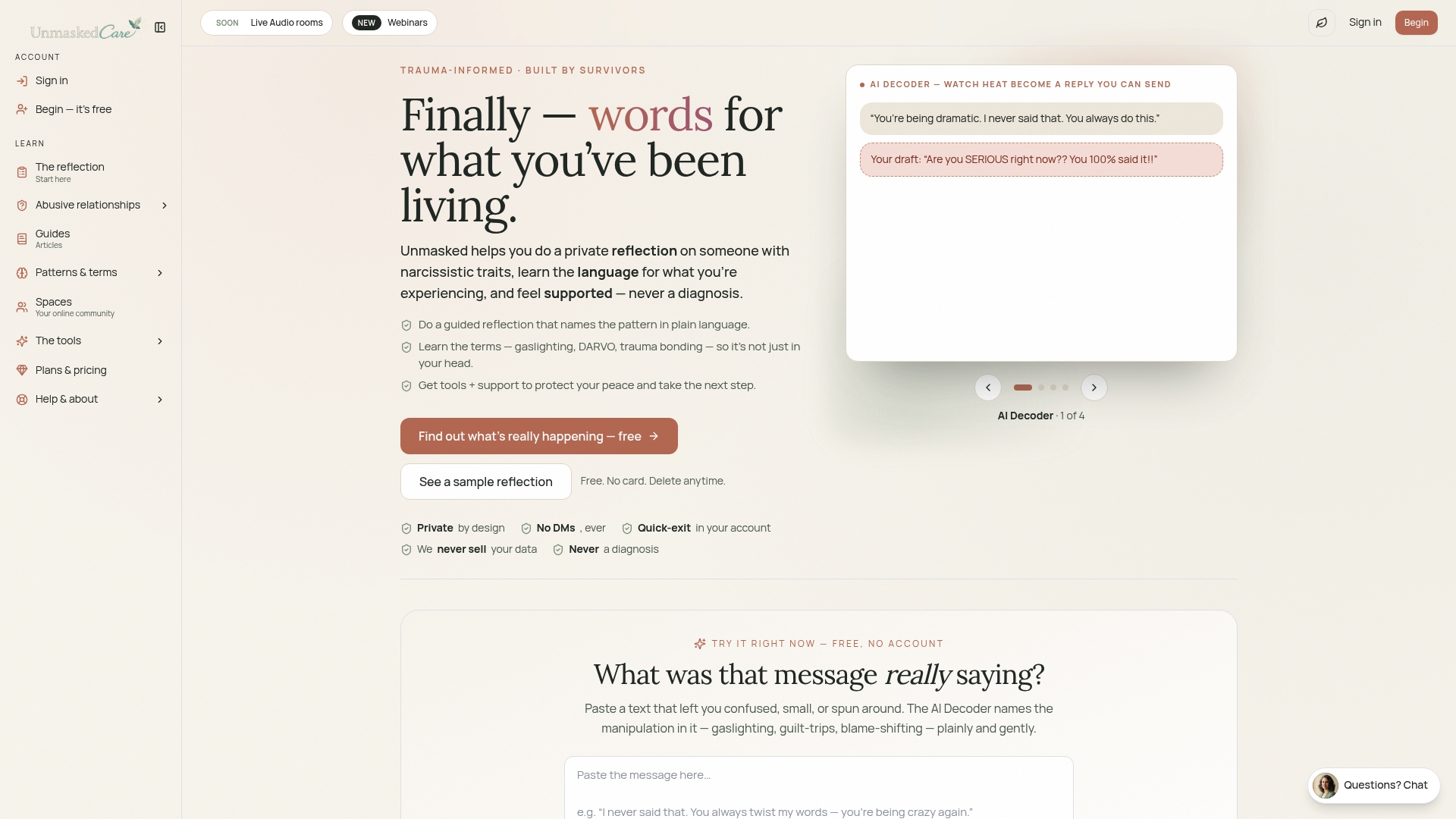
The platform’s free AI Decoder lets you paste in a message and get an immediate breakdown of the manipulation tactic being used, whether that’s gaslighting, future faking, or DARVO. It’s not therapy, but it names what’s happening in language you can bring to a therapist later. The searchable therapist directory filters for relational abuse specialists so you’re not starting from scratch. Structured reflection tools and a private evidence file help you document your experience safely while you wait for a clinical slot. Community forums and live audio rooms connect you with people who already understand what you’re describing.
Unmaskedcare’s healing resources and curated guides give you the vocabulary and context that make therapy more productive from the first session. Start with the free AI Decoder today and see what it surfaces.
Useful sources
The following sources informed this article’s clinical and practical guidance. Verify any clinician’s licensure directly through your state licensing board before booking.
- Ross Kellogg, LMFT — Therapy for Narcissistic Abuse: Overview of trauma modalities used in narcissistic abuse recovery, including EMDR, IFS, CPT, and somatic approaches.
- On Par Therapy NYC — Narcissistic Abuse Recovery: Clinical perspective on specialist credentials (NATC), the importance of therapist familiarity with gaslighting and identity erosion, and what survivors need from a first contact.
- Dr. Kelsey Harper — Online Therapy and Licensing: Practical guidance on telehealth state licensing, PSYPACT, and the role of the initial consultation in assessing fit.
- John Tzanos, PhD — Online Trauma Therapist: Clinical safety guidance on pacing, consent, and avoiding retraumatization in trauma treatment.
- Meghan Gilliland, LCSW — EMDR Overview: Evidence-based summary of EMDR’s effectiveness and its delivery via telehealth.
- Melissa Willard, LMFT — Intensive Therapy Formats: Description of intensive multi-hour therapy formats as an alternative to weekly sessions.
- Melanie Eddy Counseling — NATC Certification: Example of a certified NATC clinician profile with explicit narcissistic abuse specialization across multiple states.