
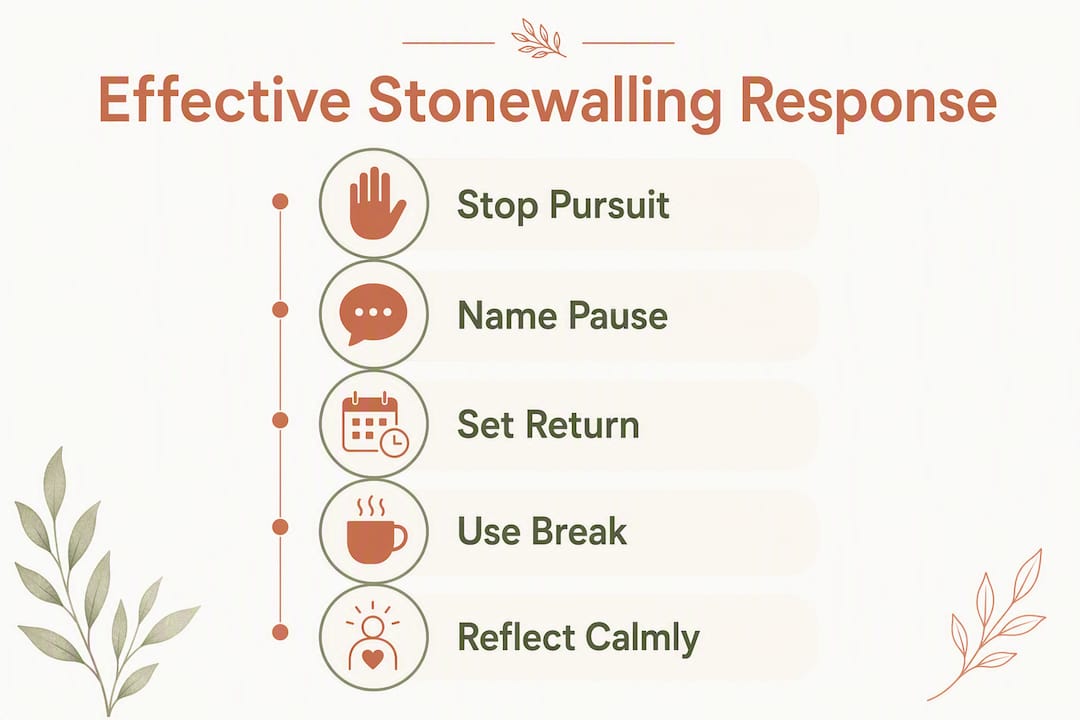
When someone stonewalls you, the single most effective response is to stop pursuing, name the pause out loud, and set a specific time to return. The Gottman Institute calls this a pre-agreed break signal, and recommends setting a minimum 20-minute reset period to allow the body to recover before resuming the conversation. If you are recovering from narcissistic or borderline personality abuse, getting your stonewalling response right in the moment is not just about communication — it is about your safety and your nervous system.
What to do right now:
- Say something brief and neutral: “I can see we both need a pause. Let’s come back to this after a suitable break.”
- Move to a different room or step outside. Physical distance helps both of you down-regulate.
- Set a timer. Do not leave the return time open-ended.
- Do NOT follow them, repeat yourself, or escalate your tone.
- Do NOT text or message repeatedly during the break.
Sample script you can use immediately: “I’m going to step away for a while. I want to finish this conversation. I’ll come back at the agreed time.”
After the break, Unmaskedcare’s reflection tool can help you process what happened before you re-engage. If you feel unsafe at any point, contact the National Domestic Violence Hotline at 1-800-799-7233.
Pro Tip: Write the return time on a sticky note and leave it visible. It signals commitment, not abandonment.
Table of Contents
- What should you actually say when someone withdraws?
- Do’s and don’ts when someone goes silent mid-conflict
- How do you set a pre-agreed break signal that actually works?
- Quick grounding techniques to use during the break
- When is stonewalling a sign of abuse, not just a shutdown?
- How to reflect and prepare a repair message after an episode
- What therapy and support options actually help long-term
- Key Takeaways
- What actually changed things for me
- Unmaskedcare can help you right now
- Useful sources and further reading
What should you actually say when someone withdraws?
Scripts matter because your brain is flooded and you will not think clearly under pressure. The key distinction clinicians make is between reactive stonewalling (the person is genuinely overwhelmed) and strategic stonewalling (silence is being used to control). Your words should stay descriptive either way. Labeling behavior as “stonewalling” or “manipulation” mid-conflict almost always increases defensiveness and derails any chance of repair.

Reactive / flooded partner: (Gottman guidance and clinical research consistently support the 20-minute break recommendation for physiological recovery.)
Strategic / controlling pattern: Safe-boundary exit (when you need to leave): Safety-need check-in (when you’re unsure if it’s safe to re-engage): Chasing a flooded partner prolongs their physiological shutdown. In a strategic dynamic, persistent pursuit can actually reinforce the silence as a control tool because it shows the behavior gets a reaction. Either way, pulling back is the move.
Pro Tip: Keep your voice at conversational volume. A raised tone, even slightly, can trigger the other person’s threat response and extend the shutdown by another 20 minutes or more.
Do’s and don’ts when someone goes silent mid-conflict
Do:
- Name the pause clearly and briefly.
- Commit to a specific return time before you walk away.
- Use the break to self-soothe, not to rehearse your argument.
- Document what happened afterward, privately.
Don’t:
- Chase, follow, or send repeated messages.
- Call the behavior “stonewalling” or “manipulation” in the moment.
- Threaten consequences during the break (“If you don’t talk to me, I’m done”).
- Escalate volume or body language to force a response.
The physiology here is worth understanding. When someone is flooded, their heart rate spikes and their prefrontal cortex — the part that handles rational thought — goes partially offline. Pursuing them at that point does not produce conversation; it produces more shutdown or an explosive reaction. A timed break is not giving up. It is the only path back to a productive exchange.
One distinction that matters: a healthy cooling-off period has a defined end point and a commitment to return. Indefinite withdrawal with no agreed return, especially repeated across many conflicts, is a different pattern entirely.
How do you set a pre-agreed break signal that actually works?
The break signal only works if you set it up before a conflict, when both of you are calm. Here is a practical setup:
- Choose a neutral signal together. A word (“pause”), a hand gesture, or a simple phrase. It should carry no emotional charge.
- Agree on a minimum reset time. The Gottman Institute recommends at least 20 minutes for the body to down-regulate stress hormones.
- Decide who sets the return time. The person calling the break names the time. The other person confirms it.
- Agree on what happens if the signal is ignored. Write this down: “If the signal is used and the other person continues the argument, we both stop talking for the agreed time.”
- Practice it once in a low-stakes moment so it does not feel foreign under pressure.
Taking a break can be highly effective, but only if it is handled carefully. Commit to returning. During the break, do something genuinely calming. Do not use the time to rehearse arguments or fuel grievances.
— Simply Psychology, summarizing Gottman research
Write the agreement down and keep a copy. If the pattern is entrenched or one partner consistently ignores the signal, bring a therapist into the process. A third party can hold accountability in ways a private agreement often cannot.
Quick grounding techniques to use during the break
The break only resets your nervous system if you use it for actual regulation, not mental replaying of the argument.
Regulation tools:
- Paced breathing (4 counts in, hold 4, out 6)
- A short walk outside, even 5 minutes
- Progressive muscle relaxation: tense each muscle group for 5 seconds, then release
- A simple sensory task: cold water on your wrists, holding something textured
- A neutral distraction: a short podcast, folding laundry, anything that occupies your hands
Mini breathing exercise (30–45 seconds): Breathe in through your nose for 4 counts. Hold for 4. Exhale slowly through your mouth for 6. Repeat 3 times. Notice your shoulders drop.
Research on physiological flooding shows the body typically needs at least 20 minutes to metabolize stress hormones and return heart rate to baseline. How you use that time determines whether the reset actually works.
If you find yourself using the break to plan what you will say next, or to obsess over what was said, switch to the sensory task immediately. Rumination keeps cortisol elevated and the reset fails.
When is stonewalling a sign of abuse, not just a shutdown?
Not every episode of withdrawal is the same. Repeated stonewalling combined with any of the following is a red flag for a controlling or abusive dynamic:
- Withdrawal is indefinite, with no agreed return and no explanation.
- The silence is used explicitly to punish (“you’ll see how it feels”).
- DARVO appears: they deny, attack, and reverse victim and offender when you try to address the pattern.
- Contempt, threats, or isolation accompany the silence.
- They refuse to honor a pre-agreed break signal or return time.
- Boundaries you set are met with escalation rather than respect.
If you recognize this pattern, setting boundaries with a narcissist requires a different approach than standard communication repair. Document each incident privately, including dates, what was said, and how long the withdrawal lasted. Use Unmaskedcare’s red-flags checklist to track patterns over time. Individual therapy is the right next step here; joint couples therapy can be risky when manipulation or lack of accountability is present, because it can give an abusive partner new material to use against you.
How to reflect and prepare a repair message after an episode
Before you re-engage, take 10 minutes with this framework:
- What happened: Describe the observable sequence, no labels.
- How I felt: Name the emotion, not the interpretation.
- What I need next time: One specific, concrete request.
- My boundary or ask: What I will do if this pattern continues.
Example repair message using the framework: “When our conversation stopped and you left the room, I felt scared and confused. I’d like us to agree that if either of us needs a break, we say so and name a time to return. Can we try that?”
No labels. No accusations. A clear request. That is the structure that gives repair a real chance.
Unmaskedcare’s AI Decoder can help you turn private notes into structured messages and identify manipulative patterns in responses you receive. Before sharing any logs or drafted messages with a partner, consider whether doing so is safe given your specific situation.
Pro Tip: Keep your reflection notes in a private, password-protected file. Unmaskedcare’s evidence file feature is built for exactly this.
What therapy and support options actually help long-term
Individual therapy is the starting point, not couples work, when there is any suspicion of manipulation or control. Look specifically for therapists with experience in narcissistic or BPD relational dynamics.
- CBT and DBT-informed individual therapy for building distress tolerance and boundary skills.
- Trauma-informed therapy (EMDR, somatic approaches) for survivors with complex PTSD responses.
- Emotionally Focused Therapy (EFT) for couples when both partners are accountable and safety is not in question.
- Peer support groups for survivors, in-person or online, including Unmaskedcare’s community spaces.
- Safety hotlines: National Domestic Violence Hotline (1-800-799-7233) for safety planning.
Questions to ask a prospective therapist:
- Do you have experience with narcissistic or BPD relational dynamics?
- How do you approach couples sessions when one partner may be using manipulation?
- What is your stance on safety planning if a client feels controlled?
Couples therapy is contraindicated when there are active safety threats, when one partner consistently denies accountability, or when sessions are being used to gather information for later retaliation. When in doubt, start with individual work and use Unmaskedcare’s healing resources to orient yourself before your first appointment.
This article is general information, not professional advice. Confirm your specific situation with a licensed therapist or qualified professional.
Key Takeaways
The most effective stonewalling response is to stop pursuing, name the pause, commit to a return time, and use the break to regulate, not to ruminate.
| Point | Details |
|---|---|
| Don’t chase | Pursuing a flooded partner deepens withdrawal and can reinforce control dynamics. |
| Use a neutral break signal | Agree on a word or gesture in a calm moment; commit to a minimum 20-minute reset. |
| Regulate during the break | Paced breathing, a short walk, or a sensory task keeps the reset from failing. |
| Document red flags | Indefinite withdrawal, DARVO, or refusal to return are signs of an abusive pattern. |
| Unmaskedcare supports recovery | The AI Decoder and reflection tool help survivors process episodes and track patterns safely. |
What actually changed things for me
Most people in these situations spend the break doing exactly the wrong thing: mentally rehearsing the argument, drafting texts they do not send, or spiraling into self-doubt. The break signal only works when you treat it as a physiological intervention, not a timeout. What shifted things was having a written agreement, a timer, and a grounding task ready before the next conflict arrived. The pre-agreed signal removed the guesswork about whether silence meant punishment or overwhelm. Reflection tools, including the kind Unmaskedcare offers, made it possible to put the episode into words before re-engaging, which meant fewer reactive messages and more clarity about what actually needed to be said. Small experiments, done consistently, are what move the needle. You do not need a perfect conversation. You need a safer one.
Unmaskedcare can help you right now
When you are in the middle of a pattern like this, having a structured place to process what happened is not a luxury. Unmaskedcare gives you tools built specifically for this situation: a reflection tool that walks you through what occurred and what you need, an AI Decoder that names manipulation tactics in messages you have received, a private evidence file for documenting incidents, and a red-flags checklist you can use to track whether the pattern is escalating.
Free access covers education, community forums, and live audio rooms. Paid tiers unlock personalized AI reflections, deep pattern analysis, and enhanced privacy features. Unmaskedcare is a complement to professional therapy, not a substitute for it. Your notes stay private unless you choose to share them.
Start with the free tier at unmaskedcare.com/features and see which tools fit where you are right now.
Useful sources and further reading
- The Four Horsemen: Stonewalling — Gottman Institute: Research-backed explanation of stonewalling as one of four key relationship predictors, with guidance on break signals and de-escalation.
- Help! Someone Told Me I’m Stonewalling — Gottman Institute: Covers the 20-minute physiological reset and how to use the break productively.
- Stonewalling in Relationships: Therapist Guide — Couples Learn: Clinical perspective on reactive vs. strategic stonewalling and when patterns indicate abuse.
- Stonewalling: Meaning, Effects, and How to Respond — Therapist.com: Practical protocols for naming the pause and committing to a return time.
- Stonewalling in Relationships — Boundary Playbook: Clinician guidance on descriptive vs. diagnostic language during conflict.
- What Is Stonewalling and How to Stop — Cleveland Clinic: Plain-language overview of stonewalling types and how to respond when you are on the receiving end.
- National Domestic Violence Hotline: 24/7 safety planning and crisis support for U.S. survivors. Call 1-800-799-7233 or text START to 88788.
Recommended
- Why does a narcissist give the silent treatment? — Unmasked Care
- What is the gray rock method? — Unmasked Care
- How do I set boundaries with a narcissist? — Unmasked Care
- What is gaslighting, with examples? — Unmasked Care
Article generated by BabyLoveGrowth