
When someone gaslights you, the most effective immediate response is a short, neutral line that gives nothing away. Say “Noted” or “That’s interesting — tell me more about how you remember it” and then stop talking. Those few words do more than a long defense ever could.
Here is what to do in the next 60 seconds:
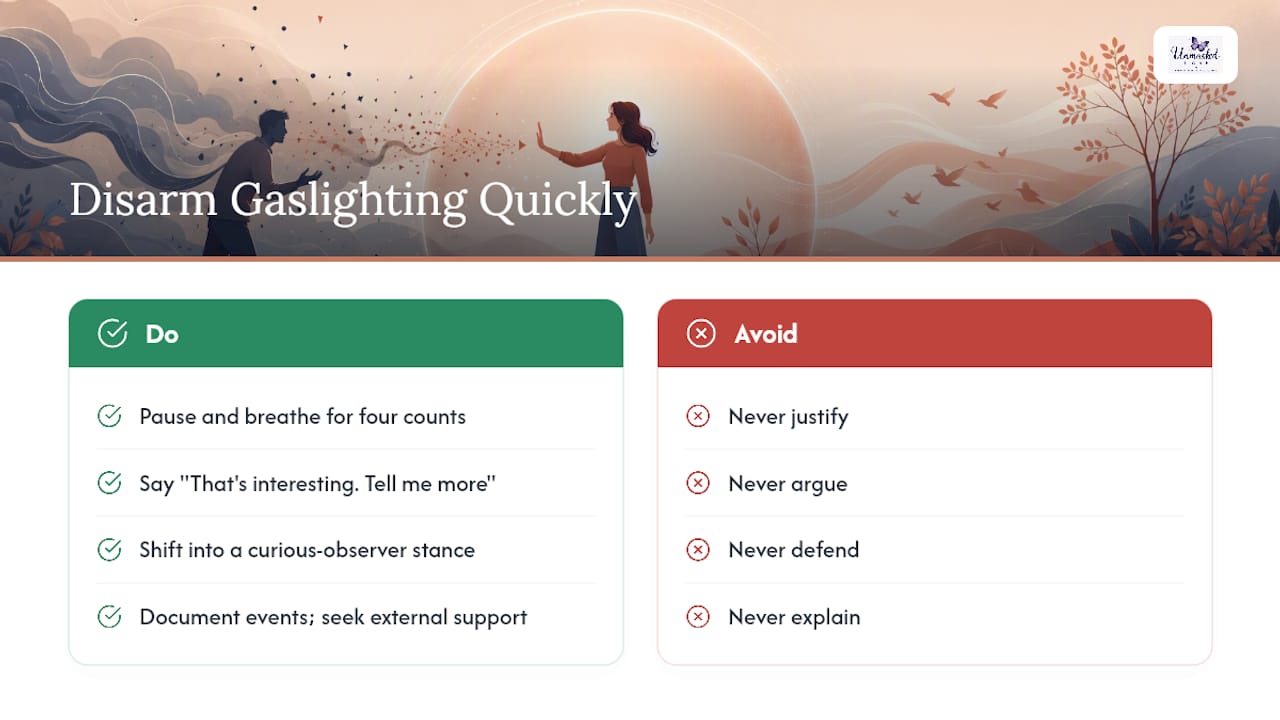
- Say one short neutral line (see examples above) and go quiet.
- Take a slow breath before you respond to anything else.
- If the exchange is escalating, name a reason to pause: “I need a few minutes. We can continue this later.”
- Do not justify, explain, or defend your memory in the moment.
- If you feel unsafe at any point, leave the space and call for help.
Safety reminder: This article is educational content, not a clinical diagnosis or a substitute for professional support. If you are in crisis or feel unsafe, call 988 (Suicide and Crisis Lifeline) or 1-800-799-7233 (National Domestic Violence Hotline) right now.
Key Takeaways
A calm, neutral gaslighting response removes the emotional fuel manipulation depends on, and pairing it with secure documentation gives you both clarity in the moment and a reliable record afterward.
| Point | Details |
|---|---|
| Use neutral scripts first | Lines like “Noted” or “That’s interesting — tell me more” remove emotional fuel without escalating. |
| Apply the JADE principle | Never justify, argue, defend, or explain in a heated exchange; brief responses are safer. |
| Document every incident | Record date, exact words, witnesses, and evidence in a secure location the other person cannot access. |
| Know the crisis numbers | Call 988 (Suicide and Crisis Lifeline) or 1-800-799-7233 (National Domestic Violence Hotline) if you feel unsafe. |
| Use Unmaskedcare’s AI Decoder | Analyze specific messages for manipulation tactics and prepare responses before a difficult conversation. |
This article is educational content only and does not constitute a clinical diagnosis or professional advice.
Table of Contents
- What is the best gaslighting response for any context?
- Why do neutral responses actually disarm gaslighting?
- How to be assertive without being aggressive
- How the Gray Rock technique reduces manipulation and protects you
- How to document interactions and protect your evidence
- When gaslighting becomes abuse and how to get help
- One practical next step: prepare your scripts and secure your evidence
- A note from the Unmasked Care Team
- Structured tools for preparing responses and protecting evidence
- Sources
What is the best gaslighting response for any context?
The scripts below are organized by setting. Each one is short enough to memorize and neutral enough to use without escalating the situation. Delivery matters as much as the words: keep your tone flat and even, slow your speech slightly, and breathe before you open your mouth.
Neutral acknowledgments (gray-rock style)
These phrases work in almost any context because they neither agree nor argue. They buy you time and remove the emotional reaction a manipulator is looking for.
- “Noted.”
- “That’s interesting. Tell me more about how you remember it.”
- “I hear that you see it differently.”
- “I’ll think about what you’ve said.”
- “We may have to agree to disagree on this one.”
Firm boundary lines
Use these when someone repeatedly denies something you know happened, or when the conversation is going in circles.
- “I remember it differently, and I’m not going to change that.”
- “I’m not going to keep discussing this. My position is [X].”
- “That’s not how I experienced it, and I’m comfortable with my account.”
Workplace and public settings
When you are in a meeting, a performance review, or a public setting where you cannot disengage freely, these redirect the conversation without creating a scene.
- “Let’s put a pin in this and come back to it with notes from both sides.”
- “I’d like to follow up on this in writing so we have a clear record.”
- “I want to make sure I understand your concern — can you send that to me in an email?”
For more context on recognizing these patterns at work, Unmaskedcare’s guide on toxic manager behavior covers the specific tactics that show up in professional settings.
Fill-in-the-blank templates
Adapt these to your situation:
- “I hear that you believe [X]. I experienced it as [Y], and I’m standing by that.”
- “I’m not going to [action] right now. I’ll let you know when I’m ready to talk.”
- “That’s a different memory than mine. I’m not going to debate it further.”
Pro Tip: Slow your speech by about 20 percent when you use these lines. A calm, measured pace signals that you are not rattled — and that signal alone reduces the incentive to push harder.
Why do neutral responses actually disarm gaslighting?
Gaslighting is, at its core, a power-seeking behavior rather than a genuine attempt to resolve a disagreement. The tactic depends on your emotional reaction: when you defend yourself, argue your case, or show distress, you supply the engagement that keeps the cycle running.
Neutral responses cut that supply off. According to behavioral expert coverage on CNBC, emotional regulation through slow breathing and pausing before responding preserves your decision-making under pressure and reduces the reactive behaviors that manipulators exploit. A pause is not passivity. It is the moment you reclaim control of the exchange.
The specific phrase “That’s interesting. Tell me more” works for a precise reason: as psychology expert commentary on CNBC explains, it forces the other person to supply specifics and removes the immediate pressure on you to defend your memory. You shift from defendant to curious observer in one sentence.
Clinical-practice guidance from the American Academy of Family Physicians reinforces this through the JADE principle: never justify, argue, defend, or explain in a heated exchange. Those four responses are the exact fuel a manipulator needs to keep the interaction going.
“Attempting to convince or reason with a gaslighter often fails because gaslighting is frequently a power-seeking tactic; documentation and external support better validate the gaslightee’s reality.”
— Licensed counselors cited in Time
Pro Tip: Before you respond to anything, take one slow breath in through your nose for four counts and out for four counts. That single physiological reset measurably reduces the stress response and keeps your tone neutral.
How to be assertive without being aggressive
Assertiveness is not about winning the argument. It is about stating your position clearly, once, and holding it without escalating. The four-step framework below is compact enough to use in real time.
- Observe the facts. State only what happened, not what it means. “You said [exact words] in front of [person] at [time].”
- Describe your experience briefly. One sentence, no accusations. “I felt dismissed when that happened.”
- Make a concrete request. Specific and behavioral, not emotional. “I need you to stop interrupting me during team meetings.”
- Use the broken-record if needed. Repeat your request calmly and without variation if the other person deflects. Assertiveness training guidance from the University of Virginia’s Office of Team Wellbeing identifies the stuck-record technique as one of the most reliable tools for maintaining a boundary without escalating.
For workplace situations specifically, Unmaskedcare’s resource on setting limits with difficult people walks through how to apply this framework when the other person has authority over you.
| Response style | When to use it | Risk to watch for |
|---|---|---|
| Neutral acknowledgment | Any setting; first line of defense | May feel unsatisfying if you want to be heard |
| Assertive broken-record | When a boundary has been crossed repeatedly | Can frustrate the other person; use calmly |
| Disengagement / timeout | When the exchange is escalating or circular | May be misread as avoidance; name it explicitly |
| Written follow-up | Workplace or legal contexts | Creates a record — use when that is the goal |
How the Gray Rock technique reduces manipulation and protects you
The Gray Rock method works on a simple principle: manipulative behavior is reinforced by emotional reactions. When you become as uninteresting as a gray rock, the reward disappears.
During an interaction, Gray Rock looks like this:
- Give one-word or one-sentence answers.
- Avoid sharing personal information, plans, or feelings.
- Keep your facial expression and body language flat and neutral.
- Do not volunteer anything the other person did not directly ask.
- Respond to questions with facts only, no emotion attached.
Disengagement tactics
When Gray Rock is not enough, strategic disengagement reduces contact and removes the opportunity for manipulation to occur.
- Timeouts: Name a reason to pause and leave the space. “I need to step away. We can talk later.”
- Limiting channels: Move communication to one medium (email or text only) so you have a record and can respond on your own timeline.
- Delaying replies: You are not obligated to respond immediately. A deliberate pause before replying reduces reactive exchanges.
- Unilateral consequences: State a consequence once and follow through. “If this continues, I will end the call.” Then end it.
Pro Tip: When you state a consequence, say it once in a neutral tone and then act on it. Repeating the warning without following through teaches the other person that the limit is negotiable.
When disengagement may increase risk
Reducing contact can sometimes escalate behavior in situations involving coercive control, surveillance, or threats. If the other person has shown any pattern of physical intimidation, monitoring your devices, or threatening harm, do not disengage without a safety plan. Contact the National Domestic Violence Hotline at 1-800-799-7233 before making changes to contact patterns.
How to document interactions and protect your evidence
Gaslighting often targets your memory directly. A written record is the most reliable way to hold onto what actually happened, and Medical News Today’s guidance on gaslighting recommends keeping records in a location the other person cannot access, such as a secure cloud folder, a separate device, or off-site physical storage.
What to document after each incident:
- Date and time
- Exact words used (quote directly, do not paraphrase)
- Location and any witnesses present
- Screenshots of messages, with the date and sender visible
- Your emotional state at the time (brief, factual note)
- Any physical evidence (voicemails, emails, written notes)
Use this short template for written notes:
“[Date/time]. [Location]. [Person] said: ‘[exact quote].’ [Witness, if any]. I felt [one word]. Evidence saved: [yes/no, file name].”
Keeping your evidence safe
| Storage method | Access risk | Recommended use |
|---|---|---|
| Separate cloud account (new email) | Low, if password is unique | Ongoing documentation |
| Second phone or device | Low, if kept off-site | Screenshots and voice memos |
| Encrypted notes app | Low, with strong PIN | Quick incident logs |
| Physical binder off-site | Very low | Printed screenshots, letters |
Avoid saving anything on a shared device or a cloud account the other person has credentials for. If you are unsure whether your device is monitored, use a library computer or a trusted friend’s phone to set up a new account.
When you are ready to share documentation, bring it to a trusted friend, a licensed counselor, or a legal professional, or consider utilizing specialized mediation services to help resolve disputes constructively. Unmaskedcare’s resource on why others may not believe you explains how to present your account clearly when you feel disbelieved.
When gaslighting becomes abuse and how to get help
Not every gaslighting interaction carries the same level of risk. Some patterns are manipulative but not immediately dangerous. Others signal a situation that requires a safety plan.
Warning signs that suggest escalating risk:
- Threats of harm to you, your children, or your pets
- Isolation from friends, family, or financial resources
- Monitoring your phone, location, or communications
- Coercion around finances, housing, or employment
- Physical intimidation, even without contact
- Escalating behavior after you try to set a limit
If any of these are present, the priority shifts from communication strategy to physical safety.
Immediate steps if you feel unsafe:
- Leave the space if you can do so safely.
- Go to a trusted person’s home, a public place, or a shelter.
- Preserve your evidence file before you leave if it is safe to do so.
- Notify one trusted contact of your location.
- Call 911 if you are in immediate danger.
- Call 988 (Suicide and Crisis Lifeline) if you are in emotional crisis.
- Call 1-800-799-7233 (National Domestic Violence Hotline) for safety planning, shelter referrals, and confidential support.
The Office on Violence Against Women lists national hotlines and resources for survivors across the United States. VictimConnect also provides confidential, trauma-informed support and referrals by phone, text, or chat for anyone navigating abuse.
For a curated list of recovery resources, Unmaskedcare’s narcissistic abuse recovery page and therapist directory are available as internal resources.
This article is educational content only. It is not a clinical diagnosis, and it does not replace professional mental health, legal, or safety advice.
One practical next step: prepare your scripts and secure your evidence
The gap between knowing what to say and actually saying it under stress is real. Cognitive load spikes in a tense exchange, and the scripts you rehearsed once in a calm moment are the ones you will actually reach for.
A simple tool checklist to prepare now:
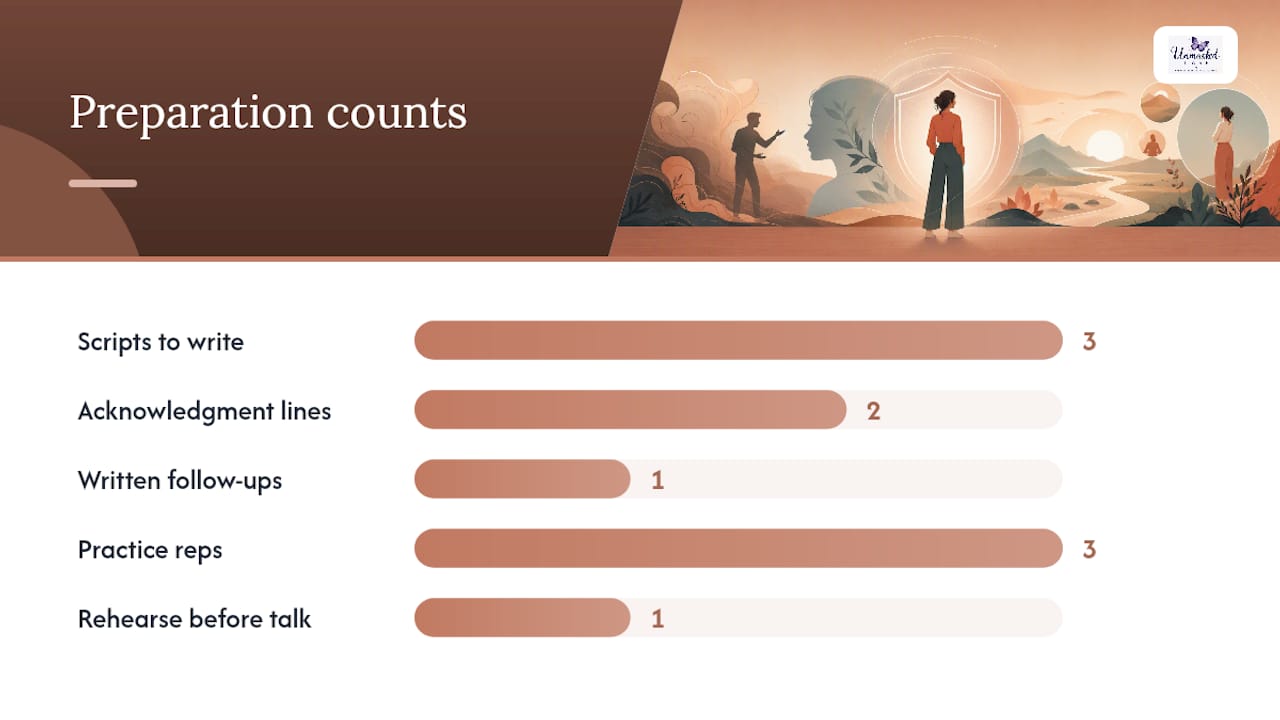
- Write out three short scripts from this article and save them somewhere you can access quickly.
- Create a private evidence folder using a new cloud account the other person cannot access.
- Set up a brief incident log template (date, quote, witness, evidence saved) and use it within an hour of any difficult interaction.
- Rehearse your boundary lines aloud at least once before a known difficult conversation.
- Use a structured reflection tool to process what happened after an incident, not just during it.
Use-case examples (illustrative, not personal accounts):
- Preparing for a performance review with a manager who has previously denied giving instructions: draft two neutral acknowledgment lines and one written-follow-up request in advance.
- Saving a message from a partner that contradicts something they later denied saying: screenshot it, note the date, and move it to a secure folder immediately.
- Rehearsing a script for a tense family dinner: practice the broken-record line three times aloud so it comes out flat and calm, not defensive.
Structured tools reduce the cognitive load of responding in the moment because the decision is already made. Unmaskedcare’s AI Decoder helps you identify manipulation in specific messages and prepare a considered response, rather than reacting in real time.
Pro Tip: If you know a difficult conversation is coming, write your three key lines on a small card and keep it in your pocket. Having the words physically nearby lowers the chance you will freeze or default to defending yourself.
A note from the Unmasked Care Team
The conventional advice around gaslighting tends to focus on recognition: learn the signs, name the behavior, and confront it. That framing puts the burden on the person being manipulated to prove something to someone who has already demonstrated they will not accept the proof.
What actually moves the needle is a different orientation entirely. Stop trying to win the argument and start protecting your clarity. A short neutral line is not a concession. It is a strategic choice to stop feeding a dynamic that cannot be resolved through debate. Documentation is not paranoia. It is the only reliable anchor when someone is actively working to rewrite your shared history.
The scripts in this article are not magic. They work because they remove the emotional reaction that manipulation depends on, and because they give you something concrete to do in a moment when the instinct is to either freeze or over-explain. Practice them before you need them. Store your evidence before it disappears. And if the situation involves any physical risk, prioritize safety over communication strategy every time.
This content is educational and does not constitute a clinical diagnosis. If you are navigating a situation that feels unsafe, please reach out to a qualified professional or one of the crisis lines listed in this article.
Structured tools for preparing responses and protecting evidence
Knowing what to say is one thing. Having a private space to prepare, rehearse, and store evidence before a difficult conversation is another. Unmaskedcare is built specifically for people navigating relationships with narcissistic or borderline patterns, and its tools address the exact gap this article describes.
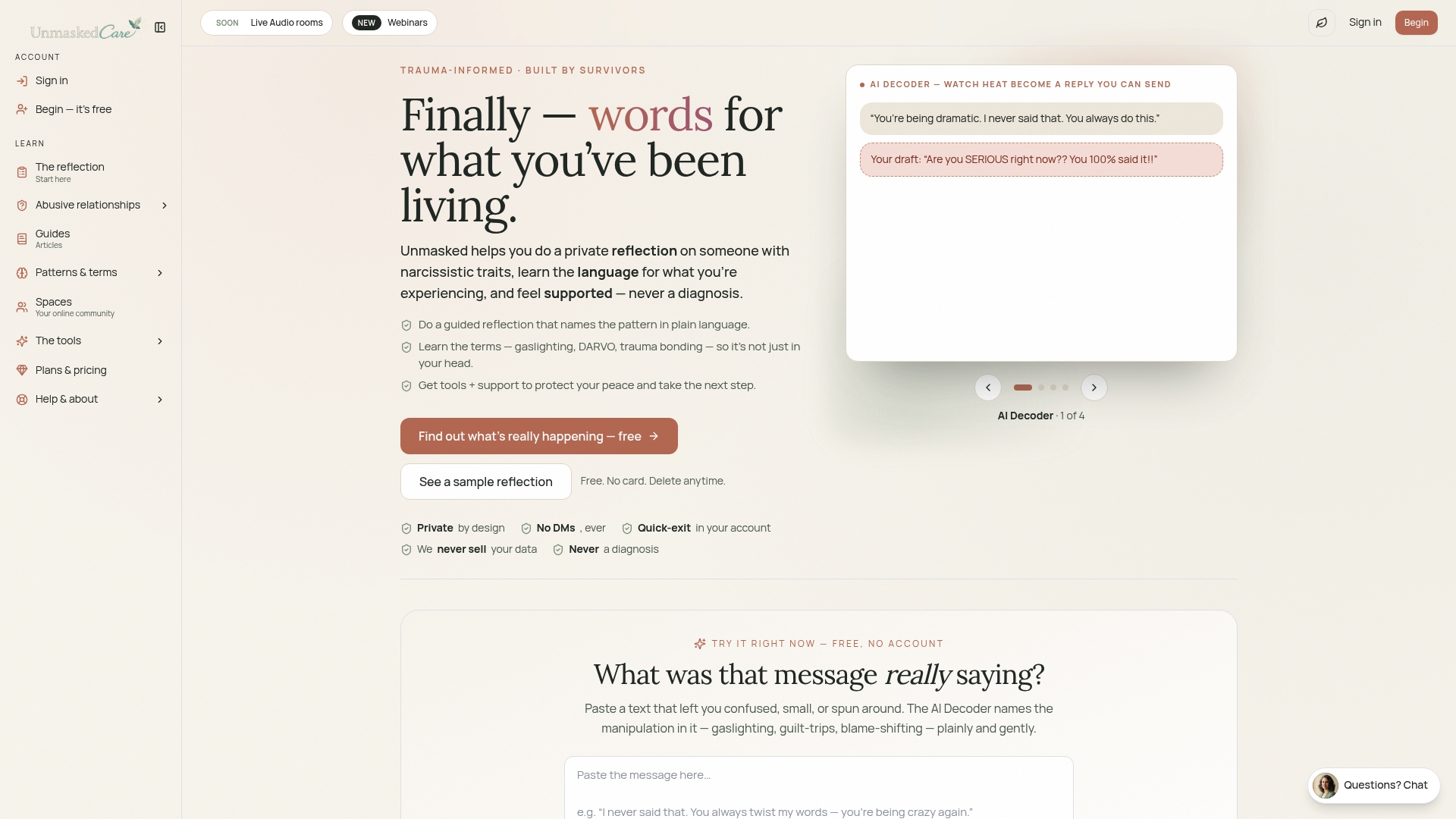
The AI Decoder analyzes specific messages and helps you identify manipulation tactics by name, including gaslighting and DARVO, so you can prepare a considered response instead of reacting in the moment. The platform’s private evidence file feature stores your documentation in a privacy-first environment the other person cannot access. Guided reflection tools walk you through structured questions that help you articulate what happened in precise terms, which is useful both for personal clarity and for any future conversations with a counselor or legal professional.
Onboarding is short. Free access includes educational guides and community features. Paid tiers unlock the AI tools, personalized reflections, and enhanced privacy features. Start with the free AI Decoder to analyze a message you have already received and see exactly what you are dealing with.
Sources
U.S. crisis lines (available 24/7):
- Psychology expert: The No. 1 way to respond to a manipulator
- Assertiveness Training - Office of Team Wellbeing
- Gaslighting: what it is, examples and how to get help - Medical News Today
- Usa
- VictimConnect Resource Center fact sheet
- NCBI PMC article on manipulation and abuse dynamics
Research and guidance used in this article:
Internal resources at Unmaskedcare:
This article is general information, not a substitute for advice from a qualified doctor. Consult a qualified healthcare professional about your own circumstances before acting on anything here.