
A small set of neutral, repeatable phrases reliably protects your energy when dealing with narcissistic or borderline-abusive behavior. The scripts below are short enough to memorize, boring enough to stop an argument cold, and designed to be used once, calmly, then stopped. The enforcement rule is equally simple: a boundary is an action you take, not a rule you ask the other person to follow. You don’t JADE (Justify, Argue, Defend, or Explain). You state the limit, apply the consequence, and repeat.
Ready-to-use scripts you can rehearse today:
- “My answer is no.”
- “I trust my memory. I’m not going to debate what happened.”
- “That won’t work for me.”
- “I’m not discussing this right now.”
- “I hear your opinion. I’m confident in my choice.”
- “If this continues, I’m ending the call.”
- “We can talk when the conversation is respectful.”
- “That’s personal.”
The gray rock technique pairs naturally with these: keep your tone flat, your answers short, and volunteer nothing personal. Narcissistic behavior runs on emotional fuel. Deny the fuel, and the interaction loses its grip on you. Expect an extinction burst when you first hold a new limit. That spike in pressure or rage is the old pattern losing effectiveness, not proof you’ve done something wrong.
Pro Tip: Write your two or three most-needed scripts on a notecard. Read them aloud before any anticipated interaction. Your nervous system needs the rehearsal as much as your brain does.
Table of Contents
- Which boundary style fits your situation: wall or drawbridge?
- Script bank: exact phrases for gaslighting, guilt trips, rage, and more
- How to deliver scripts safely without freezing
- Predictable pushback and brief responses that protect you
- How to enforce consequences, document interactions, and build a safety plan
- How do you know if a boundary is actually working?
- How Unmaskedcare’s tools help you personalize and practice scripts
- Emotional self-care before and after enforcing a boundary
- Identifying manipulation tactics to tailor your scripts
- Key Takeaways
- What boundaries actually cost you — and why that’s worth knowing
- Unmaskedcare: tools built for exactly this situation
- Useful sources and U.S. resources
Which boundary style fits your situation: wall or drawbridge?
Therapists draw a useful line between two boundary types. A wall means no contact or near-zero contact, used when the relationship is dangerous, when harm is repeated and documented, or when there is a confirmed NPD pattern with no evidence of change. A drawbridge means conditional contact: you engage, but only under specific, pre-set rules, and you raise the drawbridge the moment those rules break.
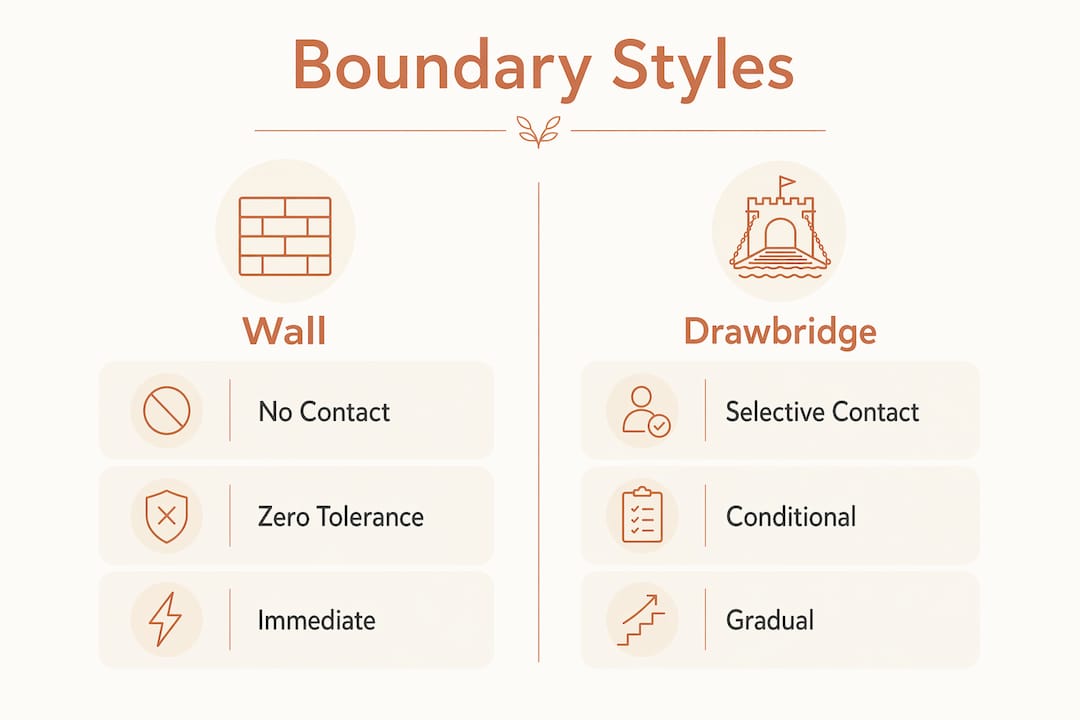
Clinical guidance distinguishes genuine NPD (which typically requires wall-style limits) from protector strategies, where someone’s harmful behavior stems from fear or attachment wounds rather than a fixed personality structure. The distinction matters because it changes what you can realistically expect and what consequences are enforceable.
Signs you likely need a wall:
- Physical safety is at risk.
- Harm repeats despite prior limits.
- There is a pattern of legal threats, custody manipulation, or stalking.
- Every attempt at conditional contact ends in escalation.
Signs a drawbridge may work:
- The person shows some capacity for behavioral change.
- Contact is legally required (co-parenting, shared custody).
- Harm is verbal and situational, not physical or escalating.
- You have a support structure in place to hold the line.
Choose consequences that are safe, proportional, and things you can actually do: ending a call, leaving a room, switching to written communication only, or limiting visit length. If you can’t follow through on a consequence, pick a different one.
Script bank: exact phrases for gaslighting, guilt trips, rage, and more
Short, neutral phrases outperform long explanations every time. The table below maps common scenarios to a one-line script and the reason it works.

| Scenario | Script | Why it works |
|---|---|---|
| Gaslighting | “I remember it differently. I’m not going to debate that.” | Asserts your memory without inviting argument |
| Guilt-tripping | “I hear that you’re upset. My answer is still no.” | Acknowledges feeling; holds the limit |
| Rage or yelling | “When you raise your voice, I leave the room.” | Behavior-based, not emotional |
| Love-bombing after a limit | “I appreciate that. The limit stays.” | Doesn’t punish warmth; doesn’t reward it either |
| DARVO (deny, attack, reverse victim and offender) | “I’m not going to debate who the victim is here.” | Refuses the frame without explaining |
| Triangulation | “I’m not discussing [person]. That’s between them and me.” | Closes the triangle |
| Public pressure | “We can talk privately. I’m not doing this here.” | Removes the audience |
Scenario variants by relationship type:
- Family: “I can visit for two hours. If the conversation turns personal, I’ll head home.”
- Work: “I’m happy to review project feedback. I’m not available for personal comments.”
- Romantic/ex-partner: “I’m not discussing our history over text. If you’d like to talk, I’m available [day/time].”
- Co-parenting: “I’ll respond to messages about school and health. I won’t respond to personal attacks.” (See Unmaskedcare’s co-parenting guidance for more.)
How to deliver scripts safely without freezing
The delivery rule is one sentence: say the script in a neutral voice, once, then stop or leave if things escalate. Rehearsal is the mechanism that makes this possible under stress. The body tends to freeze in high-conflict moments, and a pre-loaded phrase bypasses that freeze.
“Practicing scripts aloud and starting small builds the capacity to use them in high-stress moments. The goal is muscle memory, not perfection.” — Boundary Scripts for Driven Women, Annie Wright
Three practical rehearsal methods: read your scripts aloud in front of a mirror, record yourself on your phone and listen back for tone, or role-play with a trusted friend or therapist. Aim for a flat, matter-of-fact delivery, what one guide calls “weather reporter energy.” For timing, avoid public confrontations when possible. Use text or email when safety or documentation is the priority, and get agreements in writing so there’s no room for later denial.
Predictable pushback and brief responses that protect you
When you say no to a narcissist, the pushback is a defensive move to re-establish control, not evidence that your limit was wrong. Knowing the playbook in advance makes it far less destabilizing.
- Demands for a rationale: “I don’t owe an explanation for this.”
- Gaslighting: “I remember it differently.”
- Slander to third parties: Say nothing to the audience. Document it.
- Love-bombing: “I appreciate that. The answer doesn’t change.”
- Rage: Leave or hang up. No script needed.
- Silent treatment: Let it stand. Silence as punishment only works if you chase it.
The extinction burst is the spike of pressure that often follows a new limit. It signals the old pattern is losing its grip. Holding the line through the burst is often the turning point. If escalation reaches physical threats or property damage, that is a safety situation, not a boundary conversation.
How to enforce consequences, document interactions, and build a safety plan
Enforcement is behavioral. You hang up. You leave. You block. You switch to email-only. You stop opening the door. The consequence has to be something you can do unilaterally, right now, without the other person’s cooperation.
| Action | When to use it |
|---|---|
| End the call or leave the room | Any time the agreed limit is crossed |
| Switch to written communication | Co-parenting, workplace, or legal situations |
| Block on non-essential channels | When contact outside agreed channels continues |
| Involve HR or a mediator | Workplace patterns that repeat after documentation |
| Contact a domestic violence hotline | Any physical threat or fear for safety |
Documentation is protection, not paranoia. Keep dated notes after interactions, save screenshots with timestamps, and store them somewhere the other person cannot access. Unmaskedcare’s evidence file feature is built for exactly this: private, organized, and accessible when you need it for a therapist, attorney, or custody proceeding.
Pro Tip: Before any high-stakes conversation, write a one-sentence note with the date, time, and what you expect to discuss. After, add what actually happened. Two sentences, dated, is enough to anchor your memory months later.
For immediate safety in the U.S., the National Domestic Violence Hotline is available 24/7 at 1-800-799-7233. Unmaskedcare’s safety planning tools can help you build a personalized plan before a situation escalates.
How do you know if a boundary is actually working?
Success is your consistent enforcement, not the other person’s compliance. Expecting compliance is the trap that makes people abandon limits that are actually working.
Realistic markers of progress:
- You feel less triggered after interactions than you did three months ago.
- Escalations happen less often, even if they still happen.
- You have clearer data about the relationship and what you’re willing to accept.
- You spend less time justifying your choices to yourself after the fact.
- You leave interactions sooner and with less guilt.
A simple tracking method: after each interaction, note the boundary you used, the immediate reaction, and how you felt an hour later. Patterns become visible within a few weeks.
How Unmaskedcare’s tools help you personalize and practice scripts
Generic scripts are a starting point. What actually holds up is a phrase tuned to your specific dynamic, your relationship history, and the exact manipulation pattern you’re facing.
- AI Decoder: Paste a manipulative text or message and get a plain-language breakdown of the tactic being used, plus suggested response language. Start at unmaskedcare.com/decode.
- Reflection prompts: Structured questions that help you name your experience using precise terms like gaslighting, DARVO, or future faking, so your scripts address the actual pattern.
- Evidence file: A private, organized space to store dated notes and screenshots, separate from your personal devices.
- Therapist directory: Searchable by specialty, so you can find someone with actual experience in narcissistic and borderline dynamics.
A practical workflow: decode the message, choose a script from your reflection notes, rehearse it aloud, save the interaction to your evidence file, and flag it for your next therapy session if needed.
Emotional self-care before and after enforcing a boundary
Your nervous system takes a hit before and after these interactions, regardless of how well the script goes. A few minutes of preparation and recovery make a measurable difference in how quickly you regulate.
Before: Slow your exhale to signal safety to your body. Name what you’re about to do (“I’m going to say my script and leave if it escalates”). Set a time limit for the interaction in advance. Unmaskedcare’s healing resources include grounding exercises built specifically for pre-contact anxiety.
After: Give yourself a transition period before jumping back into your day. Write two sentences about what happened while it’s fresh. Talk to one trusted person, not to process endlessly, but to reality-check. Physical movement, even a short walk, helps discharge the cortisol spike that conflict produces.
The goal is not to feel nothing. It’s to recover faster each time.
Identifying manipulation tactics to tailor your scripts
Not every harmful behavior follows the same pattern. Narcissistic personality traits tend to produce grandiosity, entitlement, and a need for admiration that makes any limit feel like an attack. Borderline traits often produce fear of abandonment, splitting (seeing people as all-good or all-bad), and emotional intensity that can look like rage or withdrawal. Unmaskedcare’s guide on splitting in BPD explains how that pattern shapes conflict.
Knowing which tactic you’re facing lets you choose the right script. Gaslighting calls for a memory-assertion script. Guilt-tripping calls for acknowledgment plus a held limit. Rage calls for exit, not engagement. DARVO calls for refusing the reframe entirely. The DARVO pattern is particularly disorienting because it flips responsibility mid-conversation. Naming it to yourself, even silently, helps you stay grounded.
Key Takeaways
Short, repeatable boundary scripts work because they deny the argument, not the person. Consistency of enforcement is the only metric that matters.
| Point | Details |
|---|---|
| Scripts should be short and neutral | One sentence, flat tone, no explanation — repeat without deviation if challenged. |
| Enforcement is your action, not their compliance | Leave, hang up, or block; you cannot control their response, only your own behavior. |
| Expect an extinction burst | Escalation after a new limit is predictable and temporary, not a sign the boundary failed. |
| Document everything | Dated notes and saved messages protect your memory and support future legal or therapeutic needs. |
| Unmaskedcare personalizes the process | The AI Decoder, evidence file, and reflection prompts help you tailor scripts to your exact situation. |
What boundaries actually cost you — and why that’s worth knowing
Most guides focus on what boundaries gain you. Few say plainly what they cost: discomfort, guilt, the grief of accepting that someone you love may not change, and the exhaustion of holding a line that gets tested repeatedly. That cost is real, and pretending otherwise sets people up to abandon limits the moment they feel bad about them.
The clinical insight that changed how I think about this is the wall-versus-drawbridge distinction. Too many people apply wall-level enforcement to a drawbridge situation, or worse, keep a drawbridge open when a wall is the only safe option. Getting that call right matters more than having the perfect script. A beautifully worded limit in the wrong situation is just a more articulate way of staying stuck.
If you’re unsure which situation you’re in, that uncertainty is itself data. Seek a therapist with specific experience in narcissistic and borderline dynamics, not just general relationship counseling. The difference in outcome is significant.
Unmaskedcare: tools built for exactly this situation
If you’ve read this far, you already know what you’re dealing with. What you need now is language that fits your specific dynamic, not a generic list.
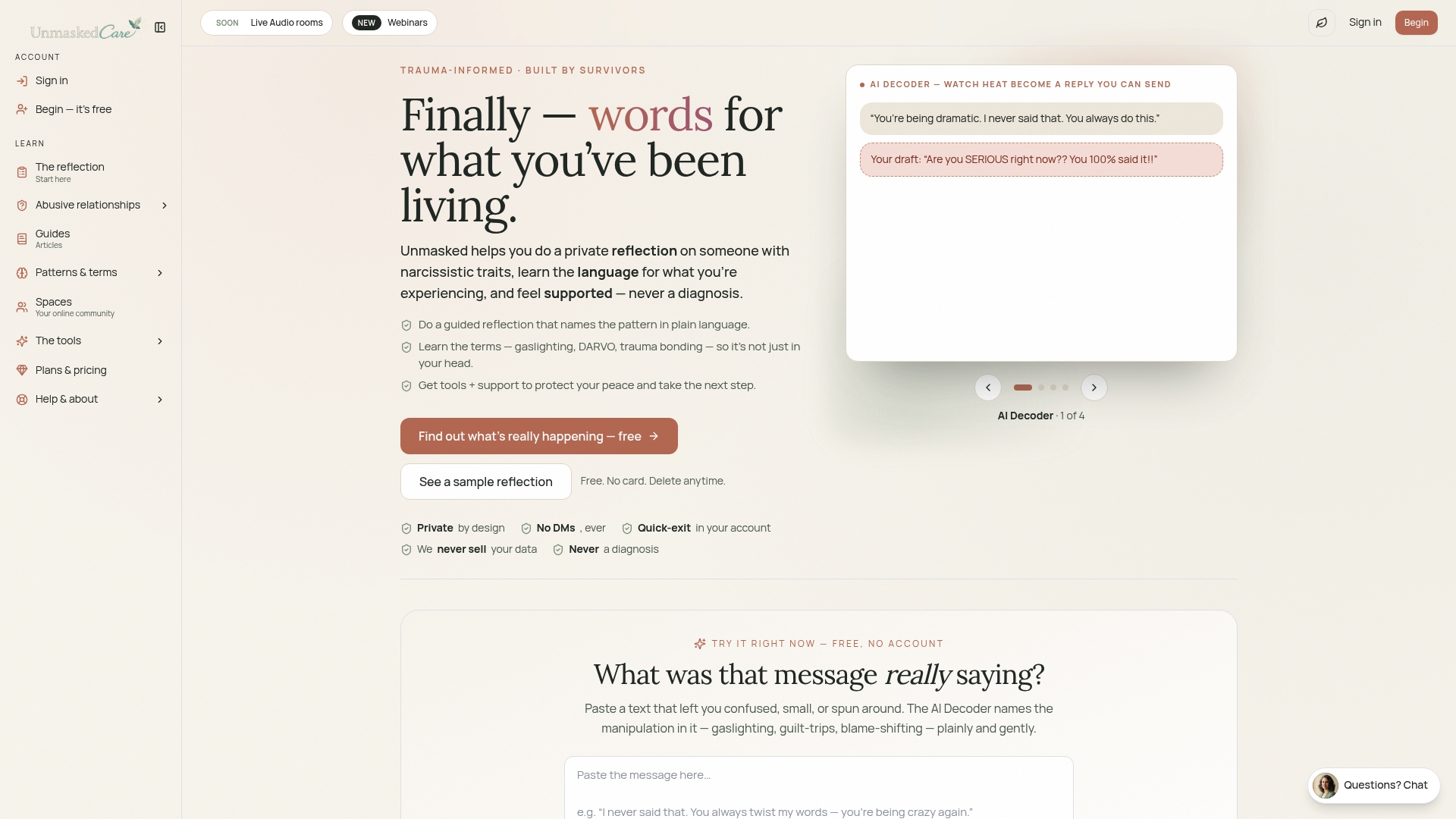
Unmaskedcare is built for people navigating narcissistic and borderline relationships who need more than a blog post. The free AI Decoder at unmaskedcare.com/decode analyzes a real message from your situation and names the tactic being used. Paid tiers unlock personalized reflection reports, a private evidence file, and access to a therapist directory filtered by abuse-pattern expertise. Community forums and live audio rooms are available for peer support, with anonymous profile options for privacy. Start with the free decoder, save your first evidence note, and see what it feels like to have the right words ready.
Useful sources and U.S. resources
- National Domestic Violence Hotline — 1-800-799-7233, available 24/7 for safety planning and crisis support. Call or text if you feel unsafe.
- Psychology Today: What to Expect When You Tell a Narcissist No — Clinical overview of pushback patterns and why they occur.
- Verywell Mind: 10 Phrases to Disarm a Narcissist — Therapist-sourced phrase list with explanations for each.
- Empathi: How to Set Boundaries With a Narcissist — Therapist’s guide covering behavioral framing, documentation, and the wall-versus-drawbridge distinction.
- Unmaskedcare narcissistic abuse resources — Curated tools, guides, and community support for recovery.
- Unmaskedcare safety planning — U.S.-focused safety planning templates and privacy-first documentation tools.
This article is general information, not professional advice. For your specific situation, consult a licensed therapist, legal advisor, or contact a crisis line.
Recommended
- Infographics: Narcissistic & Borderline Patterns | Unmasked
- Q&A: Narcissistic & Borderline Relationships | Unmasked
- How do I set boundaries with a narcissist? — Unmasked Care
- Narcissistic Mother-in-Law: Signs & Boundaries | Unmasked
Article generated by BabyLoveGrowth