
The core narcissistic traits to watch for are grandiosity, a constant need for admiration, lack of empathy, entitlement, exploitative behavior, and arrogance. According to the Mayo Clinic, these behaviors form the recognizable pattern clinicians associate with narcissistic personality disorder (NPD). This checklist is educational only. It is not a diagnosis, and only a licensed clinician can make that determination. If you are in immediate danger, call 911. For crisis support, call or text 988 (Suicide & Crisis Lifeline) or 1-800-799-7233 (National Domestic Violence Hotline).
Quick reference: core narcissistic traits
- Grandiosity: an inflated, often unrealistic sense of self-importance
- Excessive need for admiration and validation from others
- Lack of empathy: difficulty recognizing or caring about others’ feelings
- Entitlement: expecting special treatment without earning it
- Exploitative behavior: using others to meet personal goals
- Envy: believing others envy them, or resenting others’ success
- Arrogance: dismissive, condescending, or contemptuous attitudes
- Preoccupation with fantasies of unlimited success, power, or brilliance
Pro Tip: A single trait, on a bad day, does not tell you much. What matters is whether these behaviors appear repeatedly, across different settings, and leave you feeling consistently diminished, confused, or afraid.
Key Takeaways
Narcissistic traits follow recognizable patterns across settings and time, and the most useful thing you can do with a checklist is document what you observe, assess its impact on you, and seek professional support before taking action.
| Point | Details |
|---|---|
| Checklist is educational only | No checklist can diagnose NPD; only a licensed clinician can make that determination. |
| Look for patterns, not single acts | Frequency, cross-context presence, and impact on you matter more than any one incident. |
| DSM-5 threshold is five of nine | Clinicians require at least five criteria, pervasive across settings, present since early adulthood. |
| Document safely before acting | Log dates, direct quotes, and context in a private, secure location before confronting anyone. |
| Unmaskedcare supports the next step | The AI Decoder, red-flags checklist, and privacy evidence file help you document and decode patterns safely. |
Table of Contents
- What does a full narcissistic traits checklist look like?
- What do the DSM-5 criteria actually say?
- How to use this checklist to assess patterns, not just moments
- What are the practical next steps if you recognize these signs?
- Why narcissistic traits vary so much from person to person
- The Unmasked Care Team’s perspective on using this checklist
- What Unmaskedcare offers people who recognize these patterns
- Sources
What does a full narcissistic traits checklist look like?
The following 12 traits expand on the quick list above. Each entry shows how the behavior tends to appear in real relationships or workplaces. Use this as a reference, not a verdict.
-
Grandiosity / superiority. The person speaks as though their opinions, achievements, or status are obviously superior. At work, this might look like dismissing a colleague’s idea in a meeting without engaging with it at all.
-
Need for excessive admiration. Conversations consistently circle back to their accomplishments, and they grow visibly cold or irritable when attention shifts elsewhere.
-
Lack of empathy. When you share something painful, the response is minimal or redirected. They may acknowledge your words but show no genuine curiosity about your experience.
-
Entitlement. Rules that apply to everyone else simply do not apply to them, in their view. Waiting in line, following a policy, or taking turns feels like an insult.
-
Exploitative behavior. Relationships tend to be transactional. Favors come with invisible price tags, and help is withdrawn the moment it stops serving their interests.
-
Envy and projection. They assume others envy them, and when they feel envious themselves, that feeling often gets projected outward as suspicion or contempt.
-
Arrogance. Condescension shows up in small moments: the eye roll, the correction in front of others, the dismissive “you wouldn’t understand.”
-
Love-bombing. Early in a relationship, attention and affection arrive in overwhelming waves. It feels like finally being truly seen. The intensity is the warning sign.
-
Devaluation. After the idealization phase, the same qualities they praised become targets. The Psychology Today piece on narcissistic abuse describes this as a predictable cycle: idealize, devalue, discard.
-
Gaslighting. You are told that what you remember did not happen, that your reaction is the problem, or that you are “too sensitive.” Over time, you start doubting your own perception. Unmaskedcare’s gaslighting explainer breaks down how this tactic works with concrete examples.
-
DARVO. When confronted, the person Denies, Attacks, and Reverses Victim and Offender. Suddenly, you are the one who caused harm. Learn more about what DARVO looks like in practice.
-
Future-faking. Promises about the future (moving in together, changing a behavior, making things right) are used to reset the cycle without any real follow-through. Unmaskedcare’s guide on future-faking covers the pattern in detail.
Pro Tip: Frequency and cross-context presence are your two most reliable signals. If the same behavior shows up at home, at work, and with friends, and it consistently harms the people around them, that pattern carries far more weight than any single incident.
What do the DSM-5 criteria actually say?
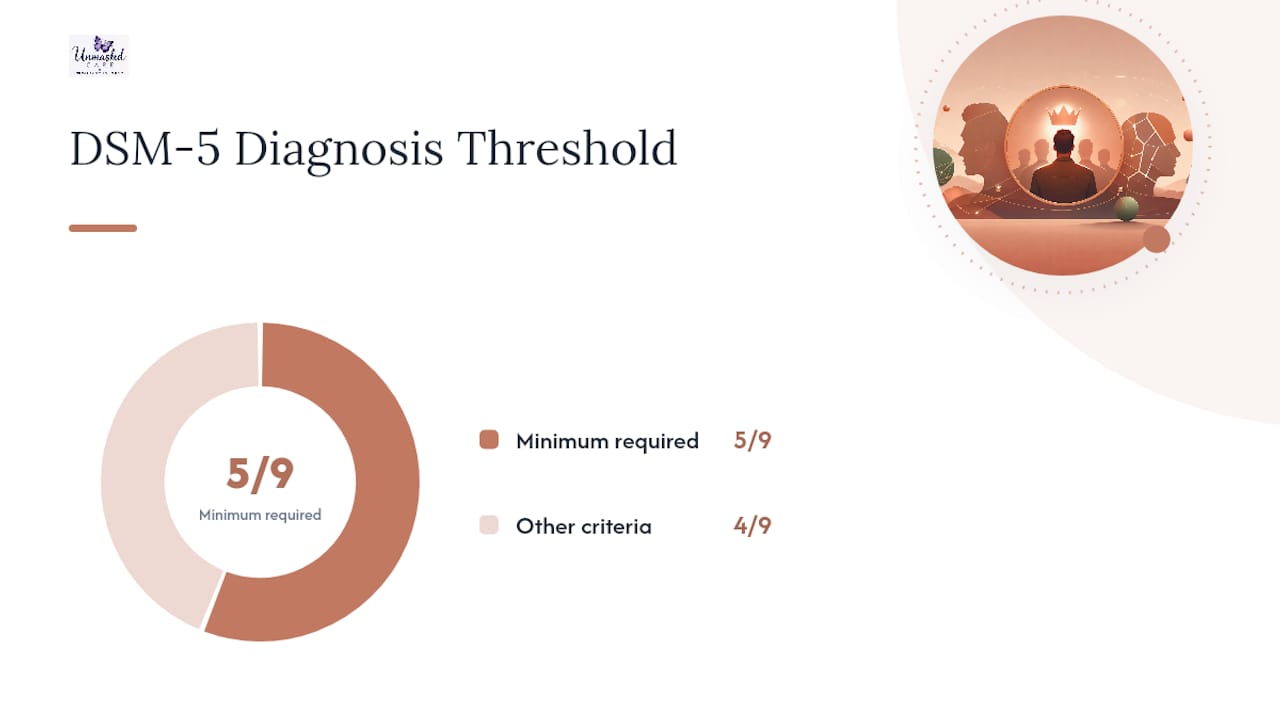
The American Psychiatric Association defines narcissistic personality disorder as a pervasive pattern of grandiosity, need for admiration, and lack of empathy beginning by early adulthood and present across contexts. The DSM-5-TR lists nine specific criteria. According to StatPearls via NCBI, clinicians typically require that a person meet at least five of the nine criteria, and that the pattern be pervasive, inflexible, and cause significant impairment or distress.
The nine DSM-5-TR criteria, in plain language:
- Grandiose self-importance: Exaggerates achievements; expects recognition as superior without matching accomplishments
- Preoccupation with fantasies: Absorbed by visions of unlimited success, power, brilliance, beauty, or ideal love
- Belief in special status: Believes they can only be understood by, or should associate with, other high-status people
- Need for excessive admiration: Requires constant, disproportionate praise and attention
- Sense of entitlement: Expects automatic compliance with their expectations
- Interpersonal exploitation: Takes advantage of others to achieve personal goals
- Lack of empathy: Unwilling or unable to recognize others’ feelings and needs
- Envy: Envies others or believes others envy them
- Arrogant behaviors or attitudes: Haughty, condescending, or dismissive in manner
A checklist is not a diagnosis. Clinicians assess whether these traits are pervasive across settings, persistent over time, traceable to early adulthood, and causing real impairment. A person can show several of these traits without meeting the clinical threshold for NPD. Labeling someone else based on a checklist is not only inaccurate — it can also distract from the more useful question: how is this behavior affecting you?
How to use this checklist to assess patterns, not just moments
A checklist becomes useful when you apply it systematically rather than reactively. Here is a straightforward workflow:
-
Observe without labeling. Notice specific behaviors as they happen. Stay descriptive: “They interrupted me and dismissed my concern” rather than “They are a narcissist.”
-
Log what you observe. Write down dates, direct quotes where possible, and the context. A private, secure note (more on that below) works better than memory alone.
-
Rate frequency and impact. Ask yourself: does this happen once in a while, or is it a near-constant pattern? Does it leave you feeling confused, ashamed, or afraid?
-
Check for cross-context presence. Does the behavior appear only with you, or also with coworkers, family members, and strangers? Patterns that cross settings carry more clinical weight.
-
Decide your next step. If the pattern is clear and the impact on you is significant, that is the signal to seek professional support, not to confront the other person with a checklist.
Red flags that warrant immediate attention:
- Physical threats or violence of any kind
- Controlling access to money, transportation, or communication
- Isolation from friends and family
- Threats involving children, immigration status, or housing
- Escalating intensity after you try to set a boundary
Documentation tips:
- Record dates, times, direct quotes, and who else was present
- Use a private app, a locked note, or a secure email draft
- Keep records off shared devices and accounts
- Unmaskedcare’s privacy evidence file is built specifically for this purpose
Pro Tip: If you share a device or account with the person you are documenting, use a private browsing window or a separate email address they do not know about. Safety comes before thoroughness.
What are the practical next steps if you recognize these signs?
Recognizing a pattern is the beginning, not the end. Here is what to do with that recognition, in order of priority.
-
Prioritize physical safety first. If you are in immediate danger, call 911. If the situation is not immediately dangerous but feels unsafe, call 988 or 1-800-799-7233 to talk through your options with a trained advocate.
-
Secure your documentation. Move your logs to a device or account the other person cannot access. Consider recovery resources that walk through safe documentation practices.
-
Tell one trusted person. Isolation is a common feature of these dynamics. Naming what is happening to someone you trust, even in general terms, breaks that isolation.
-
Set a boundary you can actually hold. Vague limits (“I need more respect”) are easy to dismiss. Specific, behavioral ones (“I will leave the room if you raise your voice”) are harder to argue with. The gray rock method is one low-engagement strategy worth understanding.
-
Consult a professional before confronting. A therapist, a domestic violence advocate, or in some cases a family law attorney can help you think through the risks of direct confrontation. If children are involved, co-parenting guidance and legal advice on parental alienation may also be relevant.
-
Plan an exit if needed. If you are considering leaving, do not announce it prematurely. Safety planning with a professional advocate reduces risk significantly.
Signs you need professional or emergency help now:
- You feel afraid of the other person’s reaction to ordinary events
- You have been threatened, physically harmed, or followed
- Your children are being used as leverage
- You feel unable to make decisions without the other person’s approval
Why narcissistic traits vary so much from person to person
Not everyone who shows narcissistic behaviors fits the same profile. The Cleveland Clinic notes that clinicians often discuss trait-based presentations, including grandiose, vulnerable, and high-functioning types, even though the DSM-5-TR does not formally list subtypes.
Grandiose vs. vulnerable presentations:
- Grandiose: Outwardly confident, domineering, openly contemptuous of others. The “classic” picture most people recognize.
- Vulnerable (covert): Outwardly shy or self-deprecating, but internally holds the same sense of specialness and entitlement. Hypersensitive to criticism. Signs of a covert narcissist are often harder to spot because the presentation looks like insecurity rather than arrogance.
- High-functioning: Maintains a polished, successful exterior. The behaviors surface most clearly in close relationships where the mask slips.
The APA also notes that grandiosity and vulnerability can alternate in the same person, which explains why someone can seem genuinely fragile one day and contemptuous the next.
Co-occurring conditions complicate the picture further. Anxiety, depression, and substance use disorders frequently appear alongside narcissistic traits. This matters because treatment for co-occurring conditions can look different, and a clinician needs the full picture to assess accurately.
A formal diagnosis requires more than a checklist. Clinicians assess whether traits are pervasive, inflexible, persistent over time, and traceable to early adulthood. They also look for clinically significant impairment or distress. Diagnostic instruments, clinical interviews, and often collateral history all play a role. No self-assessment tool replaces that process.
Evidence-based treatment for narcissistic traits typically centers on psychotherapy, with approaches such as schema therapy, mentalization-based therapy, and transference-focused psychotherapy used in clinical settings. Progress tends to be slow and requires sustained engagement. If you are wondering whether the person in your life will change, a therapist who specializes in personality-related presentations is the right person to consult, not a checklist.
The Unmasked Care Team’s perspective on using this checklist
Most articles about narcissistic traits hand you a list and leave you to figure out what to do with it. The harder problem is what happens after recognition: the self-doubt, the urge to find one more piece of evidence before trusting your own perception, and the very real safety questions that come with acting on what you now know.

The Unmasked Care Team’s position is that a checklist is a starting point for clarity, not a finish line. Naming a behavior precisely, whether it is gaslighting, DARVO, or future-faking, gives you language for something that may have felt impossible to describe. That language matters. It reduces the isolation that comes from not being able to explain what is happening to someone else. It also makes documentation more useful, because vague descriptions are easy to dismiss and specific ones are not.
What the team cautions against is using a checklist as a weapon in a confrontation. Telling someone “you meet five of nine DSM criteria” rarely produces the outcome you hope for, and in some situations it escalates risk. The more productive use of this information is internal: understanding your own experience, deciding what you need, and building a plan that puts your safety first.
This content is authored by the Unmasked Care Team and is educational in nature. It is not a clinical diagnosis or a substitute for professional advice. If you are in crisis, call 988 or 1-800-799-7233.
What Unmaskedcare offers people who recognize these patterns

Recognizing the pattern is one thing. Having a private, structured place to work through it is another. Unmaskedcare is built for exactly this moment: after the checklist, when you need tools that go deeper than a symptom list.
The platform’s AI Decoder analyzes specific messages or interactions and names the manipulation tactic at work, so you are not left guessing whether what you read was gaslighting or just a bad day. The red-flags printable checklist gives you a tangible reference you can use offline. The privacy evidence file lets you log dated entries, direct quotes, and context in a secure environment designed for people who cannot risk leaving a paper trail on a shared device.
Free educational content, community forums, and the resource library are available without a subscription. Paid tiers unlock personalized AI reflections, deeper analysis tools, and enhanced privacy features for people who need more structured support. Start with the free tools and go from there.
Sources
This article is educational and does not constitute a clinical diagnosis. If you are in crisis, call 988 or 1-800-799-7233.
- Narcissistic Personality Disorder - StatPearls - NCBI Bookshelf
- What Is Narcissistic Personality Disorder? — American Psychiatric Association (APA)
- Narcissistic personality disorder - Symptoms and causes — Mayo Clinic
- Narcissistic Personality Disorder: Symptoms & Treatment — Cleveland Clinic
- Recognizing and Healing From Narcissistic Abuse | Psychology Today
This article is general information, not a substitute for advice from a qualified doctor. Consult a qualified healthcare professional about your own circumstances before acting on anything here.