
Use these short, copy-ready boundary scripts to stop unwanted requests, protect your time, and stay safe. The fastest way to start: pick one line below, say it out loud three times before your next difficult conversation, and follow through exactly as written.
Three scripts to use right now:
- “I’m not able to do that.” (Work or family requests you can’t take on)
- “That topic doesn’t work for me. Let’s talk about something else.” (Intrusive questions at gatherings)
- “I need to step away now. We can reconnect when things feel calmer.” (Partner or family conflict)
When to use each:
- Work: “I’m not able to do that” ends scope creep without explanation or apology.
- Family: The redirect line shifts the conversation without a confrontation.
- Partner: The step-away line creates distance without escalating.
Pro Tip: Say the script in a flat, calm tone, not apologetic and not aggressive. If the boundary is crossed anyway, follow through on exactly what you said you’d do. Saying it and not doing it teaches the other person the limit isn’t real.
According to APA guidance on clinical practice, delivery matters as much as the words. A neutral, steady tone signals that the limit is firm, not negotiable.
Key Takeaways
Ready-to-use boundary scripts work best when they’re short, delivered in a calm tone, and backed by consistent follow-through — the words alone are not enough without the action that follows.
| Point | Details |
|---|---|
| Keep scripts short | One to two sentences is enough; every extra word gives the other person more to argue with. |
| Deliver in a flat, calm tone | APA guidance confirms that tone signals firmness; apologizing or over-explaining weakens the limit. |
| Expect pushback | An extinction burst (short-term escalation) is normal when a boundary is first enforced; hold the line. |
| Practice aloud before use | Rehearsing 3–5 times builds automaticity so the words come out under stress without freezing. |
| Unmaskedcare for deeper support | The AI Decoder and red-flags checklist help identify manipulation and track patterns alongside script use. |
Your 7-day practice plan: Each day this week, pick one script from this guide, say it aloud five times in a calm tone, and identify one real situation where you’ll use it before the week ends.
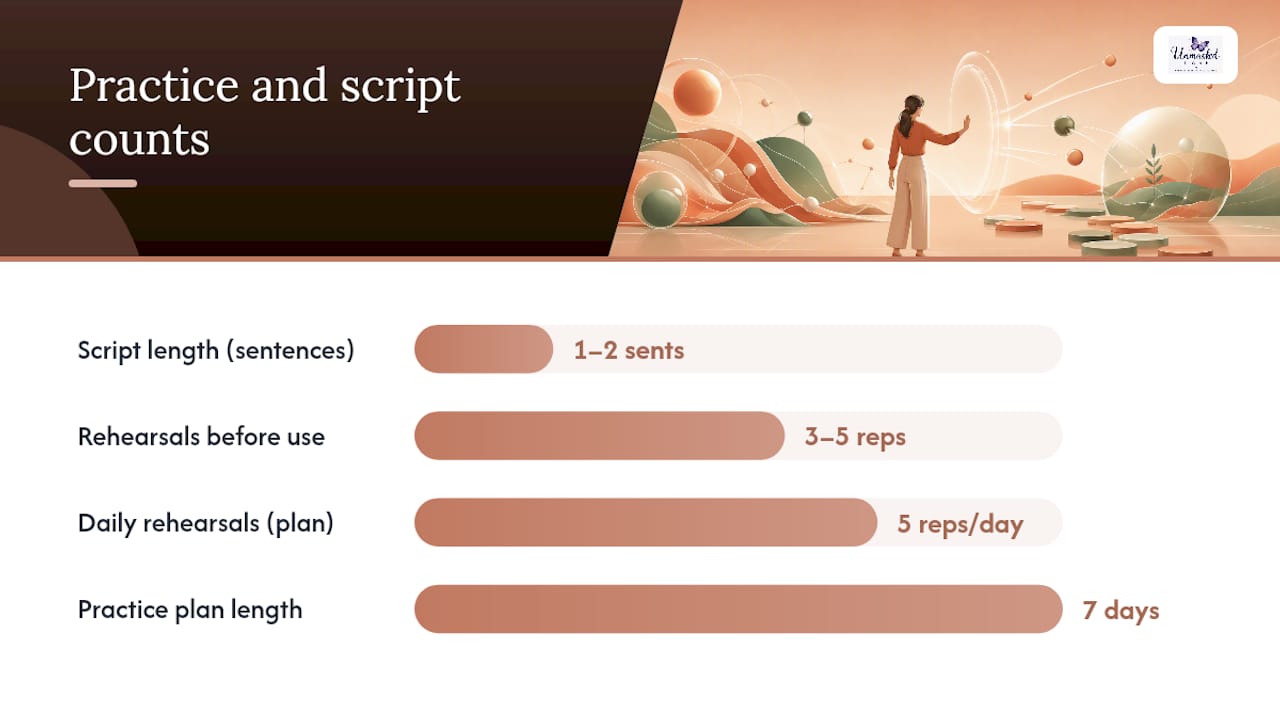
Table of Contents
- What are the best boundary scripts for every situation?
- How to set workplace boundaries in email, chat, and meetings
- Scripts for family gatherings, intrusive questions, and social events
- Scripts for partners and situations where manipulation may be happening
- Scripts for illness, caregiving, and medical situations
- How do you respond when someone pushes back on your boundary?
- What does research say about how to deliver a boundary script?
- How do you personalize a boundary script to fit your voice?
- When the other person may be manipulative or abusive: red flags and safety resources
- A note from the Unmasked Care Team on the scope of this guide
- How Unmaskedcare supports your boundary work
- Sources
What are the best boundary scripts for every situation?
Momentum Psychology notes that a boundary is a statement about what you will do and what happens next if the limit isn’t respected. Short, explicit language works best. The Boundary Playbook’s collection of 50+ scripts organizes them by relationship type so you can find copyable language fast. The sections below follow the same logic.
Social gatherings and events
These lines work at parties, dinners, and group settings where you need to exit a conversation or decline without a scene.
- “I appreciate the invite. I won’t be able to make it.” (No explanation needed.)
- “That’s not something I want to get into tonight.” (Redirect for personal questions.)
- “I’m going to head out now. Thanks for having me.” (Clean exit, no negotiation.)
- “I can stay for about an hour.” (Time-limit, set at arrival.)
- “I’d rather not talk about that. How’s [topic change]?” (Soft redirect.)
- “I’m going to grab some water. Catch you in a bit.” (Physical exit without explanation.)
Softer variation: “I’m not really up for that conversation tonight, but I’d love to hear about [other topic].” Follow-through: If the person pushes, repeat the redirect once and physically move away.
Family scripts
Family settings often involve the longest history and the most pressure. Keep these short.
- “That’s not up for discussion.” (For topics you’ve already addressed before.)
- “I love you, and I’m not going to talk about this.” (Warm but firm.)
- “I’ll visit for two hours. I have plans after.” (Time-limit set in advance.)
- “Please don’t comment on my [weight/relationship/choices]. It’s not helpful.” (Direct ask.)
- “I’m going to step outside for a few minutes.” (De-escalation exit.)
- “We see this differently, and that’s okay. I’m moving on.” (Closing a circular argument.)
Softer variation: “I know you mean well, and I need you to trust me on this one.” Follow-through: If a family member continues after one redirect, leave the room or end the call.
Work scripts
- “I can take that on next week. My plate is full through Friday.” (Deadline-based decline.)
- “That falls outside my current scope. Can we loop in [manager/team]?” (Scope redirect.)
- “I’m offline after 6 PM. I’ll respond first thing tomorrow.” (After-hours limit.)
- “I want to do this well, which means I need more time. Can we revisit the deadline?” (Quality-based ask.)
- “I’m in a meeting right now. I’ll follow up at [time].” (Meeting protection.)
- “I’m not comfortable with that approach. Here’s what I can offer instead.” (Values-based redirect.)
Softer variation: “I want to help. Let me check my capacity and get back to you by end of day.” Follow-through: If the request comes again after your limit, restate it once and copy a manager if needed.
Partner scripts
- “I need a 20-minute break before we continue this conversation.” (Cooling-off request.)
- “I’m not okay with being spoken to that way. I’ll come back when things are calmer.” (Tone limit.)
- “This conversation isn’t productive right now. Let’s pause.” (Neutral exit.)
- “I need you to respect [specific limit]. This is important to me.” (Direct ask.)
- “I’m not going to engage when the conversation gets to this point.” (Pattern-based limit.)
- “I care about us, and I need this to change.” (Relationship-preserving frame.)
Softer variation: “I want to work through this with you. Right now I need a little space to think.” Follow-through: If the partner escalates after you’ve stepped away, do not re-engage until you’re both calm.
Medical and caregiving scripts
- “Please direct all medical questions to [designated contact].” (For family members calling the hospital.)
- “I’m not able to take visitors right now. I’ll reach out when I’m ready.” (Recovery boundary.)
- “I can help with [specific task], and that’s the limit of what I can take on.” (Caregiver capacity.)
- “I’m not in a place to discuss my health right now.” (Energy-conservation line.)
- “Updates will come through [name]. Please reach out to them.” (Designated-contact redirect.)
- “I appreciate your concern. I need rest more than conversation right now.” (Warm but firm.)
Softer variation: “I know everyone wants to help. The best thing right now is space and quiet.” Follow-through: If someone bypasses the designated contact, repeat the redirect and don’t provide the update yourself.
Short vs. longer script formats at a glance
| Format | Length | Best for | Follow-up needed? |
|---|---|---|---|
| Short (1 line) | 5–10 words | Quick exits, familiar people | Yes, if ignored |
| Short + follow-up | 1 line + 1 action sentence | Work, family, recurring issues | Built in |
| Longer / negotiable | 2–3 sentences | New limits, sensitive topics | Yes, restate if pushed |
How to set workplace boundaries in email, chat, and meetings
Professional settings add a layer of complexity: there’s a power dynamic, a paper trail, and often an expectation that you’ll say yes. These templates are designed to be pasted directly.
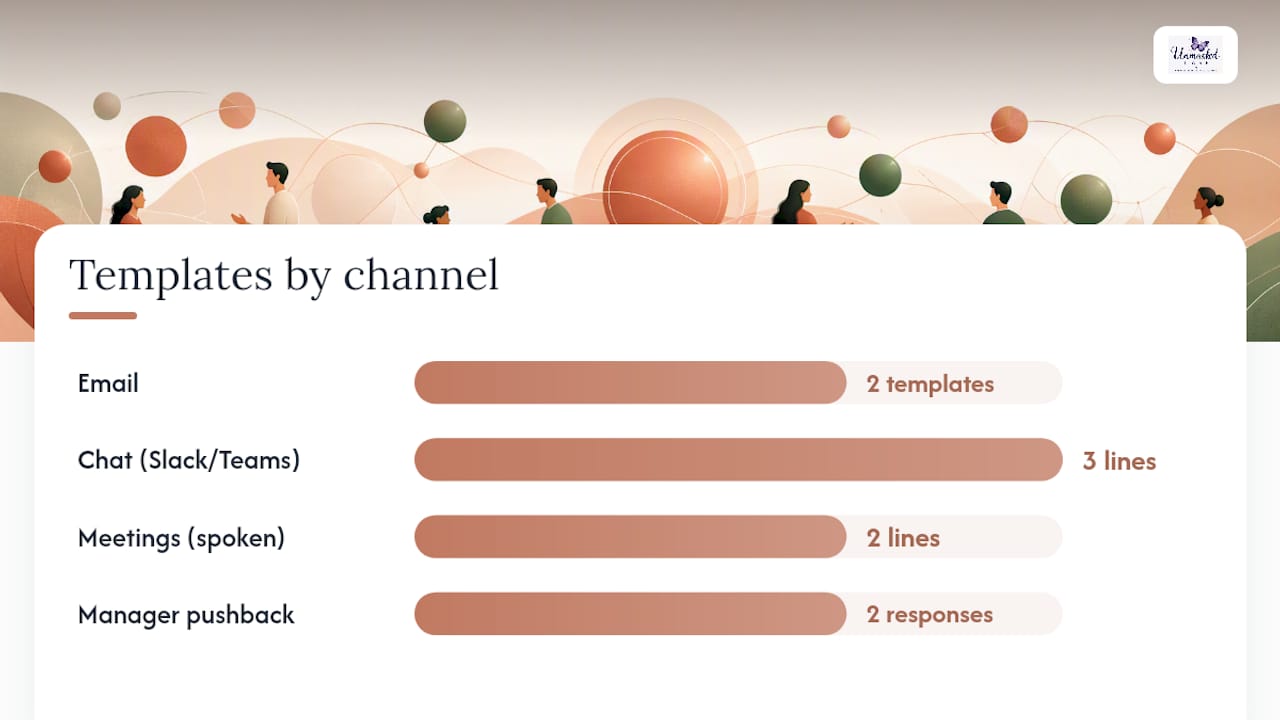
Email: after-hours request
Hi [Name], thanks for reaching out. I’m offline after 6 PM and will respond to this first thing tomorrow morning. If it’s urgent, please contact [backup contact].
Email: scope creep
Hi [Name], this request falls outside the agreed scope for this project. I’d like to loop in [manager/team lead] before moving forward. Can we set up a quick call this week?
Chat (Slack/Teams) lines:
- “On a deadline right now. Back at [time].”
- “That’s outside my lane. Tagging [person] who can help.”
- “Heads up: I’m not monitoring messages after [time] today.”
Spoken in meetings:
- “I want to make sure I can deliver quality work, so I need to flag that this timeline isn’t realistic for me.”
- “Can we table this until I’ve had a chance to review the scope?”
When a manager pushes back:
- “I hear you. I want to meet the deadline. To do that, I’d need [X resource or Y task removed]. Which would work better?”
- “I can prioritize this if we move [other task] to next week. Does that work for you?”
These responses don’t refuse outright. They reframe the limit as a capacity question, which tends to land better with managers without abandoning the boundary itself.
Scripts for family gatherings, intrusive questions, and social events
Family and social settings are where boundary scripts feel the most awkward and where they’re most needed. The goal isn’t to win an argument. It’s to redirect or exit cleanly.
Redirect phrases for intrusive questions
- “I’d rather not get into that. What’s going on with you?”
- “That’s pretty personal. I’m keeping it private for now.”
- “I’ve got nothing new to report on that front.” (Neutral, closes the topic.)
Opt-out lines for visits and gatherings
- “I won’t be able to make it this time. I’ll catch you at the next one.”
- “I’m going to keep it short tonight. I have an early morning.”
- “I’m going to head out. Thanks for a great evening.” (No apology, no explanation.)
Time-limit language
Set the limit before the event, not during it. “I can be there from 4 to 6” is easier to hold than trying to leave mid-conversation.
- “I can stay until [time]. After that I need to head out.”
- “I’ve got about an hour. Let’s make the most of it.”
Exit scripts for draining conversations
- “I need to step away from this conversation.”
- “I’m going to get some air. Back in a few.” (Physical break, no commitment to return to the topic.)
- “I think we’ve covered this. I’m going to move on.”
On sequencing: Repeat a redirect once. If the person continues, use an exit line. If the exit line is ignored, leave the room or end the call. You don’t owe a third explanation.
Scripts for partners and situations where manipulation may be happening
When a relationship involves controlling or manipulative behavior, standard boundary language sometimes isn’t enough. The scripts below are designed for situations where the other person may escalate, dismiss, or twist what you say. This section describes behaviors, not diagnoses.
Gray rock: short, emotion-neutral lines
The gray rock method reduces engagement by keeping responses flat and unremarkable. The goal is to give the other person nothing to react to.
- “Okay.”
- “I see.”
- “I’ll think about it.”
- “That’s not something I’m going to discuss.”
- “I don’t have anything to add.”
These aren’t dismissive. They’re deliberate. The less emotional fuel you provide, the less traction a manipulative pattern gets.
No-contact language
If you’ve decided to end contact, keep the message short and don’t invite a response.
- “I’m ending contact. Please don’t reach out.”
- “I won’t be responding to further messages.”
- “This relationship isn’t working for me. I’m stepping away.”
Steps: Send it once, in writing. Do not respond to replies. Block if needed. If the person escalates to threats or shows up in person, contact local law enforcement.
Safety callouts
Certain behaviors signal that a limit alone isn’t enough:
- Threats, whether direct or implied
- Showing up uninvited after you’ve asked for space
- Monitoring your location, devices, or communications
- Pressure that intensifies every time you try to step back
If any of these are happening, prioritize safety over the script. Call 988 (Suicide & Crisis Lifeline) or 1-800-799-7233 (National Domestic Violence Hotline) for immediate support and safety planning.
For more on setting limits with someone who uses manipulative tactics, see how to set boundaries with a narcissist.
Scripts for illness, caregiving, and medical situations
Illness strips away energy fast. The scripts below are designed to be short enough to use when you have very little left.
Designated-contact template
Send this to family members at the start of a medical situation:
This removes the burden from the patient and creates a single point of communication.
Status update script
When someone asks for an update and you’re not ready to give one:
- “There’s nothing new to share right now. We’ll be in touch.”
- “I’m not in a place to talk about this today. I’ll reach out when I am.”
Energy-conservation lines
- “I need to rest. I’ll call you when I’m feeling up to it.”
- “Visits aren’t possible right now. I’ll let you know when that changes.”
- “I appreciate you thinking of me. I need quiet more than company right now.”
Caregiver capacity scripts
Caregivers often absorb more than they agreed to. These lines help reset the scope:
- “I can help with [specific task]. That’s what I’m able to take on right now.”
- “I need to step back from [task]. I’m not in a position to continue with that.”
- “I’ve reached my limit for today. I’ll check in tomorrow.”
Follow-through: If someone bypasses the designated contact or keeps asking for updates, repeat the redirect once and don’t provide the information. Consistency is the follow-through.
How do you respond when someone pushes back on your boundary?
Pushback is normal. It doesn’t mean the boundary is wrong. Psychotricks explains that scripts act as neural scaffolding, reducing cognitive load so you can stay steady under pressure.
The repeat technique
Restate the boundary without adding new information, apologizing, or explaining further.
- First statement: “I’m not able to take that on.”
- After pushback: “I understand. I’m still not able to take that on.”
- After more pushback: “My answer hasn’t changed.”
No new reasons. No softening. The repetition itself signals that the limit is real.
Exit lines for escalating conversations
- “I’m not going to continue this conversation right now.”
- “We can revisit this when things are calmer. I’m stepping away.”
- “I’ve said what I need to say. I’m done for now.”
What to expect: the extinction burst
When you enforce a boundary for the first time, the other person often pushes harder before they stop. This is sometimes called an extinction burst: the old pattern isn’t working, so they try it with more intensity. Psychotricks describes this as a temporary escalation that typically fades when the boundary holds. The key is not to interpret the escalation as proof the boundary was wrong. It’s usually proof it was necessary.
- If someone guilt-trips: “I hear that you’re upset. My answer is still the same.”
- If someone threatens: Document it and contact the appropriate authority.
- If someone goes silent: Let them. That’s their response, not your problem to fix.
What does research say about how to deliver a boundary script?
The words matter. How you say them matters just as much. APA guidance is direct: a neutral, steady, calm tone signals that a limit is firm. Apologizing or over-explaining weakens it.
The most important delivery rule
Say it once, in a flat tone, without justification. That’s it. Every word you add after the core statement gives the other person something to argue with.
Evidence-based delivery tips
Trauma-informed approaches, including somatic therapy and Internal Family Systems (IFS) methods described by Helen Beynon, recommend preparing your nervous system before the conversation, not just your words. That means:
- Slow your breathing before you speak. Three slow exhales lower the physiological stress response.
- Keep your body language open and still. Crossed arms or a raised voice changes how the same words land.
- Practice the script aloud, not just in your head. Momentum Psychology recommends rehearsing until the words feel automatic, which reduces the chance of a nervous-system freeze mid-conversation.
A short rehearsal script
Read this aloud 3–5 times before a difficult conversation:
Say it in a flat, even tone. Not cold, not apologetic. Just clear. The repetition builds what practitioners call automaticity: the words come out under stress because they’ve already been practiced under calm.
Pro Tip: Record yourself saying the script once on your phone. Play it back. If you sound apologetic or your voice rises at the end, try again until the tone is level. That recording is your baseline.
Cultural context shapes how direct language lands. A script that feels appropriately firm in one setting may read as aggressive in another. For guidance on culturally informed communication, The Therapy Canvas offers a practical overview of how intersectionality affects counseling and communication norms.
How do you personalize a boundary script to fit your voice?
A script that doesn’t sound like you won’t come out under pressure. The goal is to adapt the template, not memorize someone else’s exact words.
Fill-in-the-blank templates
Template 1: Basic limit “I’m not able to [action]. I’ll [follow-up action] instead.”
- Formal: “I’m not able to attend that meeting. I’ll send a written update instead.”
- Brief: “Can’t do that. I’ll email you.”
- Compassionate: “I wish I could be there. I’m not able to make it work right now.”
Template 2: Redirect “I’d rather not talk about [topic]. Can we talk about [alternative] instead?”
- Formal: “I’d prefer to keep that private. Can we focus on the project timeline?”
- Brief: “Not going there. What else is going on?”
- Compassionate: “That’s a tender topic for me right now. Tell me what’s new with you.”
Template 3: Time limit “I can [action] until [time]. After that, I need to [follow-up action].”
- Formal: “I’m available until 5 PM. After that, I’ll be offline.”
- Brief: “I’ve got an hour. Then I’m out.”
- Compassionate: “I’d love to stay longer. I need to leave by 7 to take care of myself tonight.”
Three quick rules for personalizing scripts
- Keep it short. Every sentence you add gives the other person more to respond to.
- Skip the justification. “Because I’m tired” invites debate. “I’m not able to” doesn’t.
- Match your actual tone. If you’re naturally warm, use warmer language. If you’re direct, stay direct. A script that sounds like you is one you’ll actually say.
When the other person may be manipulative or abusive: red flags and safety resources
This section describes behaviors, not diagnoses. The information here is educational and is not a substitute for professional assessment or clinical advice.
Some situations call for more than a script. When the other person responds to limits with escalating pressure, threats, or tactics designed to make you doubt your own perception, the priority shifts from communication to safety.
Behaviors that signal a limit alone may not be enough
- Dismissing or mocking the boundary after you’ve stated it clearly
- Twisting your words or denying things that were said (see what gaslighting looks like)
- Responding to your limit with threats, punishment, or withdrawal designed to force compliance
- Cycling through apology and pressure to wear down your resolve
- Escalating contact after you’ve asked for space
These behaviors describe patterns, not a person’s identity. If you recognize them, the scripts in this guide are still useful, but they work best alongside a safety plan.
Safety resources
If you’re in immediate danger or need to talk to someone:
- 988 (Suicide & Crisis Lifeline): call or text, 24/7, 988lifeline
- 1-800-799-7233 (National Domestic Violence Hotline): call or text, 24/7
If you’re unsure whether what you’re experiencing is manipulation or abuse, Unmaskedcare’s printable red-flags checklist can help you identify specific patterns and track them over time. The AI Decoder lets you paste a message and see whether it shows signs of manipulative language, in a private, secure workspace.
For deeper context on relational patterns that can make boundary-setting especially difficult, Unmaskedcare’s guide on what DARVO is explains how some people deflect accountability in ways that make the person setting the limit feel like the problem.
A note from the Unmasked Care Team on the scope of this guide
This guide was developed by the Unmasked Care Team as an educational resource for people navigating difficult conversations and relationships. The scripts, frameworks, and delivery tips here are drawn from practitioner guidance and published resources. They are not a clinical intervention, and nothing in this article constitutes a diagnosis of any person, including the reader or anyone in the reader’s life.
Boundary-setting is a skill. Like any skill, it develops with practice and sometimes with professional support. For situations involving safety risk, complex trauma, or patterns that feel impossible to shift alone, working with a licensed clinician is the most appropriate next step. Unmaskedcare’s therapist directory can help you find a clinician without leaving the platform.
How Unmaskedcare supports your boundary work
Scripts give you the words. Unmaskedcare gives you the tools to understand what’s happening beneath them.
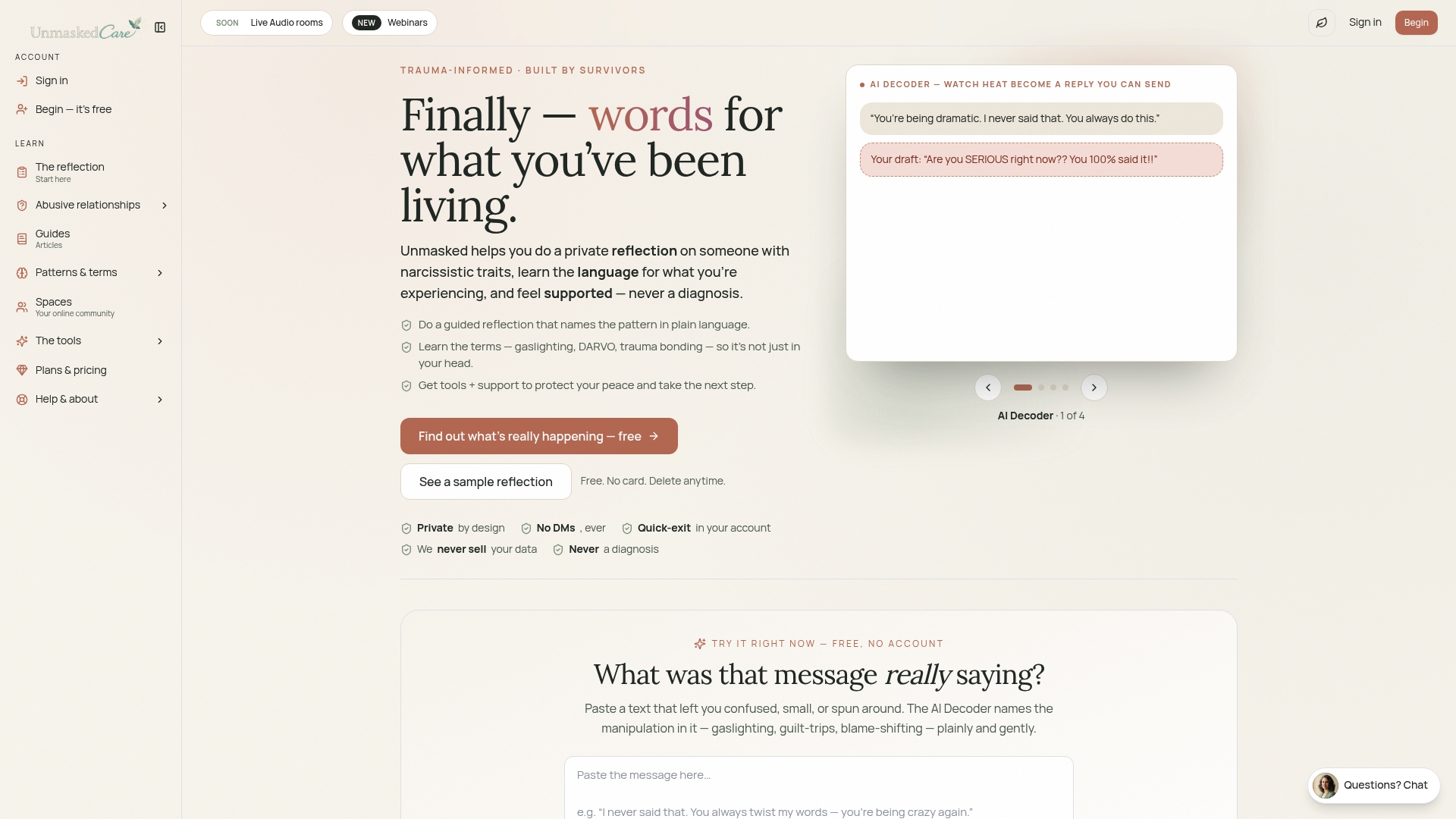
For people navigating relationships where manipulation is a factor, Unmaskedcare offers a set of tools built specifically for that context:
- AI Decoder: Paste any message and the tool identifies whether it contains manipulative language patterns, including gaslighting, DARVO, and future faking. Useful for preparing a response before you send it.
- Red-flags checklist: A printable tracker for identifying and documenting repeated boundary violations over time.
- Privacy-focused evidence file: A secure space to log incidents, messages, and patterns without them being visible to anyone else.
- Guided reflections: Structured questions that help you articulate what happened, what you felt, and what limit you want to set next.
- Community and live audio rooms: Anonymous or public spaces to hear how others have handled similar situations.
The full feature set is available to explore at no cost for education and community access. Paid tiers unlock the AI tools and personalized reflection reports. Start with the free AI Decoder to see whether a message you’ve received shows signs of manipulation before you decide how to respond.
Sources
- APA — Better boundaries in clinical practice
- How to set boundaries — examples and scripts (Momentum Psychology)
- Boundary Playbook — Examples of boundaries: 50+ scripts
- Boundaries as a psychological skill (Psychotricks)
- How to set boundaries using somatic therapy & IFS — six steps (Helen Beynon)
- 988 Lifeline
This article is educational and is not a diagnosis. If you are in a situation involving safety risk, please contact a qualified professional or use the crisis resources listed above.