
State the limit calmly, prefaced by validation, at a time when you’re both regulated, and follow through the same way every time. Name one behavior, one consequence, and stick to it. If you feel unsafe, call 988 (Suicide & Crisis Lifeline) or 1-800-799-7233 (National Domestic Violence Hotline) before anything else.
TL;DR:
- Consistency in enforcing boundaries is crucial because shifting responses teach partners that protest can change limits over time.
- Preparing clear, observable boundaries in advance and choosing calm moments to communicate increases the likelihood they will be respected.
- Using validation before stating limits helps prevent boundaries from being perceived as rejection and reduces potential argument.
- Escalation calls for short responses, planned time outs, and moving to a safe space rather than engaging further in heightened emotions.
- Ongoing routines and regular self-checks help maintain boundaries long-term, while professional support is recommended for threats or persistent dysregulation.
Table of Contents
- What does setting boundaries with a BPD partner actually look like?
- Why does consistency matter more than the wording of the boundary?
- How do you plan a boundary before you bring it up?
- What should you say, and how should you say it?
- How do you handle it if things escalate?
- How do you keep a boundary from eroding over time?
- When is it time to bring in professional support?
- How can Unmasked Care support boundary practice?
- [Perspective: boundaries are care, not punishment — as explained in tips for communicating with the other party’s solicitor can be helpful setting boundaries: tips for communicating with the other party’s solicitor](#perspective-boundaries-are-care-not-punishment-as-explained-in-tips-for-communicating-with-the-other-partys-solicitor-can-be-helpful-setting-boundaries-tips-for-communicating-with-the-other-partys-solicitorhttpsfindamckenziefriendcomarticlescurtis-clarksetting-boundaries-tips-for-communicating-with-the-other-party-s-solicitor)
- Try Unmasked Care’s tools for practicing boundaries
- Sources
What does setting boundaries with a BPD partner actually look like?
Setting boundaries with a BPD partner is not about controlling another person or issuing an ultimatum meant to punish. A boundary is a statement about what you will do, not a demand about what someone else must feel or stop feeling. That distinction changes everything about how the conversation lands.
This matters because the goal is protecting the relationship’s safety and your own capacity to stay in it, not scoring a point. A boundary might sound like “I’m going to leave the room when voices get raised” rather than “You need to stop yelling.” The first is something you control. The second asks someone else to regulate on command, which rarely works for anyone, with or without a personality disorder.
Behavior-focused language keeps the conversation from turning into a referendum on someone’s character:
- Name the specific action, not the person’s worth or intentions (“when messages come every few minutes” instead of “you’re obsessive”).
- Describe what you will do in response, not what you’re forbidding them from feeling.
- Keep the boundary about your capacity (“I need a quiet evening”) rather than their diagnosis (“your BPD is too much tonight”).
- Avoid mind reading. Stick to observable behavior you can point to later without argument.
None of this is a diagnostic tool, and nothing here should be used to label a partner or determine whether they meet criteria for borderline personality disorder. Only a licensed clinician can make that determination. This article addresses behavior patterns and communication strategies, and it is educational information, not a diagnosis of any specific person.
Why does consistency matter more than the wording of the boundary?

Predictability is the mechanism that makes any of this work. A nervous system that knows what happens next has less reason to escalate to find out. When responses shift depending on mood, exhaustion, or guilt, the relationship becomes a puzzle to solve through pressure rather than a stable place to land, and inconsistent limits teach that pushing harder eventually gets a different answer.
That’s the core mechanism worth sitting with: every time a boundary bends under enough protest, it confirms that protest is the tool that works. Hold the same line calmly on Tuesday and on Sunday, and the behavior that tests it tends to lose its payoff over time.
Holding a boundary after enforcing it often triggers what clinicians informally call a “boundary hangover” — a wave of guilt, anxiety, or self-doubt that shows up not because the boundary was wrong, but because change of any kind activates the nervous system.
Pro Tip: Expect the hangover. Plan one grounding action in advance, a short walk, five slow breaths, a text to a friend, so you have something to do with the discomfort besides reversing the boundary.
How do you plan a boundary before you bring it up?
Walking into a hard conversation without a plan is how boundaries collapse mid sentence. A few minutes of preparation beforehand changes the outcome more than anything said in the moment.
- Name the exact behavior. Not “disrespect,” but the specific, observable thing: reading your phone, showing up late, calling repeatedly after you’ve said good night.
- Decide your response in advance. Will you take a fifteen minute time out, leave the room, or pause contact until a set time? Choose something you can actually do under stress, not an ideal you’d only manage on a good day.
- Pick a calm window. Bring up the boundary when you’re both regulated, not mid argument and not right after a conflict. A high conflict moment is the worst time to introduce a new limit, since neither person has the bandwidth to process it well.
- Set a loose agenda. One sentence of validation, one sentence naming the behavior, one sentence naming your response. That’s it. Resist the urge to build a case.
- Rehearse it out loud once. Saying the words before you need them reduces the odds you freeze or over explain in the actual conversation.
Preparation isn’t about scripting your partner’s reaction. It’s about making sure you know your own next move regardless of how they respond, which is the only part of this you actually control.
What should you say, and how should you say it?
The order of operations matters as much as the words themselves. Leading with validation before naming the limit lowers the chance the boundary gets heard as rejection instead of information.
A workable script has three short parts: acknowledge the feeling, name the behavior, state the response. Keep each part to one sentence. Long explanations invite debate, and debate is where boundaries usually die.
Some starting points to adapt:
- “I can see you’re really anxious about this. When I don’t answer for a few hours, it doesn’t mean I’m gone. I’ll check my phone again after dinner.”
- “I know this is a hard night. When things get loud, I’m going to step into the other room for ten minutes and come back.”
- “I hear that you’re hurt. I’m not going to discuss this over text tonight. Let’s talk in the morning when we’re both calmer.”
- “This matters to you, I get that. I still need my Thursday evenings for myself. That’s not changing.”
Notice none of these scripts argue about whether the underlying feeling was justified or debate what the partner “really meant.” Arguing about intent is a trap. Stick to the observable behavior and your own response, and decline to relitigate motive.
Have a plan to reconnect once things settle, too. A short check in later, “I’m glad we got through that, want to grab coffee tomorrow?”, signals that the boundary was about safety, not a punishment that ends the relationship. HelpGuide’s boundary examples, including scheduled discussion times for sensitive topics and clear communication limits, are a useful starting template if you want more copy-ready structure. Unmaskedcare’s boundary scripts collection has additional phrasing built around this same validation-first structure.
Pro Tip: If a boundary conversation starts spiraling into “well what about the time you…”, it’s a sign to pause. Say “let’s come back to this tomorrow” and actually mean it.
How do you handle it if things escalate?
Escalation calls for fewer words, not more. Once voices rise or the conversation turns into pleading or threats, the goal shifts from communicating to staying safe and regulated.
A few things help in the moment:
- Use the time out you planned in advance rather than negotiating a new one on the spot.
- Move to a neutral space, a different room, a walk outside, somewhere without an audience or a locked door.
- Keep responses short: “I need a break. I’ll be back in twenty minutes.” Repeat it if needed instead of explaining further.
- Skip the bargaining. Offering to undo the boundary to calm someone down teaches the exact lesson consistency is supposed to prevent.
- Wait until both people are visibly calmer before resuming any conversation about the original issue.
Escalation sometimes crosses from emotional intensity into danger, and that line matters. If a partner threatens self-harm, threatens you, or you feel physically unsafe at any point, that is a different situation than a hard conversation. For individuals experiencing crisis, the 988 Suicide & Crisis Lifeline and the National Domestic Violence Hotline at 1-800-799-7233 provide direct, immediate support, and 911 is appropriate for immediate physical danger. Having a written safety plan prepared before a crisis, rather than during one, makes it far easier to act quickly instead of freezing.
How do you keep a boundary from eroding over time?
Boundaries that survive months, not just a single hard conversation, usually run on routine rather than willpower alone. Willpower runs out by Thursday. Routines don’t.
Build small, repeatable responses for the triggers that show up again and again, so you’re not reinventing the wheel under stress each time:
- Write a two sentence script for your most common trigger and keep it somewhere you can glance at it.
- Protect your own energy with something outside the relationship: a friend, a hobby, a support group, or a therapist of your own.
- Set a monthly check in with yourself to review which boundaries still fit and which need adjusting, separate from the moment you’re actually enforcing one.
- Treat non-core boundaries (schedule preferences, minor habits) as negotiable over time, while keeping safety-related limits fixed no matter what.
The distinction in that last point matters. Flexibility on small things signals you’re not rigid for its own sake. Rigidity on safety related limits is what keeps the whole structure from collapsing the first time it’s tested.
When is it time to bring in professional support?
Some signs point clearly toward needing outside help rather than continuing to manage things solo. Threats of harm to you or to your partner, repeated failure of a safety plan, or persistent, severe dysregulation that doesn’t settle with time and space are all reasons to loop in a professional rather than keep troubleshooting alone.
- Look specifically for a DBT-informed clinician; dialectical behavior therapy is one of the evidence-based approaches most associated with improved outcomes for BPD traits, and additional clinical review literature supports its use.
- Consider individual therapy for yourself, separate from any couples work, focused specifically on your own patterns and capacity.
- Ask about a joint safety plan if escalation has included threats or physical risk.
- Raise therapy gently and outside of conflict: “I think we’d both benefit from some outside support” lands better than bringing it up mid argument.
Unmaskedcare’s therapist directory is one starting point for locating a clinician suited to this specific work.
How can Unmasked Care support boundary practice?
Rehearsing a script out loud in private, before saying it to your partner, is one of the most effective ways to lower anxiety about how a boundary conversation will go. Unmasked Care’s structured reflection prompts walk you through naming the behavior, the feeling underneath it, and the specific validation-first phrasing that fits your situation, so you’re not starting from a blank page.
The AI Decoder adds a second layer of support: it helps translate a confusing or emotionally loaded message from a partner into plain language before you respond, which makes it easier to reply calmly instead of reactively.
- The reflection tool helps draft and refine scripts before a difficult conversation happens.
- The AI Decoder breaks down manipulative or dysregulated messages so you can respond with clarity instead of matching the intensity.
- The evidence file lets you document recurring patterns privately, without exposing sensitive details publicly.
- The BPD glossary and survivor’s guide give plain-language background on the patterns you’re navigating, without diagnosing anyone.
None of these tools replace a licensed clinician, but they give you somewhere to practice before the stakes are live.
Perspective: boundaries are care, not punishment — as explained in tips for communicating with the other party’s solicitor can be helpful setting boundaries: tips for communicating with the other party’s solicitor
A boundary held consistently is a container, not a wall. It tells both people what’s stable, which is exactly what makes closeness possible instead of exhausting. The discomfort that follows enforcing one, the second-guessing, the guilt, is a normal nervous-system response, not proof the boundary was wrong. Notice it, use a grounding practice, and let it pass instead of undoing what you just held. None of this works well in isolation. Ongoing support, whether that’s a therapist, a friend, or a structured tool built for this exact situation, makes consistency sustainable instead of something you white-knuckle alone.
— Unmasked Care Team
Try Unmasked Care’s tools for practicing boundaries
Reading scripts is one thing. Having somewhere to actually draft the words for your specific situation, before you’re standing in the middle of a hard conversation, is what makes a boundary stick. Unmasked Care’s free tier gives you access to the plain-language guides, community forums, and boundary script library covered here at no cost.
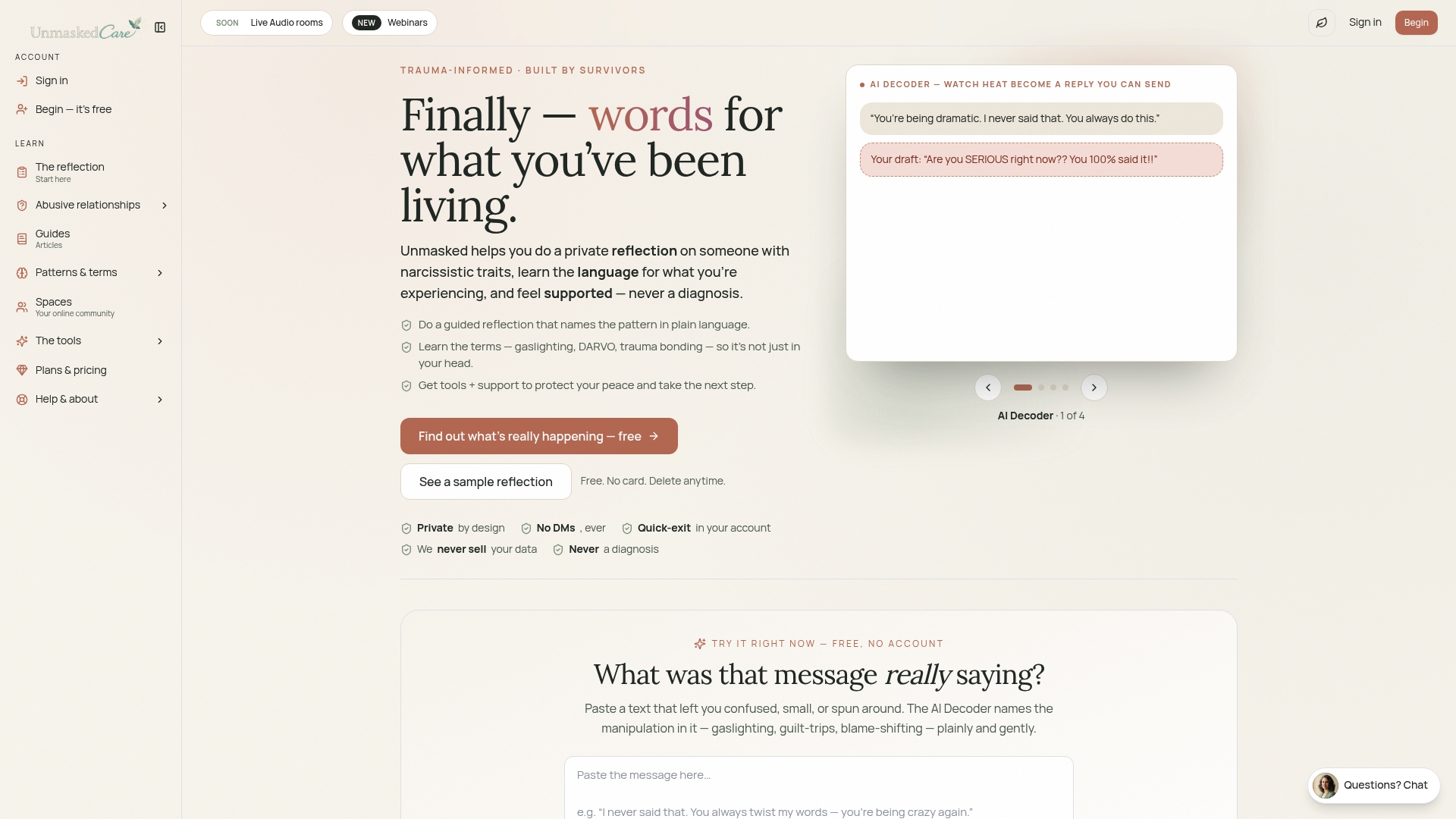
The paid tier adds the personalized reflection tool, which walks you through your specific pattern rather than a generic template, along with the AI Decoder for breaking down confusing messages and the private evidence file for tracking recurring behavior over time without exposing it publicly. If you’re trying to understand a pattern you’re currently living through, starting with a concept like gaslighting or reviewing what DBT actually involves is a reasonable first step. From there, try a free reflection prompt and see whether the structure fits before deciding on an upgrade.
This article is general information, not a substitute for advice from a qualified doctor. Consult a qualified healthcare professional about your own circumstances before acting on anything here.