
Three DBT skills cover almost every relationship conflict: DEAR MAN gets a need met, GIVE keeps the relationship intact, and FAST protects self-respect. Try this right now: next time you need something small from someone, say what you observe, say what you want in one sentence, and stop talking. That’s DEAR MAN in miniature.
Each skill guards something different:
- DEAR MAN protects your objective, the actual thing you’re asking for.
- GIVE protects the relationship itself, especially during conflict.
- FAST protects your self-respect and your values.
This article is educational and not a diagnosis. It doesn’t replace therapy or crisis care. If you or someone you know is in danger, call or text 988 (Suicide & Crisis Lifeline) or contact the National Domestic Violence Hotline at 1-800-799-7233.
Pro Tip: Pick one low-stakes conversation this week to practice on; learning why daily communication is difficult can help you make this practice more effective by recognizing common barriers and overcoming them with clear steps like those outlined in why daily communication is difficult." Skills learned under pressure for the first time rarely go well; skills rehearsed on small stuff show up when it counts.
Key Takeaways
Choosing the right DBT skill before you speak, ranking objective, relationship, or self-respect, prevents most communication failures in close relationships.
| Point | Details |
|---|---|
| Three skills, three goals | DEAR MAN protects the objective, GIVE protects the relationship, FAST protects self-respect. |
| Rank before you speak | Decide which goal matters most in this specific conversation before starting it. |
| Rehearse low-stakes first | Practice scripts on small requests before using them in high-tension conversations. |
| Validation isn’t agreement | Acknowledging a feeling doesn’t require agreeing with someone’s version of events. |
| Safety comes before scripts | If a relationship involves threats or control, use Unmasked Care’s tools to reflect privately and reach 988 or 1-800-799-7233 if needed. |
Where to find DBT handouts and worksheets
- Interpersonal Effectiveness handouts — DEAR MAN, GIVE, FAST breakdown.
- Kaiser Permanente GIVE skill handout (PDF) — printable worksheet.
- DBT Skills Training Handouts and Worksheets (PDF) — priority-ranking exercises.
- UHCL interpersonal effectiveness handout (PDF) — acronym scripts and practice.
This article is general information, not a substitute for advice from a qualified doctor. Consult a qualified healthcare professional about your own circumstances before acting on anything here.
Table of Contents
- What Are DBT Interpersonal Effectiveness Skills?
- How Does DEAR MAN Help You Ask for What You Need?
- How Does GIVE Repair a Strained Relationship?
- How Does FAST Protect Your Self-Respect in Conflict?
- Should You Use DEAR MAN, GIVE, or FAST Right Now?
- How Do You Practice DBT Skills for Relationships?
- Where Unmasked Care Fits Into Practicing These Skills
- Sources
What Are DBT Interpersonal Effectiveness Skills?
Interpersonal effectiveness is one of four core modules in dialectical behavior therapy, alongside mindfulness, emotion regulation, and distress tolerance. It exists because most people, in the heat of an argument, default to either silence or escalation. Neither gets a need met or keeps the relationship steady.
DBT organizes interpersonal effectiveness around three goals, and clinical guidance emphasizes ranking them before you speak, not during the conversation:
- Objective effectiveness (DEAR MAN): getting a request granted or a “no” respected.
- Relationship effectiveness (GIVE): keeping trust and warmth intact even during disagreement.
- Self-respect effectiveness (FAST): leaving the conversation still liking how you handled it.
Picture these as three overlapping circles rather than a checklist. Most real conversations touch all three, but usually one matters more than the others in that moment. Official worksheets from DBT skills handouts walk through exactly this ranking exercise, and they’re worth printing out.
How Does DEAR MAN Help You Ask for What You Need?
DEAR MAN structures a request or a refusal so it lands clearly instead of getting lost in over-explaining or apology. Each letter is a move, not a mood:
- Describe the situation in neutral, factual terms.
- Express your feelings with “I” statements, not accusations.
- Assert the actual ask, out loud, as a full sentence.
- Reinforce by naming what happens if the request is granted.
- Mindful: stay on topic even if the other person tries to redirect.
- Appear confident: steady voice, steady eye contact, no shrinking.
- Negotiate: offer or accept a middle ground when it’s reasonable.
Low-stakes script (roommate): “The dishes have been in the sink for three days [Describe]. It’s stressing me out [Express]. Can you wash them tonight [Assert]? I’ll handle trash pickup this week if that helps [Negotiate].”
Higher-stakes script (partner or manager): “We’ve missed our last two check-ins [Describe]. I’m starting to feel out of the loop on this project [Express]. I need a fifteen-minute update every Friday [Assert]. That’ll keep both of us from scrambling before deadlines [Reinforce].”
Three-step drill: decide your one objective, write it as a single sentence, then say it out loud twice before the real conversation. Rehearsal in low-stakes situations first is what makes the skill usable later.
Pro Tip: Drop your voice half a register and slow down by about 20 percent. Most people who “sound aggressive” are actually just talking too fast.
How Does GIVE Repair a Strained Relationship?
GIVE exists for the moments when the relationship matters more than winning the point. It works through de-escalation rather than persuasion, using four behaviors: Gentle (no attacks, no threats), Interested (actually listen, don’t just wait to talk), Validate (name their feeling as real even if you disagree with their conclusion), and Easy manner (a little warmth, maybe a small joke, to keep the temperature down).
Validation phrases you can adapt:
- “That makes sense given what you were dealing with.”
- “I can see why that felt unfair to you.”
- “It sounds like you were really overwhelmed.”
- “I get why you’re angry about this.”
Repairing trust after conflict follows a rough sequence: acknowledge what happened, validate the feeling behind it, make a specific amend, then follow through visibly over the following days. Clinicians note that validation acknowledges someone’s internal experience without agreeing to their version of events, which matters when the other person’s account isn’t accurate but their hurt is real.
GIVE assumes both people are safe to be gentle with. If a conversation involves threats, control, or fear of retaliation, gentleness is not the priority; safety is. If that describes your situation, Unmasked Care’s red-flags checklist can help you sort a rough patch from a pattern, and the crisis lines above are there if things escalate: 988 or 1-800-799-7233.
Pro Tip: Validate the feeling, not the story. “You felt dismissed” can be true even when “you dismissed me on purpose” isn’t.
How Does FAST Protect Your Self-Respect in Conflict?
FAST keeps you from trading your values for peace. Fair means fair to yourself, not just the other person. (No unnecessary) Apologies means you stop saying sorry for having needs or opinions. Stick to values means you don’t cave just because someone pushes back. Truthful means no exaggerating and no playing dumb to avoid conflict.
Refusal phrases that stay fair and firm:
- “I’m not able to do that, but I can help another way.”
- “That doesn’t work for me this time.”
- “I hear you, and my answer is still no.”
A boundary template worth memorizing: “I know this is something you want, and I’m not able to say yes to it. This isn’t about you, it’s what I need right now.” Say it once, then stop explaining. Over-explaining is usually the apology in disguise.
Should You Use DEAR MAN, GIVE, or FAST Right Now?
Before speaking, rank what matters most in this specific conversation: the objective, the relationship, or your self-respect. Ask yourself:
- If I get nothing else, what’s the one outcome I actually need? If it’s a concrete result (a schedule change, a returned item, a plan confirmed), lean DEAR MAN.
- If the relationship itself is fragile right now, is repair more urgent than being right? If yes, lean GIVE.
- Am I at risk of agreeing to something I’ll resent, just to avoid conflict? If yes, lean FAST.
Scenario A: Asking a coworker to stop taking credit for your work. The objective matters most: DEAR MAN, with GIVE layered in for tone.
Scenario B: A partner who feels neglected after a hard week. The relationship matters most here: lead with GIVE, and only assert a request once they feel heard.
Skills often layer. Safety always outranks all three.
How Do You Practice DBT Skills for Relationships?
Reading a script and using it under pressure are different skills. Bridge that gap with short daily repetition rather than one long study session.
- Days 1 to 3: Read one script aloud, alone, once per day.
- Days 4 to 6: Record yourself saying it on your phone and listen back.
- Days 7 to 9: Rehearse it as a mini role-play with a friend playing the other person.
- Days 10 to 12: Use it in one real, low-stakes situation.
- Days 13 to 14: Apply it in a moderate-stakes conversation and journal the outcome.
Role-play prompts to try: a friend cancels plans last minute for the third time; a family member brings up a sensitive topic at dinner; a coworker interrupts you in every meeting.
After each rehearsal, ask: What did my body do when I got nervous? Did I over-apologize? Did I stay on topic, or get pulled into a side argument?
Emotional flooding, over-apologizing, and mistaking assertiveness for aggression are the three most common snags. Experts note that DBT is meant to be dialectical: firm on the ask, warm in delivery, not one or the other. If flooding hits mid-conversation, pause and use a distress-tolerance skill like paced breathing before continuing; forcing the script through panic usually backfires.

If practicing a script ever feels unsafe, physically or emotionally, stop and reach out for support. 988 connects to the Suicide & Crisis Lifeline, and 1-800-799-7233 reaches the National Domestic Violence Hotline.
Pro Tip: Journal one line after every rehearsal: “What I’d say differently next time.” That single sentence compounds faster than the rehearsal itself.
How clinicians frame this work
Clinicians tend to treat DEAR MAN, GIVE, and FAST as a balancing act between acceptance and change, not a rulebook to follow rigidly. The recommended move is ranking priorities before the conversation starts, not mid-argument. Mindfulness and emotion regulation typically come first in practice, since a flooded nervous system can’t execute a script. None of this describes fixed traits. These are learnable behaviors, and this section is educational, not a diagnostic tool.
Where Unmasked Care Fits Into Practicing These Skills
Scripts help most when you’ve had space to think before you send them, which is exactly what gets lost in a heated text exchange. Unmasked Care’s guided reflection tools give you structured prompts to sort out what you actually want to say before you say it, and the AI Decoder helps you read a manipulative or confusing message and prepare a response instead of reacting in the moment.
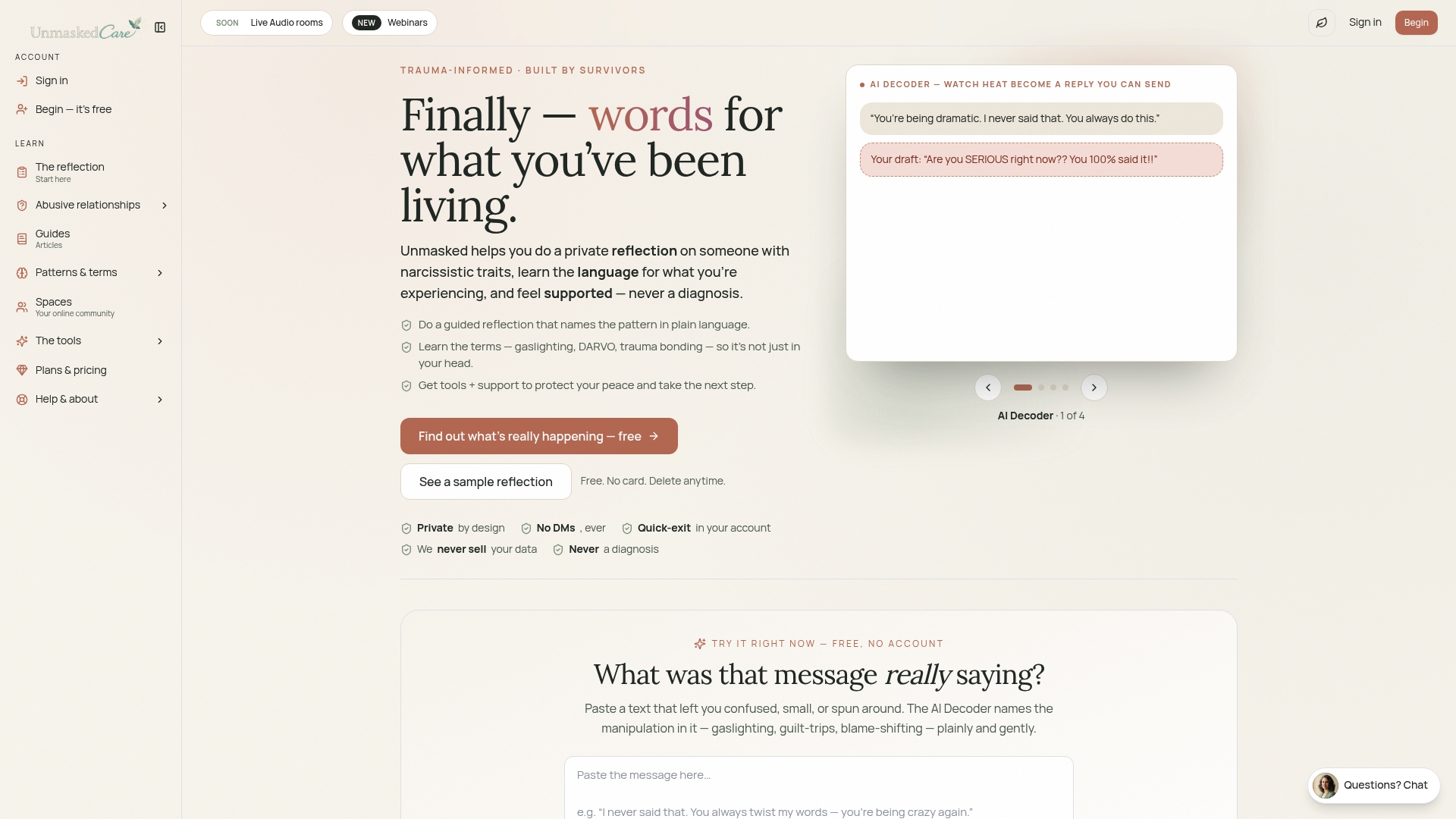
This isn’t a replacement for the rehearsal work above. It’s a private space to draft a DEAR MAN request, check whether a reply from someone else is actually GIVE-compatible, or hold onto a record of a conversation without relying on memory alone. The platform also includes a private evidence file for anyone who wants a documented history of difficult exchanges. Start by trying the AI Decoder on a real message you’re unsure how to answer.
Sources
- Interpersonal Effectiveness DBT Skills (handout) | Kaiser Permanente
- Dialecticalbehaviortherapy
- DBT skills: Interpersonal effectiveness handout (UHCL)