
If you feel unsafe right now, call 988 (Suicide & Crisis Lifeline) or 1-800-799-7233 (National Domestic Violence Hotline, also reachable at 800-799-SAFE). Both operate around the clock with live advocates.
An emotional abuse safety plan is a short, personalized set of actions you can use right now to protect your emotional and physical well-being. It doesn’t require a lawyer, a therapist, or a perfect exit strategy. It requires a plan you can act on quickly.
- Move to a room with a door and, if possible, a phone charger.
- Agree on a code word with one trusted contact that signals “call for help” without alerting anyone else.
- Gather essential documents (ID, cards, medication) into one grab-ready spot.
- Save screenshots or notes about recent incidents somewhere the other person can’t reach.
Pro Tip: Store your plan and any evidence in a password-protected notes app or with a trusted friend, never on a shared device or family computer.
This article is educational content, not a diagnosis or a substitute for a licensed advocate. If you can, reach out to a local domestic violence advocate who can help adapt these steps to your exact situation.
Key Takeaways
An effective emotional abuse safety plan combines immediate crisis steps, a support network, secure documentation, and a flexible timeline that adapts as circumstances change.
| Point | Details |
|---|---|
| Call the right number first | Use 988 for crisis support or 1-800-799-7233 for domestic violence guidance if you feel unsafe now. |
| Build the core components | Cover danger signals, safe people, a go-bag, documentation, tech privacy, and financial access. |
| Practice before you need it | Rehearse your code word and check-in routine with a trusted contact ahead of any crisis. |
| Store evidence off shared devices | Keep dated notes and screenshots in a private account or offsite drive an abuser can’t access. |
| Watch the post-leaving window | Risk of backlash often rises in the two weeks after separation, so plan extra caution then. |
| Use Unmasked Care to secure your plan | Its private evidence file and AI Decoder help you document patterns and store your plan safely. |
Quick List of Trustworthy Resources
A local domestic violence advocate can help you adapt any of these to your specific situation safely.
This article is general information, not a substitute for advice from a qualified doctor. Consult a qualified healthcare professional about your own circumstances before acting on anything here.
Table of Contents
- What Is an Emotional Abuse Safety Plan?
- What Belongs in an Emotional Abuse Safety Plan?
- How Do You Create a Safety Plan Step-by-Step?
- What Should You Document, and Where Should You Keep It?
- How Do You Stay Emotionally Steady While Planning?
- Build and Store Your Safety Plan With Unmasked Care
- Sources
What Is an Emotional Abuse Safety Plan?
An emotional abuse safety plan is a personalized, proactive set of steps designed to protect your emotional and physical well-being while you’re experiencing abuse, preparing to leave, or already rebuilding your life afterward. It’s not a legal document and it’s not therapy. It’s a working tool, closer to a fire drill than a prediction: you decide in advance what you’ll do if things escalate, so you’re not making critical decisions in the middle of a crisis.
- Emotional safety planning works alongside physical safety planning, not instead of it.
- The plan should flex as your circumstances change; it’s not something you finish once and file away.
- This is general education, not a clinical or legal diagnosis of your relationship or your partner.
What Belongs in an Emotional Abuse Safety Plan?
A workable plan covers both what’s happening in your mind and what’s happening around you. Skipping either half leaves gaps.
Danger signals and triggers. Name the specific behaviors, tones of voice, or situations that tend to precede an escalation. Recognizing a pattern early gives you more time to act instead of react.
Support network. List at least one person who can offer transport or a place to stay, and one who can call emergency services on your behalf, according to safety-planning guidance from Advocates Against Family Violence. Agree on your code phrase now, while things are calm.

Safe spaces. Identify a physical spot, at home or nearby, with an exit and a way to communicate. The Hotline’s guidance on emotional safety also recommends designing a peaceful space you can retreat to mentally and physically, even if it’s just a corner of a room.
Go-bag and documents. Pack a bag you can grab without thinking. According to Womenshealth, prioritize:
- Birth certificates, passports, or immigration papers
- Health insurance cards and a list of medications
- Financial records, recent tax returns, and bank cards
- Housing documents and spare keys
- Emergency cash and copies of important contact numbers
Documentation and evidence. Keep dated notes of incidents somewhere secure and separate from your everyday devices.
Tech and online safety. Assume shared accounts and devices can be monitored; treat your safety plan the way you’d treat a spare set of keys, kept somewhere the other person doesn’t check.

Financial access. Know where you’d get cash or open a new account if you needed to move quickly.
Children and custody. If you have kids, plan for their school pickup logistics, comfort items, and who else is authorized to collect them.
Pro Tip: Hide your plan in plain sight. A password-protected notes app, a locked file with a trusted friend, or a safe deposit box all work better than a printed page in a drawer.
How Do You Create a Safety Plan Step-by-Step?
Building a usable plan takes less time than most people expect. It just needs a sequence.
- In the next hour: Identify your nearest safe space and your one call-for-help contact. Confirm your code word.
- Within 24 hours: Locate your key documents and photograph them in case originals get left behind.
- Within the first week: Set up a private storage method for evidence and copies of documents, separate from any shared device.
- Within the first month: Build out your financial backup (a small stash of cash, a separate account if feasible) and identify housing options if leaving becomes necessary.
- Before or after leaving: Advocates note that the two weeks following separation often carry the highest risk of backlash, so plan increased caution and check-ins during that window specifically.
Practice your code word with your safe contact the way you’d practice a fire drill, calmly, before you ever need it for real. A short, awkward rehearsal now beats confusion later.
A one-page template works best: list your code word, your two safe contacts, your safe space, your go-bag location, and three grounding actions you’ll take if you feel triggered. Print it if you can store it securely, or keep a digital copy in a private, password-protected file such as Unmasked Care’s evidence storage feature.
What Should You Document, and Where Should You Keep It?
Specific, dated records matter more than general impressions. Note the date, time, what was said or done, and who witnessed it. Save screenshots of messages, photos of any property damage, and copies of financial records that show controlling behavior.
- Use a personal email account the other person has never had access to.
- Store copies on an external drive kept offsite, or with a trusted contact.
- Avoid shared laptops, tablets, or cloud accounts that sync automatically.
These records can matter later for restraining orders or custody proceedings, so keep at least one copy outside your home.
How Do You Stay Emotionally Steady While Planning?
Planning under stress taxes your nervous system as much as your schedule. A few grounding tools help you think clearly enough to act.
Try the 5-4-3-2-1 method: name five things you see, four you can touch, three you hear, two you smell, one you taste. Paired with slow, paced breathing, it can interrupt a panic spiral in under two minutes. Short journaling prompts, like writing down one true thing about today, also help create distance from the moment.
Set small, achievable goals rather than trying to solve everything at once. Advocates specifically point to concrete first steps like contacting a helpline or identifying one safe space, since incremental progress builds confidence without the overwhelm of a full exit plan. If you notice thoughts of self-harm, contact 988 immediately. A clinician can also help screen for trauma-related symptoms if things feel unmanageable.
Pro Tip: Protect your sleep and schedule short “micro-rests,” even five minutes between tasks, when you’re in an active planning phase.
Why a Personalized Emotional Safety Plan Matters
Emotional and physical safety are linked; a plan that ignores one to focus only on the other leaves gaps. Because leaving and healing rarely move in a straight line, the strongest plans stay flexible enough to match wherever you actually are today, not where a checklist assumes you should be.
Build and Store Your Safety Plan With Unmasked Care
Writing a plan is one thing. Keeping it somewhere the other person can’t find or delete is another problem entirely, and it’s the one most templates ignore.
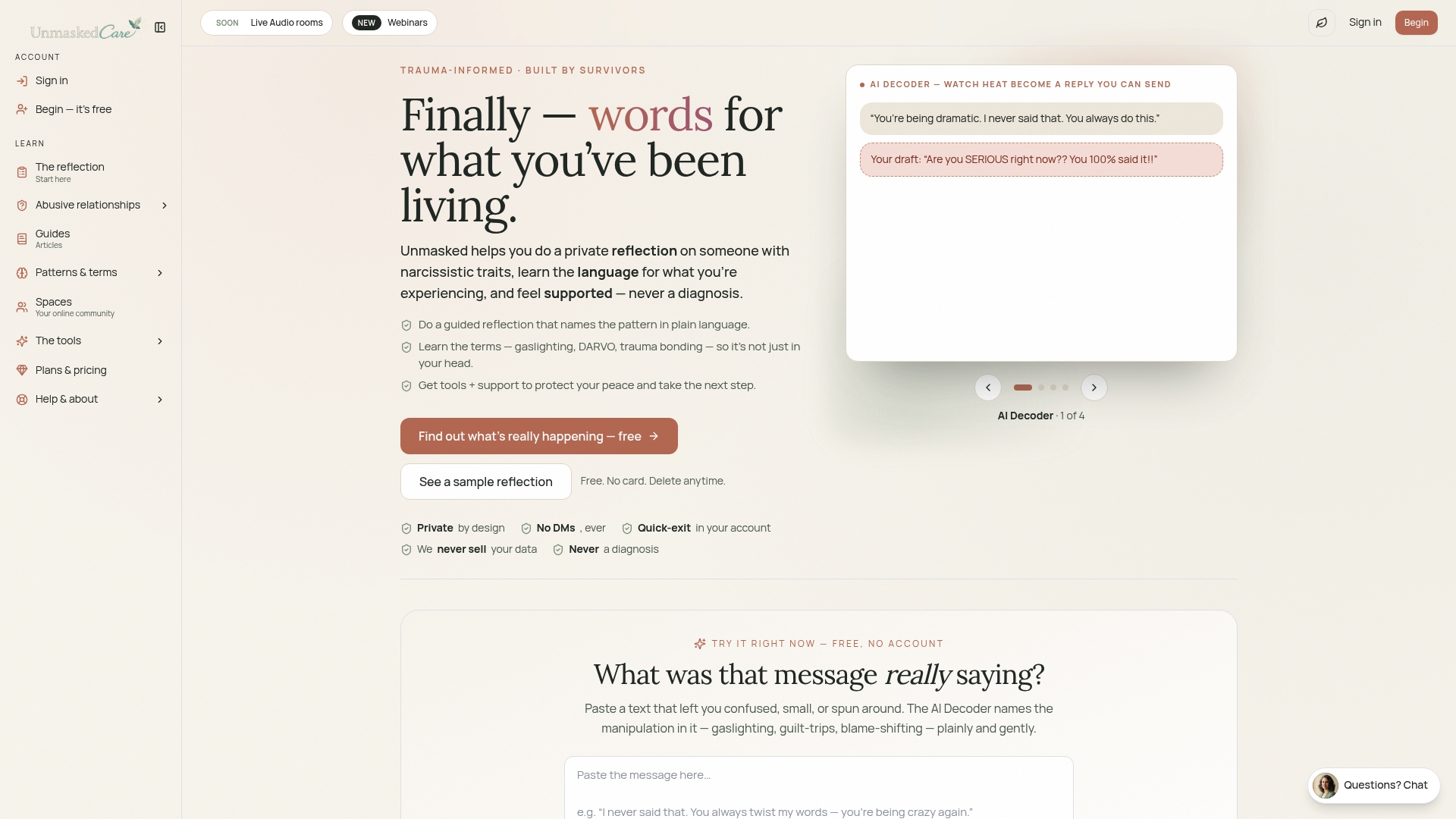
Unmasked Care gives you a private space to do both. Its guided reflection tool helps you translate what’s happening into a clear, one-page plan, using precise language instead of vague dread. The AI Decoder helps you name manipulation tactics in real messages, so you can document specific patterns instead of just a feeling that something’s wrong. And because the evidence file feature is privacy-focused by design, your notes, screenshots, and plan stay off shared devices where they could be found or deleted.
If you’re not sure where to start, the red-flags checklist is a fast, printable first step you can complete in a few minutes today.
Sources
- Planning for Emotional Safety - The Hotline
- Womenshealth
- Appendix D—Sample Personalized Safety Plan For Domestic …