
For survivors of narcissistic or borderline relationship abuse, the safest option is a moderated, trauma-informed live audio room, not an open, unmoderated chat. Unmasked Care runs audio rooms built around that principle, pairing trained facilitation with privacy controls designed for people who fear being tracked or identified by a former partner. The biggest protective factor is active moderation combined with anonymity settings that keep your identity separate from what you share.
Before joining any room, check a few things first:
- Confirm a moderator is present and their role is disclosed.
- Look for a written crisis policy and clear escalation steps.
- Verify you can join under an anonymous display name.
Unmasked Care’s live audio rooms are built around all three. You can review the features before your first session to see exactly what’s included.
Key Takeaways
Moderated, trauma-informed audio rooms reduce harm and build trust faster than unmoderated forums, and privacy controls determine whether survivors feel safe enough to speak at all.
| Point | Details |
|---|---|
| Moderation changes behavior | Active moderation cut toxic language roughly fivefold in a large analysis of mental health conversations. |
| Match format to risk level | Choose closed, screened cohorts if abuser contact or infiltration is a real concern. |
| Protect identity first | Use a neutral display name and avoid sharing identifying details in any room. |
| Know the crisis line | Call or text 988, or call 1-800-799-7233 for domestic violence support, in any emergency. |
| Unmasked Care fits the criteria | Its audio rooms combine trained moderation, anonymity settings, and an AI Decoder for message analysis. |
This article is educational and does not diagnose any individual or relationship. If you recognize these patterns in your own life, consider reaching out to a licensed professional for personalized guidance.
This article is general information, not a substitute for advice from a qualified doctor. Consult a qualified healthcare professional about your own circumstances before acting on anything here.
Table of Contents
- What Should You Check Before Joining a Mental Health Audio Room?
- Which Audio Room Format Fits Your Situation?
- Why Does Active Moderation Matter So Much?
- How Do You Join Safely and Protect Your Privacy?
- What Topics Come Up in These Rooms?
- How Are Rules Enforced Inside These Communities?
- Are Audio Rooms Enough on Their Own?
- What the Research Actually Supports, and Where Common Advice Falls Short
- Why Unmasked Care’s Audio Rooms Are Built for This Exact Situation
- Sources
What Should You Check Before Joining a Mental Health Audio Room?
Not every audio room labeled “support” is actually safe for someone recovering from narcissistic or borderline abuse. Some are unmoderated free-for-alls where the loudest voice sets the tone. Others look organized but never disclose who’s actually running the room or what happens if a conversation turns hostile.
Run through this before you commit your time or your story to a room:
- Moderator presence and training. A room should tell you who is moderating and what background they have, whether that’s peer support certification, social work training, or clinical supervision. Vague credentials are a red flag.
- Written house rules and a crisis policy. Legitimate rooms post rules covering hate speech, cross-talk, and what happens during a mental health emergency.
- Privacy controls. Look for anonymous display names, options to delete your data, and an explicit no-screenshot or no-recording policy.
- Session format details. Group size limits, speaking time guidelines, and whether the room is open to anyone or closed to a screened cohort should be stated upfront, not buried.
- Inclusive, culturally aware facilitation. Peer support specialists point to emotional safety and trauma-informed, culturally humble facilitation as core requirements for groups serving survivors, not an afterthought.
Pro Tip: Message a moderator privately before your first session and ask one direct question, like how they handle someone disclosing active danger. A thoughtful, specific answer tells you more than any bio.
Which Audio Room Format Fits Your Situation?
Audio rooms for abuse recovery come in a handful of common shapes, and picking the wrong one for your situation can leave you feeling more exposed, not less.
- Drop-in moderated rooms work well when you need to talk right now. They’re low commitment and good for diverting a spiral, though the tradeoff is less continuity since the group changes every session.
- Scheduled peer groups meet on a recurring basis with a stable roster, which builds the kind of familiarity that makes disclosure easier over time.
- Expert or facilitator-led sessions bring in someone trained to guide boundary-setting conversations or explain concepts like DARVO in real time, useful when you need more structure than peer chat provides.
- Closed, screened cohorts vet participants before admission. If you’re worried an abuser could infiltrate a room, or you’re still in contact with one, this format matters most.
The core tradeoff across all four is anonymity versus intimacy. Drop-in rooms protect anonymity well but limit depth. Closed cohorts build trust and depth but require more upfront vetting, which some survivors find reassuring and others find like one more hoop to jump through. None of these formats need to stand alone. Many survivors pair a drop-in room for acute moments with a scheduled group for ongoing support, and use follow-up resources like narcissistic abuse recovery guides between sessions to process what came up.
Why Does Active Moderation Matter So Much?
Moderation is not a nice-to-have feature. It changes how people actually behave in the room.
An analysis of 200,000 messages across 7,000 online mental health conversations found that active moderation cut toxic language roughly fivefold and increased sustained engagement, with participants sharing more candidly and showing stronger signs of trust once a moderator was present. That’s a measurable behavioral shift, not a vague feel-good claim.
The data point that matters: Moderated mental health conversations saw toxic language drop roughly fivefold compared to unmoderated ones, according to the same arXiv/NSF analysis.
Moderators generally fall into two roles. Some function mainly as rule enforcers, muting, warning, or removing people who violate house rules. Others act closer to de facto counselors, actively steering conversation, naming manipulation tactics, and knowing when a comment needs gentle redirection rather than punishment. Platforms serving survivor communities, including moderator models described in research on trained peer support moderators, typically train staff to edit or intervene before harm compounds, and to escalate to clinical supervision when someone discloses immediate danger.
Before you join a room, verify it has privacy controls and AI features designed for therapists that help keep your information safe without compromising support.
- A visible reporting function you can use mid-session.
- Mute, block, and ban capability the moderator can act on immediately.
- A clear workflow for what happens after a report, not just a button that leads nowhere.
- Some form of harm detection, whether human review or AI-assisted flagging.
If you or someone in a room is in immediate crisis, call or text 988 for the Suicide & Crisis Lifeline. If the danger involves a partner or ex-partner, contact the National Domestic Violence Hotline at 1-800-799-7233. No peer moderator, however well trained, replaces that resource in an emergency. Also skip any room that requires excessive personal data upfront or offers no way to delete your history. That’s a privacy risk regardless of how well the conversation itself is moderated.
How Do You Join Safely and Protect Your Privacy?
Getting into a room is the easy part. Protecting yourself while you’re in it takes a little preparation.
- Set up a neutral profile. Use a display name and photo with no connection to your real identity or your abuser’s contacts, a step privacy researchers specifically recommend for survivors worried about being tracked.
- Read the house rules and moderator bios first. If a room can’t tell you who’s running it, that’s information in itself.
- Listen before you speak. Sit in quietly for a few minutes to gauge tone and pacing before deciding whether to share.
- Decide your boundaries in advance. Know what you will and won’t disclose, and have an exit plan if a topic feels too close.
- Use in-session tools without hesitation. Mute, block, report, or leave the moment something feels wrong. You don’t owe anyone an explanation.
- Debrief afterward. Jot down what triggered you, save any resources mentioned, and reach out to a trusted person if you’re comfortable doing so.
Pro Tip: Keep a private note (not shared in the room) listing phrases or topics that tend to trigger you. Reviewing it beforehand makes it much easier to notice, in real time, when a conversation is heading somewhere you don’t want to go.
What Topics Come Up in These Rooms?
Survivor-focused audio rooms tend to circle a consistent set of themes, and knowing them ahead of time helps you pick a session that matches what you actually need that week.
Common topics include recognizing gaslighting and other manipulation patterns, understanding the narcissistic abuse cycle of idealization and devaluation, processing grief over a relationship that never was what it seemed, and rebuilding decision-making confidence after prolonged control. Sessions also address co-parenting with a high-conflict ex, navigating family members who minimize the abuse, and setting boundaries with someone who uses future faking or intermittent reinforcement to stay connected.

Some rooms focus narrowly, like a single hour on legal documentation or safety planning. Others run open-topic sessions where whatever is heaviest that day takes priority. Neither approach is inherently better; it depends on whether you want structure or flexibility on a given night. What matters is that the room’s topic focus is stated clearly beforehand so you’re not caught off guard mid-session by content you weren’t ready for.
This coverage is educational, not a diagnosis of you or anyone else. Audio rooms describe patterns and behaviors, and a moderator or peer naming a pattern in the room is not the same as a clinical assessment.
How Are Rules Enforced Inside These Communities?
Guidelines only work if there’s a real mechanism behind them. A posted rules page means little if nobody enforces it consistently.
Well-run survivor rooms typically publish specific, behavior-based rules: no unsolicited advice-giving, no minimizing another person’s experience, no naming or identifying a specific abuser by full detail, and no recording or screenshotting. Enforcement usually escalates in stages, a verbal reminder first, then a temporary mute, then removal for repeat or severe violations. The strongest rooms give moderators the authority to act in real time rather than requiring a slow review process while harm continues.
Some communities also use peer reporting, where any participant can flag a comment for moderator review, plus periodic moderator check-ins during longer sessions to make sure no one has been talked over or ignored. What separates a well-enforced room from a rules page nobody reads is whether the moderator visibly acts, muting a disruptive voice, checking in on someone who went quiet, before things escalate rather than after.

Are Audio Rooms Enough on Their Own?
Live audio support fills a real gap. It’s immediate, it doesn’t require scheduling weeks out like traditional therapy often does, and hearing someone else describe the exact manipulation tactic you experienced can be validating in a way that reading about it never quite matches.
It has real limits, though. Audio rooms are not equipped to handle ongoing clinical symptoms like severe depression, dissociation, or trauma responses that need sustained, individualized treatment. Peer support is designed to complement professional therapy, not substitute for it, particularly when symptoms are persistent or severe. A room also can’t offer legal advice, safety planning for physical danger, or diagnosis, even when a compassionate peer or moderator is doing their best.
Compared to text-based forums, audio rooms tend to feel more immediate and harder to misread, tone carries information text can’t. Compared to one-on-one therapy, they offer community and shared recognition that individual sessions don’t provide, but less individualized depth. The realistic approach treats audio rooms as one part of a support structure, alongside things like a searchable therapist directory for people who need clinical care alongside peer connection.
What the Research Actually Supports, and Where Common Advice Falls Short
Most general advice about online support groups treats moderation as a courtesy feature, something a good platform happens to include. That framing undersells it. The research on moderated mental health conversations shows moderation changes the actual content of what people say, not just the politeness level. Toxic language drops, and people share more candidly. For survivors specifically, that’s not a comfort feature. It’s the difference between a room where disclosing abuse feels safe and one where it invites another layer of harm.
The conventional advice to “just find a support group” also skips a step that matters enormously for this audience: screening for abuser risk. A generic support forum assumes everyone in the room wants the same thing. A closed, screened cohort assumes someone might be trying to get in who shouldn’t be there, which is a very different design problem, and one general wellness advice rarely addresses.
Readers should prioritize moderation credentials and privacy controls before anything else, including topic focus or schedule convenience. A well-run room on a topic you don’t love beats a poorly moderated room on the exact topic you need.
— Unmasked Care Team
Why Unmasked Care’s Audio Rooms Are Built for This Exact Situation
Unmasked Care exists because generic support forums weren’t built with narcissistic or borderline abuse dynamics in mind, and that gap shows up fastest in live conversation. Its audio rooms pair trauma-informed facilitation with the privacy architecture survivors actually need: anonymous display names, no forced identity disclosure, and moderators trained to recognize manipulation patterns like DARVO in real time.
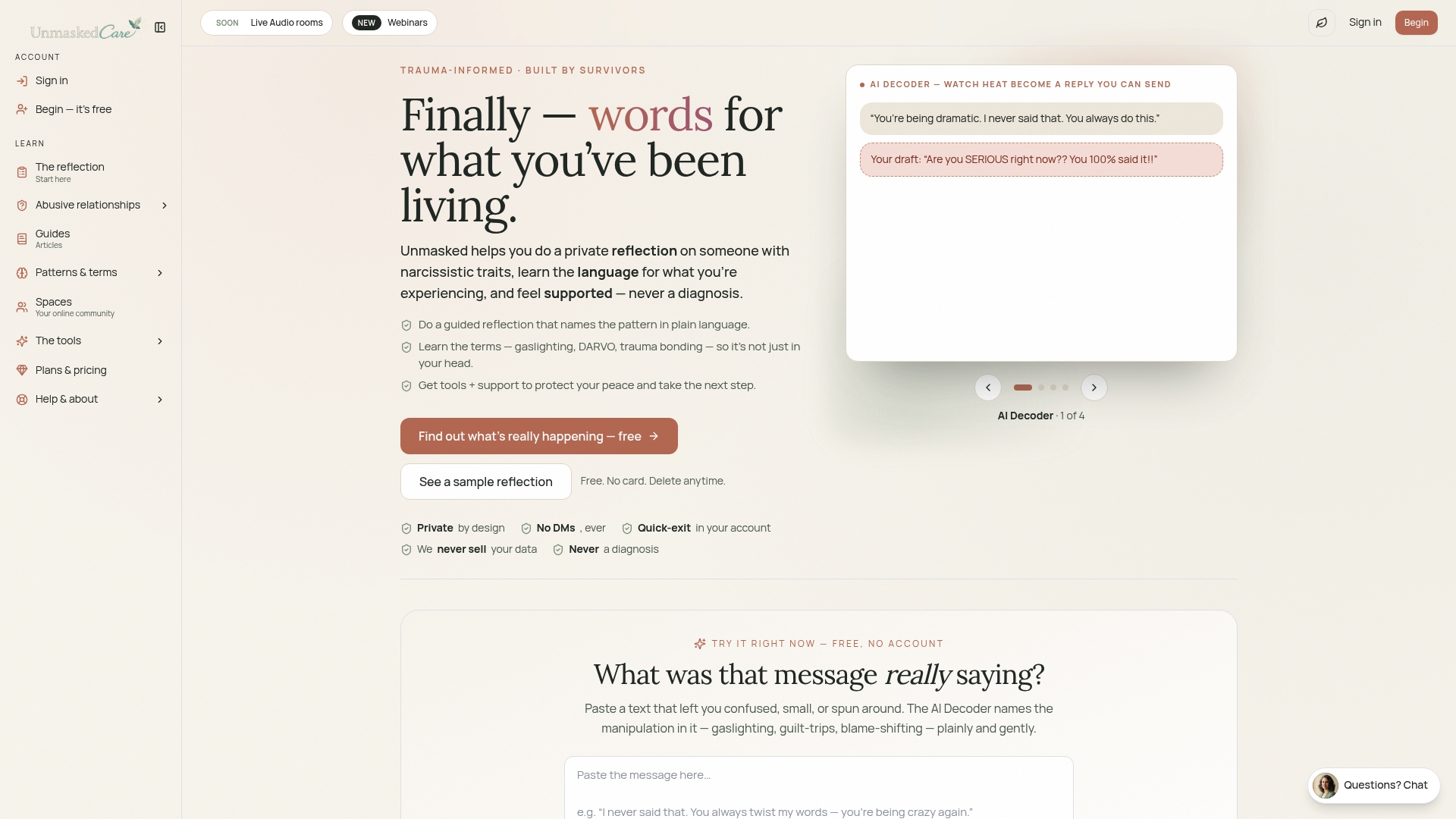
Free access covers the community forums, webinars, and educational library, including the gaslighting and DARVO breakdowns many survivors read before their first session. Paid tiers unlock deeper tools: personalized written reflections, the AI Decoder for parsing manipulative messages, and a privacy-focused evidence file for anyone documenting a pattern over time. You can try the free AI Decoder right now if you want something practical before you even join a room.
None of this replaces therapy for persistent symptoms, and Unmasked Care’s own therapist directory exists specifically because peer support has limits. Start by checking the features page to see current room schedules and pick your first session. If you’re in crisis, call or text 988, or reach the National Domestic Violence Hotline at 1-800-799-7233.
Sources
- The effect of moderation on online mental health conversations (arXiv/NSF)
- Peer support and trauma‑informed approaches (PMC article)