
If you’re searching for Talkspace alternatives because you’re dealing with narcissistic or borderline relationship abuse, general teletherapy platforms aren’t what you need. Unmaskedcare is the strongest specialized alternative for survivors in the United States, built specifically around the tools that matter most in this situation: a private evidence file, an AI message decoder that names manipulation tactics by their clinical terms, a trauma-informed community with anonymous participation, and a searchable therapist directory filtered for abuse specialization.
Three things set Unmaskedcare apart from generic virtual therapy options:
- Privacy and evidence tools: Secure, non-shared evidence file storage with timestamped logs you can export for legal use, controlled entirely by you.
- AI message decoder: Paste a manipulative message and get a plain-language breakdown of the tactic being used, whether that’s future-faking, DARVO, or coercive control.
- Specialized community and clinician access: Moderated forums with optional anonymous profiles, live audio rooms, weekly webinars, and a therapist directory filtered for narcissistic and borderline abuse training.
Free access covers the education library, community forums, and a decoder demo. Paid tiers unlock full AI reflections, exportable evidence files, and priority support. If you’re in immediate danger, contact the National Domestic Violence Hotline at 1-800-799-7233.
Table of Contents
- What must a survivor-focused platform actually offer?
- How Unmaskedcare maps to every item on that checklist
- How to document abuse safely and protect your records
- What should you expect to pay, and what’s actually free?
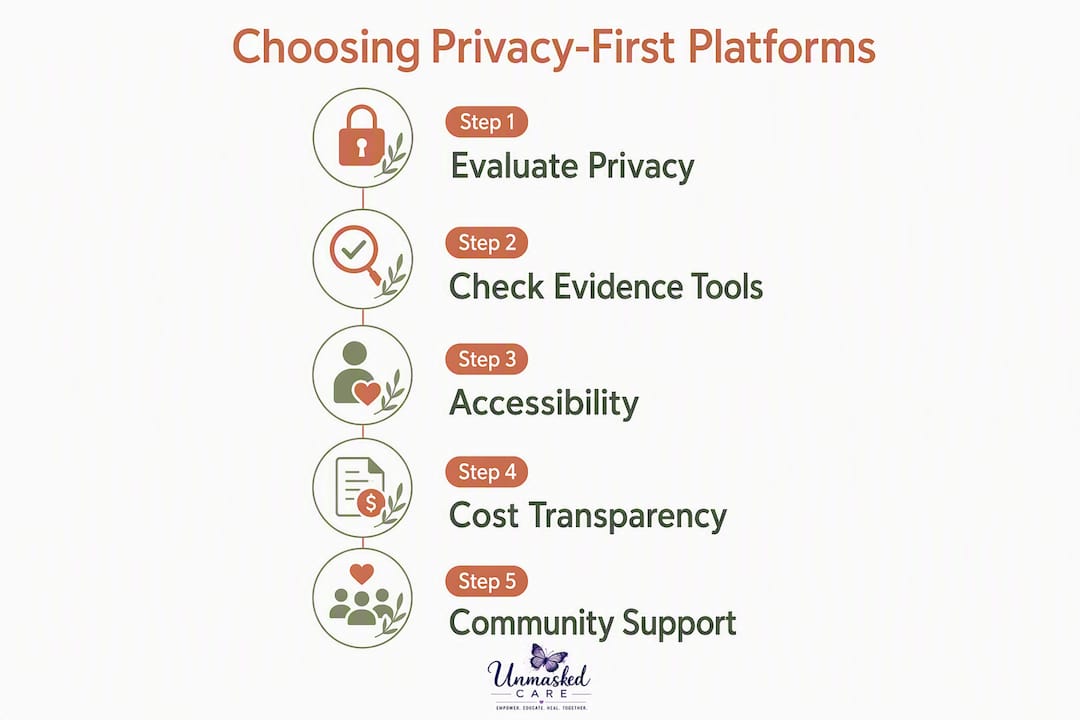
- How to choose a platform in 15 minutes or less
- Key Takeaways
- Why privacy and evidence tools came first
- Unmaskedcare gives you a real starting point today
What must a survivor-focused platform actually offer?
Most therapy apps like Talkspace are built for general mental wellness. Survivors of narcissistic or borderline abuse need a different set of features entirely. Before signing up for any platform marketed as a specialized alternative, check for all of the following:
- Data ownership and deletion controls: You must be able to delete your account and all associated data on demand, with no retention period that could expose records to a subpoena or a tech-savvy abuser.
- Encrypted, non-shared evidence storage: Files should be encrypted at rest and in transit, stored in an environment the abuser cannot access, with timestamped logs that courts can read as contemporaneous records. Legal practitioners advise storing documentation in secure, non-shared digital environments specifically to prevent tampering.
- AI-powered message decoding or guided reflections: The platform should translate manipulative language into named tactics, such as gaslighting, DARVO, or future-faking, so you can see the pattern rather than just feel the confusion.
- Trauma-specialized clinician directory: Therapists and psychologists who provide written assessments can strengthen legal cases, particularly in custody disputes. The directory should filter for EMDR, somatic approaches, and narcissistic or borderline abuse training specifically.
- Moderated peer community with anonymous participation: Support groups built for narcissistic abuse give survivors a shared language that accelerates recovery in ways general therapy settings often miss. Moderation and anonymity are non-negotiable for safety.
- Accessible export workflows: Evidence files should export in formats attorneys can use, without requiring technical skill or extra fees.
How Unmaskedcare maps to every item on that checklist
Unmaskedcare was designed around this exact list. Here’s where each feature lands:
- AI message decoder: Paste a message, get a breakdown. The decoder names the tactic, explains the psychological mechanism, and suggests a grounded response. This is the feature that tends to produce the clearest “aha” moment for survivors who’ve been second-guessing their own perception.
- Community: Anonymous forums and live audio rooms let you participate without attaching your real name. Moderation is active, and the community already speaks the language of narcissistic and borderline abuse.
- Education library and webinars: Plain-language guides cover gaslighting, DARVO, coercive control, and recovery strategies. Live sessions run weekly and are included in free access.
- Therapist directory: The searchable directory filters for clinicians trained in narcissistic and borderline abuse, including EMDR and trauma-focused approaches.
Confirm the data-deletion workflow and export format before you upgrade, especially if legal action is possible.

How to document abuse safely and protect your records
Systematic, contemporaneous documentation is what converts a survivor’s lived experience into legally usable evidence. Here’s the core process:
- Log every incident the same day it happens. Include the date, time, location, what was said or done, and your exact emotional and physical reaction. Judges respond better to concrete, timestamped narratives than to summary statements written weeks later.
- Preserve message transcripts. Screenshot texts and emails with timestamps visible. Save voicemails as audio files with metadata intact.
- Collect financial and medical records. Statements showing financial control, medical records documenting stress-related conditions, and records of missed work all build the pattern.
- Note digital monitoring evidence. Location data, account access logs, and device activity can support claims of surveillance or isolation where admissible.
- Store everything in a secure, non-shared environment. A dedicated account the abuser cannot access, on a device they have never touched, with encrypted backups held offline.
Pro Tip: Create a separate email account, unlinked from your personal phone or any shared device, used only for evidence storage. Enable two-factor authentication on that account immediately. Keep a mirrored copy on an encrypted external drive stored somewhere the abuser cannot reach.
Recording laws vary by state. In many U.S. jurisdictions, one-party consent allows you to record a conversation you’re part of, but admissibility depends on your state and the specific context. Consult a trauma-informed attorney before relying on recordings. Trauma-informed legal advocates consistently improve legal outcomes and reduce the psychological cost of the process.
Platform privacy checkpoints to verify before uploading anything:
- Who owns your data after upload?
- What is the exact deletion timeline and process?
- Is data encrypted at rest and in transit?
- Can you export files in a format attorneys accept?
- Does the platform offer account anonymization?
What should you expect to pay, and what’s actually free?
Survivor-focused platforms typically gate their most protective features behind a paywall. Here’s what a reasonable structure looks like:
- Free tier: Education library, community forum access, basic AI decoder demo, and live webinar participation. These should be available without a credit card.
- Paid tier: Full AI reflections with personalized reports, exportable evidence files, priority support, and full access to the therapist referral directory.
Watch for these hidden costs before you commit:
- Per-file storage limits that charge for additional uploads
- Export fees or attorney-formatted report add-ons priced separately
- Pro-rata billing on cancellation that charges for a full month after you cancel mid-cycle
- Onboarding that delays evidence file access by several days
Unmaskedcare’s free tier is genuinely usable from day one. The education library and community are open immediately. The AI decoder demo gives you a real sense of the tool before you pay. Paid tiers unlock the full evidence file feature and complete AI reflections. Pricing is not publicly listed for all tiers; contact support or check the features page for current rates.
How to choose a platform in 15 minutes or less
Use this sequence before you enter any personal information:
- Confirm privacy basics. Ask: Can I delete my account and all data? Is storage encrypted? Can I anonymize my profile?
- Test the export workflow. Request a sample export or ask support what format evidence files use. If they can’t answer clearly, that’s your answer.
- Review the clinician directory. Filter for narcissistic abuse, borderline personality, EMDR, or trauma-focused training. A directory with no filters is a red flag.
- Try one community interaction. Post anonymously in a forum or attend a live session. Moderation quality shows up fast.
- Decide. If privacy, export, and clinician specialization all check out, start a trial.
Red flags that should disqualify a platform outright:
- No data deletion option or a vague “we retain data for business purposes” clause
- Shared data ownership with third parties
- No anonymous participation option
- Clinician directory with no trauma or abuse specialization filter
- Basic privacy features locked behind the highest-paid tier
- No response from support within 24 hours on a safety question
Accessibility checks worth running: Does the platform have a mobile app? Can you access critical documents offline or export them without an internet connection? Is support available in languages other than English? For survivors navigating high-conflict co-parenting situations, fast mobile access to evidence files can matter in real time.
For guidance on what intersectional factors a trauma-informed therapist should consider, The Therapy Canvas offers a practical breakdown of what culturally competent counseling looks like in practice.
Key Takeaways
Unmaskedcare is the strongest specialized alternative for survivors of narcissistic or borderline abuse because it combines private evidence storage, AI message decoding, and a trauma-informed community in one platform.
| Point | Details |
|---|---|
| Specialized beats general | Platforms built for narcissistic abuse give survivors a shared language and targeted tools that general therapy apps miss. |
| Evidence files are the priority feature | Secure, timestamped, exportable logs are what convert lived experience into legally usable documentation. |
| Verify before you upload | Confirm data deletion, encryption, and export format with support before storing any sensitive records. |
| Free tier is a real starting point | Education, community, and a decoder demo are available without payment on Unmaskedcare. |
| Unmaskedcare maps to the full checklist | AI Decoder, evidence files, anonymous community, therapist directory, and webinars are all available in one platform. |
Why privacy and evidence tools came first
The conventional wisdom in mental health tech is that therapy access is the bottleneck. Build a directory, connect people with therapists, and the rest follows. That framing misses something critical for survivors of narcissistic or borderline abuse: the problem isn’t just access to a therapist. It’s that survivors often arrive at therapy without language for what happened to them, without documentation that supports their account, and without a community that already understands the specific dynamics at play.
When abusers use legal proceedings as an extension of coercive control, meticulous documentation doesn’t just help survivors feel heard. It can shift the legal outcome. That’s why Unmaskedcare’s product design started with the evidence file and the AI decoder, not with a therapist marketplace. The best resources for narcissistic abuse recovery combine clinical language, community validation, and practical tools. Therapy is one part of that. Documentation, language, and peer support are the others.
If you’re unsafe right now, don’t wait for a platform evaluation. Contact the National Domestic Violence Hotline at 1-800-799-7233 or text START to 88788.
Unmaskedcare gives you a real starting point today
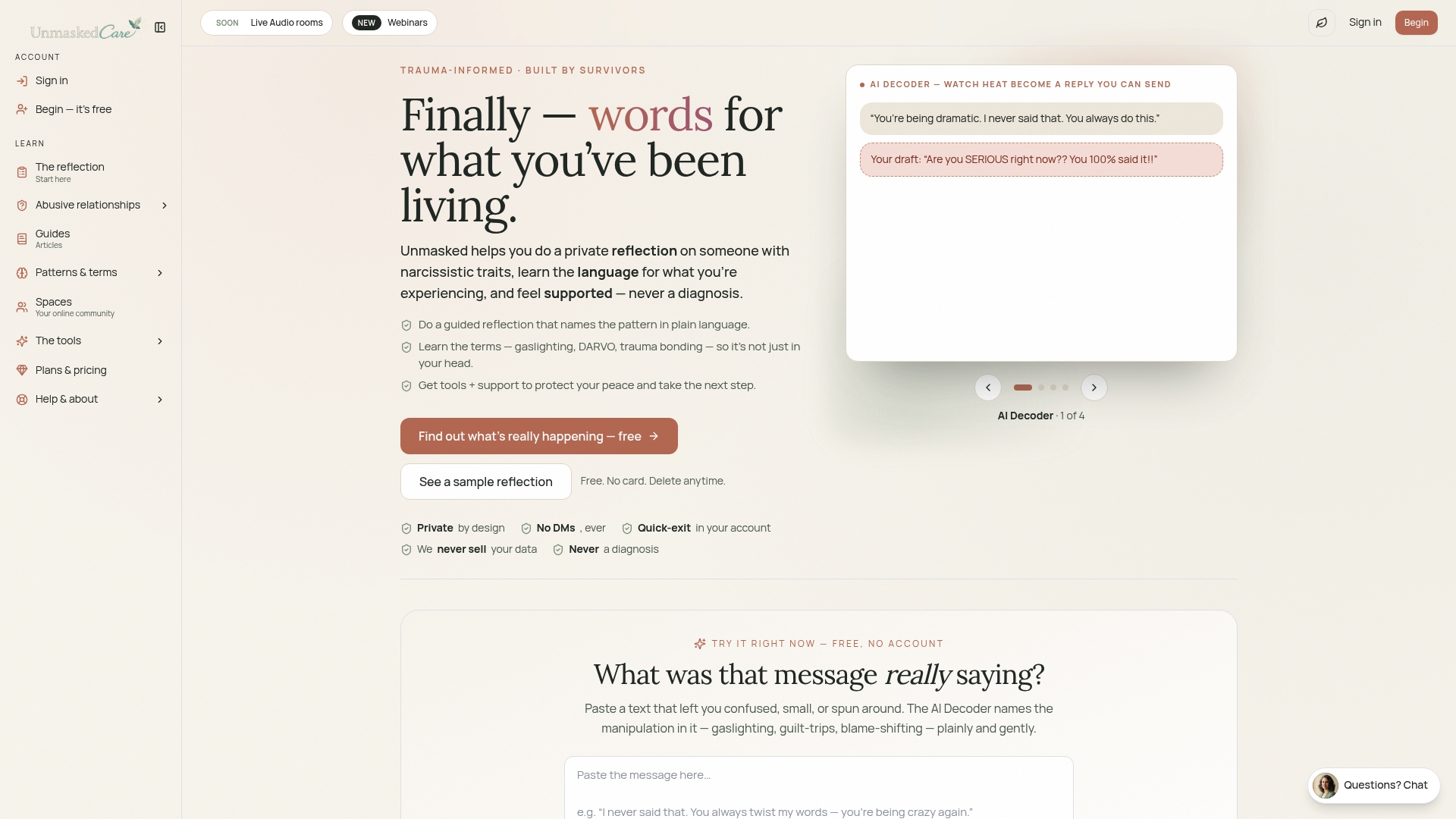
Unmaskedcare is built for exactly this situation: you need more than a therapist referral. You need a place to name what’s happening, document it safely, and connect with people who already understand the patterns.
Start free. The education library covers gaslighting, DARVO, future-faking, and coercive control in plain language. The community forums are moderated and allow anonymous participation. The AI Decoder is available as a demo without a paid subscription. When you’re ready to document, a paid subscription unlocks the full evidence file feature, complete AI reflections, and exportable reports your attorney can use.
If you’re not sure where to start, try the free decoder on a message that’s been bothering you. Then check the features page to see exactly what each tier includes before entering a payment method.