
Trauma-informed relationship journaling prompts help you document manipulation, validate your own perception, and prepare safe responses without retraumatizing yourself. Start by recording two things after any incident: the exact date and time, and the other person’s precise words in quotation marks. That’s it. Two data points. From there, the prompts below build a factual record that can support therapy, advocacy, or a safety plan.
If you are in immediate danger, call 988 (Suicide & Crisis Lifeline) or 1-800-799-7233 (National Domestic Violence Hotline) now.
This article is educational and does not constitute a diagnosis of any person.
Before you open a notebook:
- Keep any journal private and password-protected.
- Read the device-safety checklist in Section 5 before writing anything on a shared device.
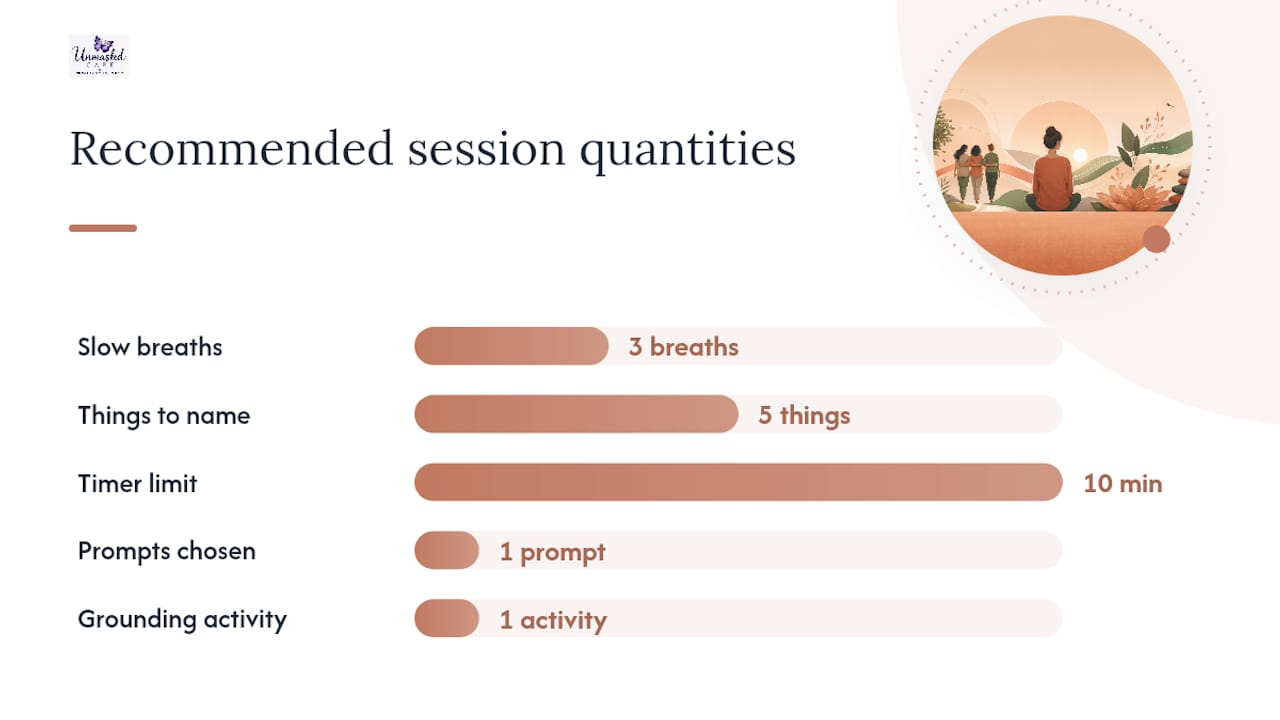
- Set a 10-minute time limit per session until you know how your body responds.
Key Takeaways
Structured, FACT-based relationship journaling prompts help survivors document manipulation, validate perception, and prepare safe responses while protecting their physical safety.
| Point | Details |
|---|---|
| Safety comes first | Assess device risk before writing; use off-device storage and clear browsing history after every session. |
| Use FACT-style entries | Record Facts, Aftermath, Context, and Track to keep logs factual and usable for advocacy. |
| Limit sessions to 10 minutes | Short, structured sessions with grounding routines before and after prevent retraumatization. |
| Name the behavior, not the person | Write what was said and done; this article is educational and does not diagnose anyone. |
| Unmaskedcare supports this work | Structured prompts, a private evidence file, and an AI Decoder are available at unmaskedcare.com. |
Crisis numbers: 988 (Suicide & Crisis Lifeline) and 1-800-799-7233 (National Domestic Violence Hotline).
Table of Contents
- How do you journal about abuse without making things worse?
- What relationship journaling prompts actually help survivors?
- How do you document incidents so they hold up later?
- Is your journal safe from a partner who checks your devices?
- How do you turn journal entries into safe, short responses?
- How does Unmaskedcare support trauma-informed journaling?
- When should you stop journaling and call for help?
- A 7-day plan for starting trauma-informed journaling safely
- Why structured prompts matter more than free-form writing for survivors
- Unmaskedcare gives you the exact tools this article describes
- Sources
How do you journal about abuse without making things worse?
The answer is structure and a hard stop. Decide your purpose before you write — “I am recording what happened on Tuesday” — not “I am going to process everything I feel.” That single shift keeps entries factual and limits the spiral that open-ended writing can trigger.
Before each session:
- Take three slow breaths and name five things you can see right now.
- Set a visible timer for 10 minutes maximum.
- Choose one prompt only.
During the session:
- Write observable facts: what was said, what was done, your physical reaction.
- Stop the moment you feel flooded. Close the notebook. Breathe.
After the session:
- Do one grounding activity (walk, cold water on wrists, name colors in the room).
- Store the journal securely before doing anything else.
On sharing entries: share only with a therapist, advocate, or attorney, and redact identifying details about third parties first. Never share with mutual friends or on social media. The CPTSD Foundation notes that structured journaling provides a container that reduces overwhelm and supports trauma recovery more reliably than free-form writing.
Pro Tip: Use the FACT format (Facts, Aftermath, Context, Track) for every entry. It keeps you in observable territory and out of interpretation, which matters if entries are ever reviewed by an advocate or attorney.
What relationship journaling prompts actually help survivors?
Each category below opens with its purpose. Use one to three prompts per session, maximum. Pacing matters more than volume.
Validate and document (FACT-style)
Purpose: anchor your memory to observable facts before they get overwritten.
- What exact words were used? Write them in quotation marks.
- What time did it happen, and who else was present?
- What did your body do during the incident (heart rate, shaking, nausea)?
- What happened immediately before the incident started?
FACT Format Example
| Component | Prompt | Example answer |
|---|---|---|
| Facts | What exactly was said or done? | “He said, ‘You’re imagining things,’ then left the room.” |
| Aftermath | How did you feel and respond? | Felt confused, apologized, couldn’t sleep. |
| Context | What led up to it? | I had asked about the deleted messages. |
| Track | Is this part of a pattern? | Third time this week I was told I was “imagining” something. |
The FACT incident log centers entries on observable behavior and connects incidents into patterns that are usable for therapy and advocacy.
Spotting gaslighting and DARVO
Purpose: name the behavior so your nervous system can process it.
- Did the other person deny something you directly witnessed? Write what you witnessed.
- Were you accused of causing the very behavior you raised? Describe the sequence.
- Did the conversation end with you apologizing for bringing up a concern?
- What did you believe about the situation before the conversation, and what were you told to believe after?
Naming patterns like gaslighting and DARVO helps the nervous system process what happened rather than absorb it as personal failure.
Patterns and timeline
Purpose: make the invisible visible across time.
- How many times in the past month did a similar incident occur?
- What triggers seem to precede these incidents?
- Has the intensity or frequency changed over the past three months?
Boundaries and values
Purpose: reconnect with what you know to be true about yourself.
- What did you need at that moment that you didn’t get?
- What would you tell a close friend if they described this same situation?
- What boundary, if honored, would have changed the outcome?
Emotional aftercare
Purpose: close the session with self-compassion, not self-criticism.
- What is one thing you handled well today?
- What does your body need right now?
- What is one true thing you know about yourself that the incident tried to take away?
Pro Tip: Write aftercare prompts on a separate page or card so they’re always ready. Ending on a grounding question rather than a documentation question signals to your nervous system that the session is closed.
How do you document incidents so they hold up later?
Write same-day, time-stamped entries. Memory degrades and gets overwritten fast, especially under gaslighting, which distorts perception and makes dated documentation critical for validating your own experience.
What to include in each incident log:
- Date, time, and location.
- Exact words spoken, in quotation marks, as close to verbatim as possible.
- Your physical state during the incident (shaking, frozen, crying).
- Any witnesses, even if they said nothing.
- Supporting files: screenshots, voice memos, photos of damage. Store these separately from the log itself.
Where to store it: off-device storage is safest. Options include a USB drive kept outside the home, a private cloud account on a device your partner cannot access, or a privacy-focused evidence file through a platform like Unmaskedcare. The Safety Net Project recommends keeping an incident log that includes technology-related abuse details and storing supporting evidence in a way that prevents deletion.
Before documenting anything, assess whether discovery would increase your immediate risk. If it would, prioritize verbal memory and a trusted advocate over written records until you have a safer storage option.

Pro Tip: Never edit an entry after writing it. Add a new dated entry instead. Unedited originals carry more weight with advocates and attorneys.
Is your journal safe from a partner who checks your devices?
Assume any device, account, or app your partner has ever touched is potentially visible to them. The National Domestic Violence Hotline recommends saving evidence copies outside shared or monitored devices and considering app-specific screenshot behaviors before capturing anything.
Device and account checklist:
- Use a device your partner has never handled, even a library computer or a trusted friend’s phone.
- Turn off auto-sync for notes, photos, and cloud backups on any device used for journaling.
- Avoid filenames like “journal” or “abuse log.” Use neutral names or store entries inside an unrelated app.
- Clear browsing history after visiting any resource page, including this one.
- Use a separate email address your partner doesn’t know about for any platform accounts.
If your partner monitors your accounts or devices, reduce on-device documentation immediately. Prioritize memorizing key dates and quotes, then transfer them to a secure location at the earliest safe opportunity. A trusted friend, family member, or advocate can hold physical copies on your behalf.
If risk is high, verbal documentation with a trusted person or advocate may be safer than any written record until you have a secure exit plan in place.
How do you turn journal entries into safe, short responses?
Start with one sentence. The goal of a response script is not to win the argument. It is to disengage without escalating.
Building a script:
- Identify the manipulation tactic from your journal (minimizing, DARVO, silent treatment).
- Choose a response goal: exit the conversation, hold a boundary, or buy time.
- Write one sentence that achieves that goal without explaining, defending, or apologizing.
Example scripts:
- Minimizing (“You’re too sensitive”): “I hear you see it differently.” Then stop talking.
- DARVO (“You’re the one who always starts this”): “I’m not going to debate that right now.”
- Pressure to respond immediately: “I need some time before I respond to this.”
The gray rock method underpins all three: give the least emotionally engaging response possible. Short, flat, factual.
After using a script, log how it felt. Did it reduce escalation? Did it feel possible to say? That feedback shapes the next version.
Pro Tip: Rehearse scripts aloud, alone, before you need them. The physical act of saying the words reduces the freeze response in the moment.
How does Unmaskedcare support trauma-informed journaling?
Unmaskedcare offers structured reflection tools, a privacy-focused evidence file, and an AI Decoder built specifically for people navigating manipulation patterns. Every feature maps to a documented need.
Key features:
- Structured prompts: guided reflection questions using precise terminology like gaslighting and DARVO, so you name behavior rather than absorb blame.
- Evidence file: a privacy-focused log for storing incident records and supporting files, separate from shared devices.
- AI Decoder: paste a message you received and get an analysis of the manipulation patterns present, which supports both journaling and response preparation.
- Plain-language guides: an extensive library covering abuse patterns, trauma bonding, and healing strategies.
- Community and live support: anonymous forums, live audio rooms, and webinars.
The Unmasked Care Team authors all platform content with a safety-first, educational framing. Content is reviewed for accuracy against recognized abuse-pattern terminology.
When should you stop journaling and call for help?
Call 988 or 1-800-799-7233 right now if:
- You are in physical danger or fear you are about to be.
- You are having thoughts of harming yourself or ending your life.
- A partner has threatened you, your children, or your pets.
- You feel you cannot safely leave your current location.
For non-emergency situations, contact an advocate through the National Domestic Violence Hotline (1-800-799-7233) when:
- Incidents are escalating in frequency or severity.
- You are planning to leave and need a safety plan.
- You want to understand your legal options before taking action.
If leaving quickly, bring: ID, financial documents, medications, phone charger, and your evidence file or a copy of key log entries. The Psychology Today five-step gaslighting safety plan recommends involving support people and focusing on self-care as core steps alongside documentation.
This article is educational and does not constitute a diagnosis of any person.
A 7-day plan for starting trauma-informed journaling safely
One commitment: 5–10 minutes a day, private, FACT-based, with a grounding routine before and after.
- Day 1: Grounding only. Practice the pre-session routine (breathe, name five things you see). Write nothing yet.
- Day 2: Use one “validate and document” prompt. Record one recent incident in FACT format.
- Day 3: Use one “spotting gaslighting” prompt. Write what you observed, not what it means.
- Day 4: Rest day. Do one aftercare prompt only: “What is one true thing I know about myself?”
- Day 5: Use one “patterns and timeline” prompt. Look back at Days 2 and 3 for any overlap.
- Day 6: Write one response script for a tactic you identified this week.
- Day 7: Archive. Move entries to secure storage. Back up any supporting files.
End-of-week checklist:
- All entries stored off the primary device.
- Browsing history cleared.
- One trusted person informed that you are keeping a log (optional but recommended).
- Note whether you need to pause, continue, or seek additional support.
Pro Tip: If any day feels too activating, skip to the aftercare prompt and stop. The plan works even if you only complete three days. Progress is not linear.
Why structured prompts matter more than free-form writing for survivors
Free-form journaling asks you to go wherever your mind goes. For someone whose perception has been systematically distorted, that can mean spiraling back into self-blame rather than building clarity. The CPTSD Foundation identifies structured journaling as a container that organizes healing rather than reopening wounds.
The DARVO recovery research from Hayfield Healing points to something specific: documentation must address both the perceptual distortion and the internalized self-blame that moral reversal creates. A prompt that asks “what exact words were used?” does both. It anchors memory before it gets overwritten, and it separates observable fact from the interpretation that was handed to you.
Naming the pattern also does physiological work. Therapist Annie Wright describes the “name it to tame it” technique as a way to calm the amygdala through cognitive labeling. Writing “this was gaslighting” is not dramatic. It is neurologically useful.
Unmaskedcare gives you the exact tools this article describes
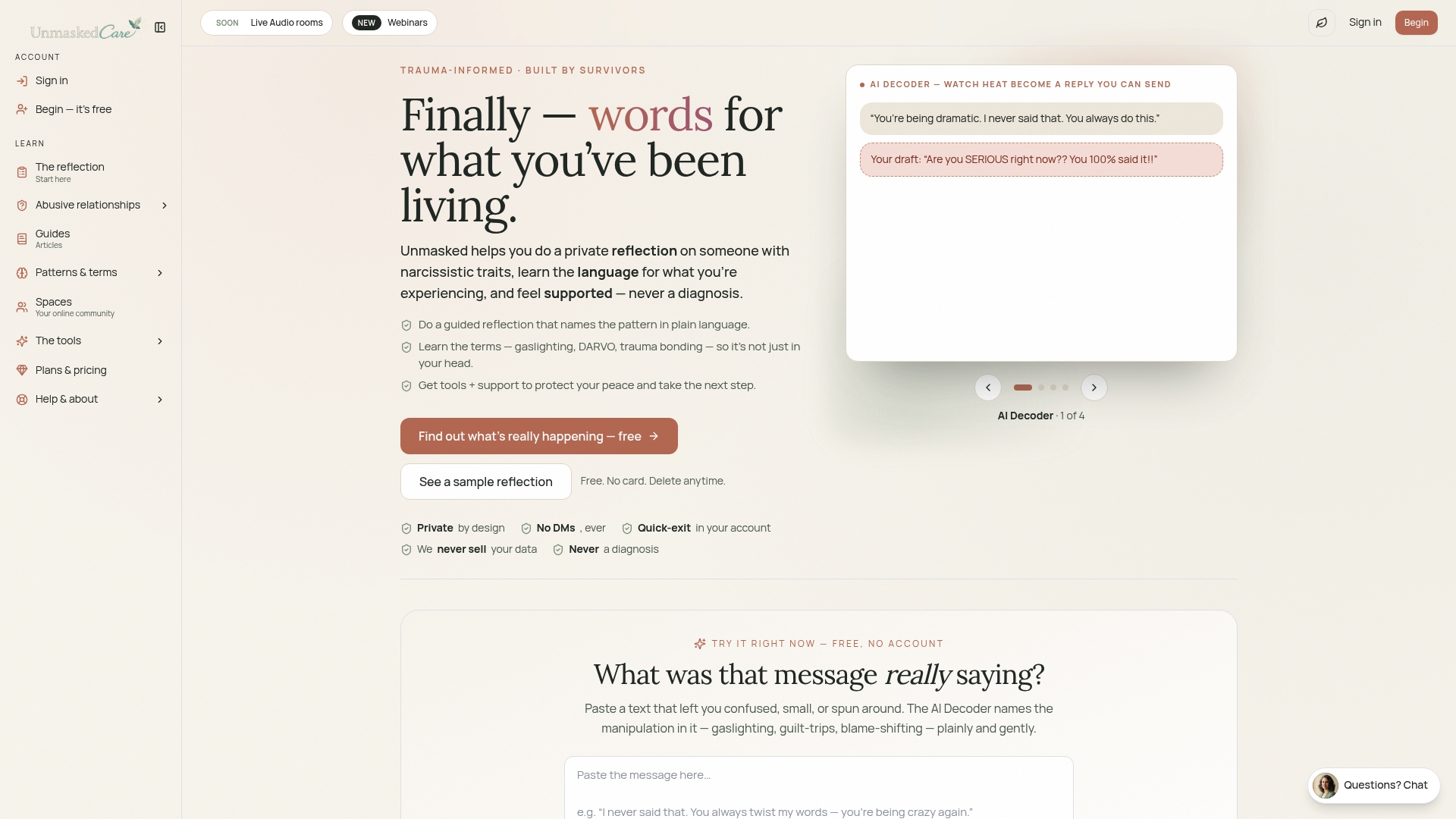
Unmaskedcare contains structured reflection prompts, a private evidence file, and an AI Decoder that analyzes manipulative messages and names the patterns present. You don’t need to build your own system from scratch.
What you get:
- Guided prompts using gaslighting and DARVO terminology.
- A secure evidence file separate from shared devices.
- AI-powered message analysis to support response preparation.
- A library of plain-language guides on abuse patterns and what gaslighting actually looks like.
Free access includes education, community, and guides. Paid tiers unlock personalized AI reflections, deep analysis, and enhanced privacy features. Start with the free AI Decoder to see how it names what you’ve been experiencing.
Sources
- The power of journaling: Structured approaches for trauma recovery — CPTSD Foundation
- A deeper look into gaslighting — The Hotline
- Documentation Tips for Survivors — Safety Net Project
- 5-step gaslighting safety plan — Psychology Today
This article is general information, not a substitute for advice from a qualified doctor. Consult a qualified healthcare professional about your own circumstances before acting on anything here.