
DEAR MAN is a DBT interpersonal effectiveness skill for asking for what you want or saying no clearly, while protecting both your relationships and your self-respect. It gives you a seven-step script to follow so you’re not improvising under pressure.
The acronym breaks into two parts: what to say (DEAR) and how to say it (MAN):
- D — Describe the situation using observable facts
- E — Express how you feel using I-statements
- A — Assert your request or refusal directly
- R — Reinforce by explaining what’s in it for the other person
- M — Mindful: stay focused on your goal, ignore distractions
- A — Appear confident through posture, voice, and eye contact
- N — Negotiate if needed; offer alternatives
This article is educational only. It is not a diagnosis, a treatment plan, or a substitute for working with a licensed mental health professional.
If you’re in crisis, please reach out now: 988 (Suicide & Crisis Lifeline) or 1-800-799-7233 (National Domestic Violence Hotline).
Key Takeaways
DEAR MAN is a seven-step DBT script that separates what you say from how you say it, and rehearsal of both parts is what makes it work in real conversations.
| Point | Details |
|---|---|
| The acronym | Describe, Express, Assert, Reinforce, Mindful, Appear confident, Negotiate — DEAR is content, MAN is delivery. |
| Practice out loud | Reading a script silently is not enough; rehearse the words and the physical cues (posture, voice, eye contact) separately. |
| Safety first | Do not use DEAR MAN in situations where asserting yourself could escalate danger; prioritize exit planning instead. |
| Crisis numbers | 988 (Suicide & Crisis Lifeline) and 1-800-799-7233 (National Domestic Violence Hotline) are available 24/7. |
| Unmaskedcare | The AI Decoder and reflection tools at Unmaskedcare help you prepare grounded, clear scripts before difficult conversations. |
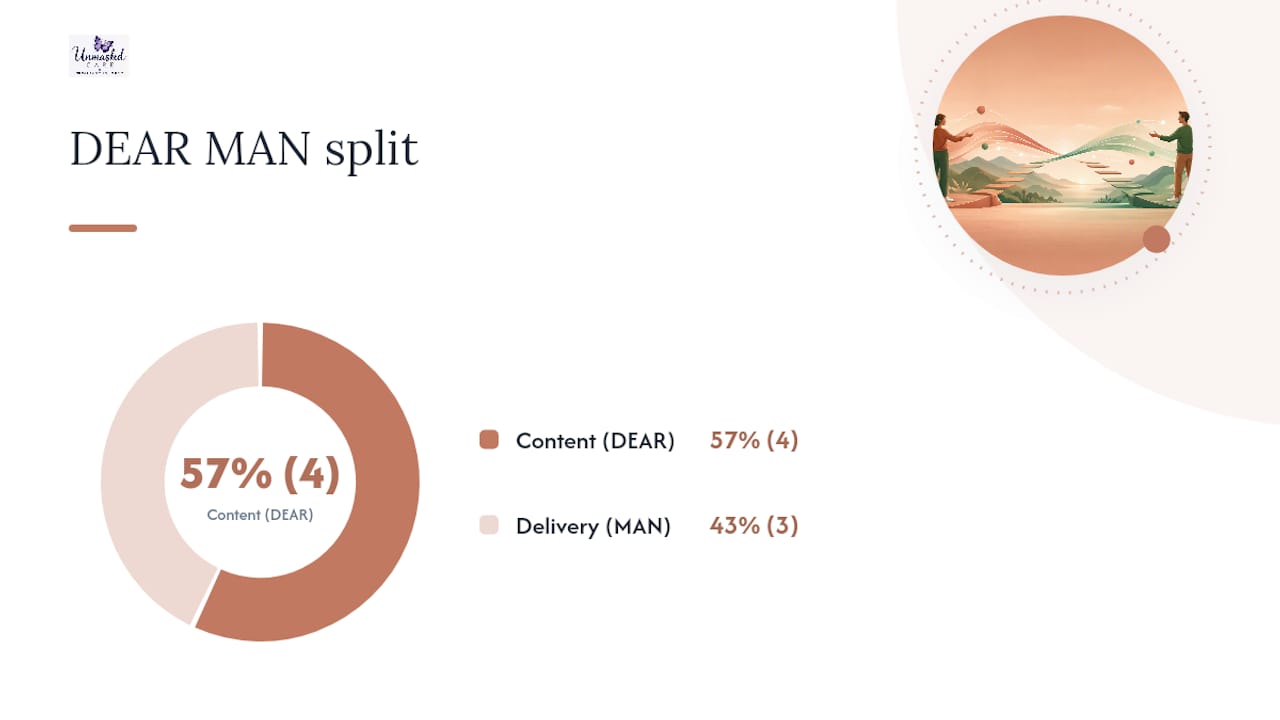
Table of Contents
- What each DEAR MAN letter actually means
- Two ready-to-use DEAR MAN scripts you can adapt right now
- How to practice with a worksheet
- Common mistakes and quick fixes when DEAR MAN doesn’t work
- How to adapt DEAR MAN across different situations
- Where DEAR MAN comes from and what to read next
- Why rehearsal and safety matter more than perfect language
- Unmasked Care tools for preparing your DEAR MAN scripts
- Sources
What each DEAR MAN letter actually means
The DEAR MAN acronym separates content from delivery deliberately. Most people collapse the two when they’re nervous, either over-explaining what they feel or forgetting to actually ask. Here’s what each step does and a one-line example you can adapt.
- Describe — State only the observable facts, no interpretation. “You’ve arrived home after 9 PM three times this week.”
- Express — Name your feeling using an I-statement. “I feel disconnected when we don’t have time together in the evenings.”
- Assert — Make the actual request or say no, plainly. “I’d like us to have dinner together at least twice a week.” No hedging, no “if that’s okay.”
- Reinforce — Tell the other person what they gain if they agree. “When we have that time, I feel closer to you and I’m easier to be around.” This step makes the request feel like a shared win rather than a demand.
- Mindful — Keep returning to your goal if the conversation drifts. If they change the subject or push back hard, use the “broken record”: calmly restate your request without arguing. “I hear you. I still need us to have dinner together twice a week.”
- Appear confident — Confidence here is a behavior, not a feeling: steady eye contact, open posture, a voice that doesn’t trail off. You can feel nervous and still look composed. Practice the physical cues separately.
- Negotiate — If the original request gets a no, offer an alternative. “What if we started with one evening a week and revisited it in a month?”
Each step is short by design. The goal is a script you can hold in your head, not a speech.
Two ready-to-use DEAR MAN scripts you can adapt right now
Practical guides consistently show that having a script before the conversation reduces the chance of freezing or over-explaining. Here are two templates, plus fill-in-the-blank prompts.
Script 1: Asking for a change (household or work example)
- “Lately, the dishes have been left in the sink overnight most days.” (Describe)
- “I feel stressed when I come into a messy kitchen in the morning.” (Express)
- “I’m asking that dishes get washed or put in the dishwasher before bed.” (Assert)
- “If we keep the kitchen clear, mornings will be less rushed for both of us.” (Reinforce)
- Deliver it with steady eye contact and a calm, even tone. (Appear confident)
- If they push back: “I understand it’s a lot. I still need the kitchen clear at night.” (Mindful / broken record)
- “Could we try it for two weeks and check in?” (Negotiate)
Script 2: Saying no / setting a boundary
- “You’ve asked me to cover your shift three weekends in a row.” (Describe)
- “I feel burned out when I don’t get time to rest.” (Express)
- “I’m not able to cover this weekend.” (Assert — no apology, no over-explanation)
- “When I have a real day off, I come back more focused and that helps the whole team.” (Reinforce)
- Stand or sit upright, keep your voice level. (Appear confident)
- If they press: “I understand you’re in a bind. I’m still not available this weekend.” (Mindful)
- “I can help you find someone else, or I could swap a weekday shift instead.” (Negotiate)
Fill-in-the-blank prompts:
- Describe: “Recently, [observable fact].”
- Express: “I feel [emotion] when [situation].”
- Assert: “I’m asking for [specific request] / I’m not able to [specific thing].”
- Reinforce: “If [agreement], then [positive outcome for both].”
Practice both scripts out loud, not just in your head. Reading silently and speaking aloud use different cognitive pathways. If the other person keeps redirecting, return to your Assert line word-for-word. That’s the broken record, and it works precisely because you’re not adding new arguments to defend.
How to practice with a worksheet
DBT Skills Training handouts include reproducible DEAR MAN worksheets with step-by-step practice guidance. The fields below follow that same structure so you can work through an upcoming conversation before it happens.
| DEAR MAN Step | Your worksheet prompt |
|---|---|
| Describe | Write one or two sentences of observable fact only. No feelings, no judgments. |
| Express | Complete: “I feel ___ when ___.” Keep it to one sentence. |
| Assert | Write your exact request or refusal. Read it back: is it direct? Does it hedge? |
| Reinforce | What does the other person gain if they agree? Write one sentence. |
| Mindful | What distractions or counterarguments might pull you off-track? Write them down, then write your broken-record response. |
| Appear confident | List two physical behaviors you’ll use: e.g., “sit up straight, keep eye contact.” |
| Negotiate | Write one alternative you’re genuinely willing to offer. |
Practice checklist:
- Set aside 10 minutes before the actual conversation
- Read your script aloud at least twice
- Roleplay with a trusted friend or in front of a mirror
- Ask your roleplay partner for one specific piece of feedback on your tone or posture
- After the real conversation, write two sentences: what went as planned, what you’d adjust
For journaling after the fact, try: “What did I ask for? What happened? What would I say differently?” Three questions, kept short. The goal is refinement, not rumination.
Pro Tip: Keep roleplay sessions to 2–5 minutes. Longer sessions tend to drift into debate practice rather than script rehearsal. Run the script once, get feedback on one thing, then run it again with that adjustment.
Common mistakes and quick fixes when DEAR MAN doesn’t work
Most DEAR MAN breakdowns trace back to a handful of predictable errors.
- Hedging the Assert step (“I was just wondering if maybe…”) — Fix: rewrite your Assert line as a complete sentence with no qualifiers. Read it aloud until it sounds like a statement, not a question.
- Over-explaining in Describe — Fix: limit Describe to two sentences of observable fact. If you find yourself explaining why the facts matter, you’ve slipped into Express territory.
- Getting sidetracked by counterarguments — Fix: use the broken record. DBT Tools describes this as calmly restating your request without arguing or defending each time the other person redirects.
- Responding to personal attacks — Fix: don’t defend yourself against the attack. Return to your Assert line. Defending pulls you off your goal.
- Skipping Reinforce — Fix: people are more likely to agree when they see a benefit. Even a brief “this helps us both” line changes the dynamic.
When to stop and disengage: If the conversation escalates, if you’re being threatened, or if the other person is using the conversation to gather information to use against you later, stop. The broken record is for ordinary pushback, not for situations where continuing puts you at risk.
If a conversation feels consistently unsafe or manipulative, recognizing those patterns is a first step. For immediate safety, call 988 or 1-800-799-7233.
How to adapt DEAR MAN across different situations
The core script stays the same. What changes is tone, level of detail, and how much you push.

Workplace context: Keep the Describe step factual and professional. Tie Reinforce to team or project outcomes rather than personal feelings. Document the conversation afterward, especially if it involves a formal request. If HR or a neutral third party is appropriate, consider whether to have a witness present.
Romantic or family relationships: Add more relational warmth to Reinforce. Acknowledge the other person’s perspective briefly in the Mindful step before restating your request. Validation isn’t agreement; it keeps the conversation from becoming adversarial.
High-emotion situations: If you’re too dysregulated to speak calmly, postpone. A DEAR MAN script delivered while flooded with emotion tends to come out as either aggression or collapse. Short practice prompts from skills sites suggest grounding first, then scripting. Keep statements short when emotions are running high.
Neurodivergent readers: Explicit scripts and rehearsal are especially useful when indirect social cues are harder to read. The CDC notes that concrete, structured communication strategies support autistic adults in social situations. DEAR MAN’s step-by-step format fits that need directly.
Unsafe or abusive situations: Do not use DEAR MAN if asserting yourself could escalate danger. Assertiveness skills assume a baseline of physical and emotional safety. If that baseline isn’t present, prioritize exit planning and support networks. Setting limits with someone who behaves manipulatively requires a different approach, and sometimes the right move is low engagement rather than direct assertion.
Pro Tip: Before any DEAR MAN conversation, decide which priority matters most: getting your objective, keeping the relationship, or keeping your self-respect. DBT handouts call this priority-setting, and it determines how hard you push and when you stop.
Crisis resources: 988 (Suicide & Crisis Lifeline) and 1-800-799-7233 (National Domestic Violence Hotline).
Where DEAR MAN comes from and what to read next
DEAR MAN was developed by psychologist Marsha Linehan as part of Dialectical Behavior Therapy. It appears in the interpersonal effectiveness module of the DBT Skills Training Handouts and Worksheets manual, which is the primary clinical source for the skill. Peer-reviewed literature places DBT skills training within a broader evidence-based framework for emotion regulation and interpersonal functioning.
This is an educational skill. It is not a clinical diagnosis and does not replace therapy. If you’re working through difficult relationship patterns, a licensed professional can help you apply these skills to your specific situation.
Authoritative resources for deeper reading:
- DEAR MAN Skill, DBT Tools — concise step-by-step breakdown with examples
- DEAR MAN Worksheet, dialecticalbehaviortherapy.com — worksheet format with scripts
- DBT Skills Training Handouts and Worksheets, Second Edition — the original Linehan handouts
Why rehearsal and safety matter more than perfect language
The most common reason DEAR MAN doesn’t stick isn’t the script. It’s that people try to use it for the first time in the hardest conversation they’ve ever had, with no rehearsal, against someone who isn’t playing by the same rules.
Behavior-focused practice matters because confidence is built through repetition of the physical cues, not through feeling ready. Posture, voice, and eye contact can be rehearsed independently of the words. That’s the insight behind the “appear confident” step: you don’t wait to feel confident before acting confident.
Safety planning matters equally. DEAR MAN assumes both people are operating in good faith. When that assumption doesn’t hold, the skill needs to be set aside, not pushed harder. Recognizing when a conversation has crossed from difficult into unsafe is its own skill, and it’s one worth developing alongside assertiveness.
This article is educational and does not constitute a diagnosis or clinical recommendation. For crisis support: 988 or 1-800-799-7233.
Unmasked Care tools for preparing your DEAR MAN scripts
Preparing a DEAR MAN script before a hard conversation is where most people get stuck, especially when the other person’s communication style is confusing or manipulative. Unmaskedcare’s AI Decoder and structured reflection tools give you a private space to work through exactly what happened, name the patterns you’re seeing, and draft a clear, grounded response before you say a word out loud.
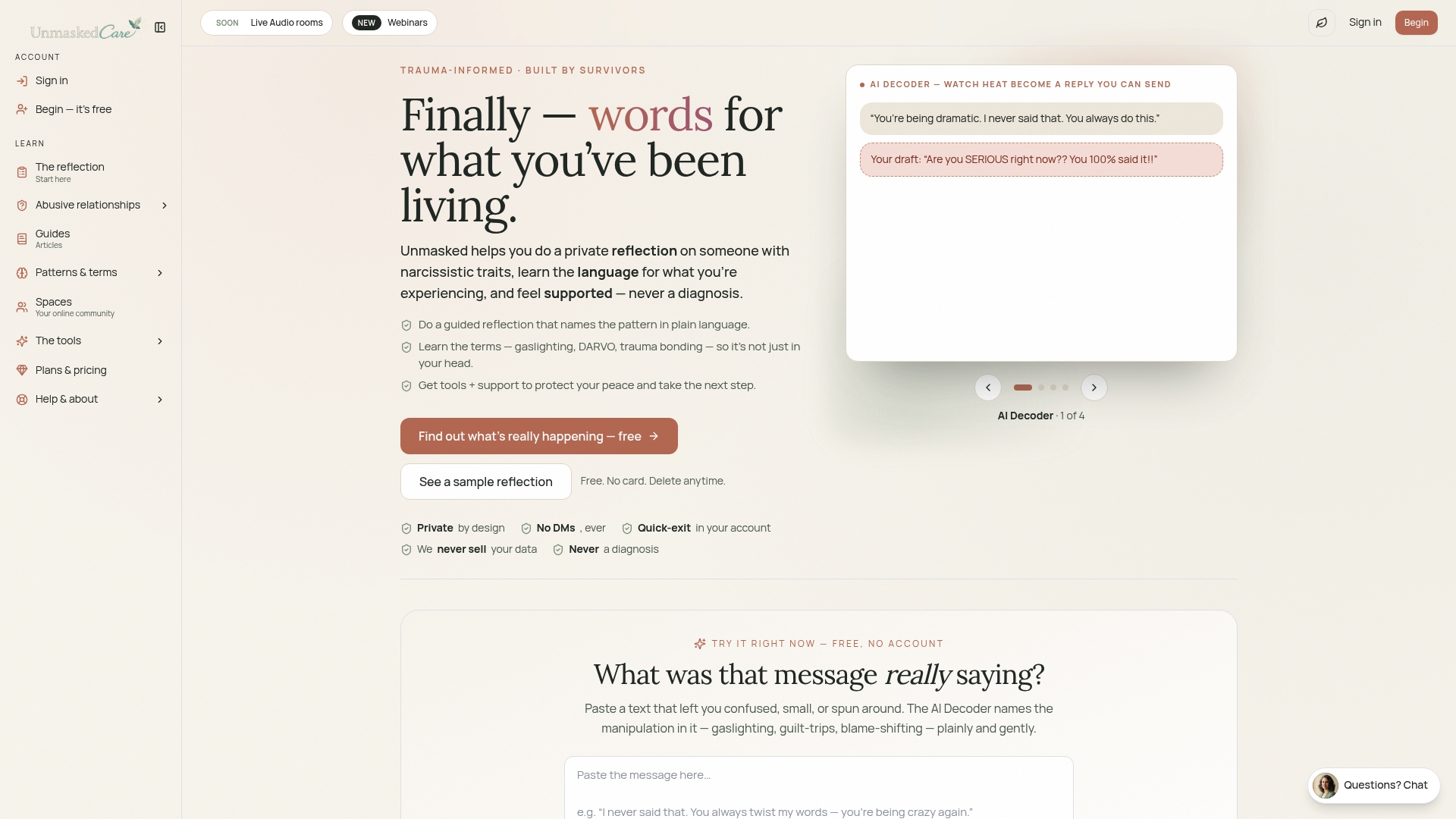
The AI Decoder is particularly useful when you’ve received a message that feels off but you can’t quite articulate why. You can run it through the decoder, get plain-language analysis of the dynamic, and then use that clarity to write your Describe and Express steps without second-guessing yourself. The structured reflection tools walk you through the situation in your own words, so your script reflects your actual experience rather than a generic template.
Unmaskedcare is an adjunctive platform, not a clinical service. For diagnosis or treatment, work with a licensed professional. To start building your scripts in a private, structured space, explore what’s inside Unmaskedcare.
Sources
The resources below are educational references, not a substitute for clinical diagnosis or professional mental health support.