
If you suspect someone is breadcrumbing you, the smartest breadcrumbing response is a two-step move: propose one concrete, time-bound plan to test whether they’ll actually show up, and if they dodge it, disengage. This is sometimes called a conversion test — you’re converting a vague pattern into a clear yes or no, without accusations or long explanations.
A conversion test looks like this: “I’d like to grab coffee Thursday at 6. Does that work?” You’re offering a specific date, time, and ask, not another open-ended “we should hang out sometime.”
Two scripts to keep handy:
- Conversion test: “I’m free Saturday afternoon, want to meet up then?”
- Disengage fallback: “Sounds like the timing isn’t right for either of us. Take care.”
This article offers general education, not a diagnosis of you or anyone else. If you’re in crisis or danger, call 988 (Suicide & Crisis Lifeline) or 1-800-799-7233 (National Domestic Violence Hotline).
Key Takeaways
A breadcrumbing response works best as a two-step process: propose one concrete plan to test commitment, then disengage cleanly if that plan gets dodged.
| Point | Details |
|---|---|
| Run one conversion test | Offer a specific day and time; a real answer beats another vague “soon.” |
| Track the pattern, not one night | Confirm three or more episodes of inconsistency before calling it breadcrumbing. |
| Match tactic to motive | Attention-seeking gets a test, fear of commitment gets a boundary, manipulation gets distance. |
| Keep messages short and calm | One or two sentences beats a long explanation every time. |
| Disengage in stages | Slow replies, mute notifications, set a defined no-contact window. |
| Reach out for real danger | Call 988 or 1-800-799-7233 if you’re in crisis or unsafe. |
Table of Contents
- Signs Your Breadcrumbing Response Needs to Kick In
- Why Do People Breadcrumb, and Does It Change Your Reply?
- What Should You Say? Scripts for a Breadcrumbing Response
- Communication Rules That Keep the Cycle From Dragging On
- When It’s Time to Step Back From a Breadcrumbing Response
- How Unmasked Care Helps You Respond Without Losing Your Footing
- What the Research Actually Supports Here
- Sources
Signs Your Breadcrumbing Response Needs to Kick In
Breadcrumbing is a pattern of inconsistent, flirtatious but noncommittal contact meant to keep you interested without any real intention of building something serious, according to Psychology Today. It’s a behavioral description, not a clinical label. Watch for these signals:
- Inconsistent replies. Days of silence, then a flurry of texts like nothing happened.
- Vague future promises. “We should totally do something soon” with no date ever attached.
- Social-only engagement. They like every Instagram story but never initiate a real conversation.
- Hot and cold. Intense attention one week, ghost mode the next.
- Actions that don’t match words. They say they’re interested but never adjust their schedule for you.
One flaky week isn’t proof of anything. Look for the pattern across several exchanges, ideally three or more, before you treat it as breadcrumbing rather than a busy stretch.
Pro Tip: *Keep a short note or journal comparing your effort to theirs over two weeks.
Why Do People Breadcrumb, and Does It Change Your Reply?
Breadcrumbing works because of intermittent reinforcement: rewards that arrive unpredictably create stronger checking behavior than rewards that arrive on a steady schedule, according to Cleveland Clinic Health Essentials. That’s why a random 11 p.m. “hey stranger” text can feel more magnetic than a consistent good morning text ever would. Your brain treats the uncertainty itself as a hook.
Motives vary, and they matter for how you respond:
- Validation-seeking: they want the ego boost of your attention with none of the effort.
- Fear of intimacy: they’re avoiding real vulnerability, not necessarily avoiding you specifically.
- Keeping options open: you’re one of several people getting the same crumbs.
- Immaturity or unresolved patterns: sometimes rooted in past relationships they haven’t worked through.
Intermittent reinforcement creates a stronger checking and hope cycle than predictable reward, which is why crumbs feel harder to walk away from than steady disinterest would.
Match your tactic to the likely motive: attention-seeking calls for a conversion test, fear of commitment calls for a test followed by a time-bound boundary, and anything manipulative calls for disengagement.
What Should You Say? Scripts for a Breadcrumbing Response
The conversion test is the core move here. You offer one specific, near-term plan and see if it converts into real follow-through. Healthline and SimplyPsychology both back this: name the behavior, state what you need, propose something concrete, then watch what happens.
Scripts by situation:
- Direct request for commitment: “I’d like to see you this weekend if you’re free. Let me know.”
- Low-effort plan: “No pressure, but if you want to grab a quick coffee Tuesday, I’m around.”
- Curious call-out: “I’ve noticed we talk a lot but rarely make actual plans. What’s going on?”
- Gray-rock neutral reply: “Cool” or “Got it” when you want to stop feeding the cycle without a scene.
- Firm boundary: “I’m not going to keep this up without more consistency. Come back when you’re ready for that.”
- Disengage message: “I’m going to step back from this. Take care of yourself.”
Running the test is a simple four-step sequence:
- Send one specific plan with a real day and time.
- Wait for a concrete yes, not a maybe or a “we’ll see.”
- Allow one repeat attempt if the first try gets a soft dodge.
- If they evade twice, apply the boundary script and stop initiating.
Pro Tip: Match your energy to what they actually return, not what you hope they’ll return. And keep texts to one or two sentences. Long messages read as pleading, even when that’s not your intent.
Communication Rules That Keep the Cycle From Dragging On
Certain habits shorten the breadcrumbing cycle. Others accidentally extend it.
Do: be specific about time and plans, stay calm, keep messages brief, and state what you need in plain language rather than hints.
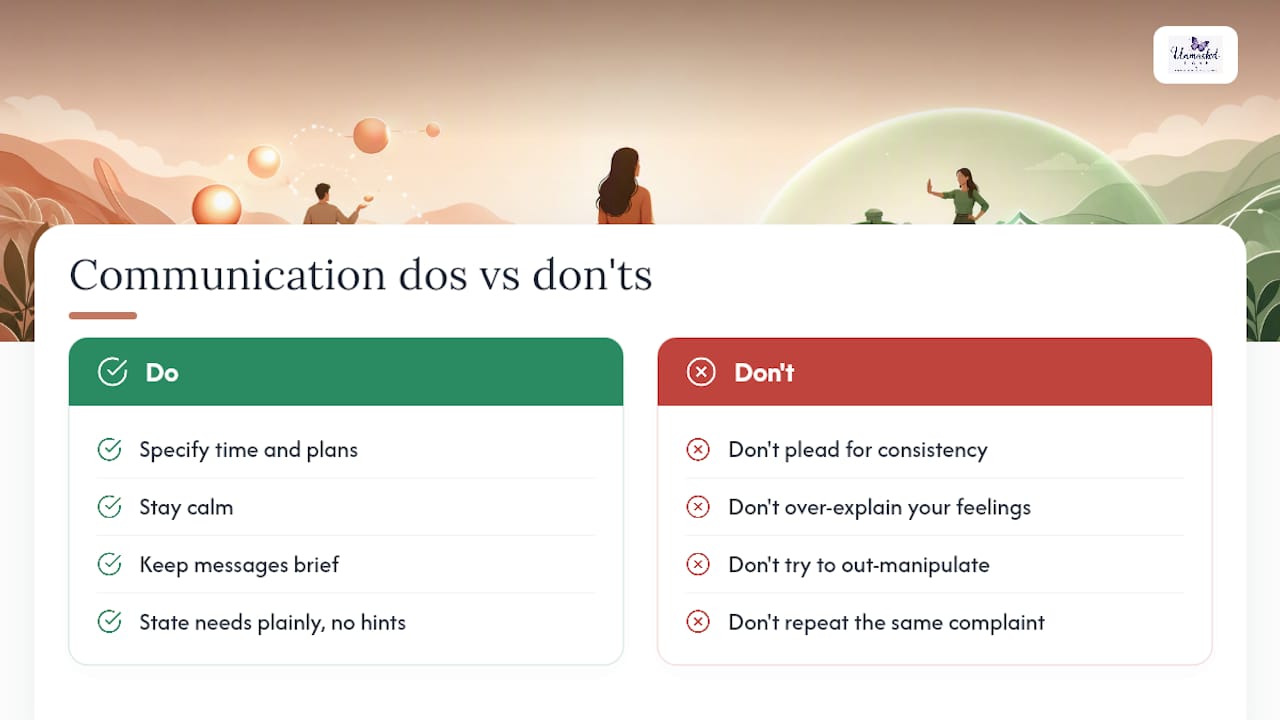
Don’t: plead for consistency, over-explain your feelings in a wall of text, try to out-manipulate someone playing games, call them out publicly, or send the same complaint three different ways hoping one lands.
Late-night crumbs deserve their own rule. A 2 a.m. “you up?” doesn’t require an essay back. A short, neutral line like “Heading to bed, talk another time” works, or simply no reply at all if that feels safer for you.
Compare the tone difference: “Why do you only text me when you’re bored?” invites a defensive dodge. “I’m looking for someone who plans ahead, not last minute” states your standard without a fight.
When It’s Time to Step Back From a Breadcrumbing Response
Three signals mean it’s time to stop testing and start protecting your time: repeated evasion after you’ve already run the conversion test, responses that twist your words or deny things they clearly said, or a pattern where contact only ever shows up late at night.
Disengaging works better as a sequence than a single dramatic exit:
- Slow your replies, then stop initiating altogether.
- Mute or silence notifications from that contact.
- Set a defined no-contact period, even just two or three weeks, rather than leaving it open-ended.
- Journal the gap between what you gave and what came back, so hindsight doesn’t get rewritten later.
- Redirect the freed-up time toward people who show up consistently.
This guidance is educational, not a diagnosis of anyone involved. If breadcrumbing is tangled up with fear, threats, or control, or if you’re in crisis, call 988 (Suicide & Crisis Lifeline) or 1-800-799-7233 (National Domestic Violence Hotline). If the pattern is affecting your sleep, work, or daily functioning, Medical News Today recommends looping in a professional, and a structured tool like Unmasked’s reflection prompts can help you organize your thoughts before that conversation.
How Unmasked Care Helps You Respond Without Losing Your Footing
Preparing a message before you send it beats reacting in the moment. Unmasked builds tools specifically for that gap between “I’m upset” and “here’s what I actually want to say”:
- The AI message decoder helps you draft a calm, clear conversion-test text instead of a reactive one.
- Guided reflection prompts walk you through naming what you actually need before you confront the pattern.
- A red-flags checklist helps you separate a busy week from a genuine cycle.
- The no-contact tracker keeps your disengagement period honest when willpower alone isn’t enough.
- Community spaces give you somewhere to think out loud with people who’ve run the same test.
Unmasked Care Team built these tools around one idea: clarity beats guessing, and preparation beats pleading.
Testing someone’s follow-through shouldn’t require guesswork or a dozen rewritten drafts. The Free AI Decoder helps you name the pattern you’re seeing and shape a response that stays calm, specific, and boundaried, whether that’s a conversion test text or a final disengage message. It’s free to try, and it’s built for exactly the moment you’re in right now.

What the Research Actually Supports Here
Most breadcrumbing advice online treats the problem as a mind game to win. It isn’t. The research points somewhere more useful: stop guessing at intent and gather data instead. A single, specific plan tells you more in one exchange than weeks of analyzing text timing ever will.
Where conventional advice falls short is the assumption that every breadcrumber is calculating and cruel. Some are. Plenty are just avoidant, overwhelmed, or repeating a pattern they’ve never examined. That distinction shouldn’t change your boundary, but it can change how much energy you spend being angry about it.
Prioritize the test first, the feelings second. Send the concrete plan before you send the paragraph explaining how confused you are. If the plan lands, you learn something real. If it doesn’t, you’ve lost a few days, not months, and you walk away with your dignity and your time intact.
This article is general information, not a substitute for advice from a qualified doctor. Consult a qualified healthcare professional about your own circumstances before acting on anything here.
Sources
- Breadcrumbing — Psychology Today
- What is breadcrumbing? — Healthline
- Breadcrumbing — Cleveland Clinic Health Essentials
- Breadcrumbing and dating psychology — SimplyPsychology
- Breadcrumbing: Medical News Today