
An abuse incident log is a private, structured record of emotional abuse: dates, exact words, context, and how each incident affected you. It exists to help you spot patterns, plan for safety, and hand a clinician or advocate something clear and factual, not to serve as a legal reporting log for police or child protective services.
If you’re in immediate danger, stop reading and call 988 (Suicide & Crisis Lifeline) or 1-800-799-7233 (The National Domestic Violence Hotline). If you’re safe right now, the most useful thing you can do today is start writing objective, timestamped entries somewhere private.
A few ground rules before you write a single word:
- Describe behavior, not diagnoses. This log is educational, not a clinical or legal assessment of the other person.
- Write what happened and what was said, not what you think it means about their mental health.
- Keep entries factual enough that a therapist unfamiliar with the relationship could read one and understand exactly what occurred.
Key Takeaways
A privacy-first abuse incident log works because consistent, factual, timestamped entries reveal patterns that single incidents can never show on their own.
| Point | Details |
|---|---|
| Log the right fields | Record date, platform, verbatim quotes, behavior category, impact, and evidence filenames every time. |
| Protect the log itself | Use a private notes app or email the other person can’t access, not a shared device or cloud account. |
| Preserve full originals | Save complete threads and uncropped screenshots with timestamps, never edited excerpts. |
| Watch for patterns, not single events | Track frequency, escalation, and retaliation after boundaries across weeks, not one incident. |
| Use structured tools for clarity | Unmasked Care’s evidence file and AI Decoder help turn scattered entries into a therapy-ready summary. |
Table of Contents
- What Should You Actually Record in an Incident Log?
- How Do You Log Incidents Without Putting Yourself at Risk?
- Preserving Screenshots, Voicemails, and Other Evidence
- Turning a Log Into a Pattern You Can See and Act On
- A Copy-Ready Template and Pre-Entry Safety Checklist
- Why This Kind of Logging Matters Without Overreaching
- Try a Private, Structured Way to Track What’s Happening
- Sources
What Should You Actually Record in an Incident Log?
A log only works if the entries are consistent enough to compare against each other. Vague notes like “he was awful again” won’t show you anything six months from now. Specific fields will.
Here’s what each entry needs and why it matters:
- Date and time. Patterns hide in timing. Escalations that always happen after 9 p.m., or right before you see friends, become visible once you’re tracking dates.
- Platform or location. Text message, phone call, in person, a shared work meeting. This matters because tone reads differently across mediums, and it shows whether the behavior follows you into new spaces.
- People present. Witnesses (even a coworker who overheard a call) can matter later and help you remember you’re not imagining the dynamic.
- Verbatim quotes. Put exact words in quotation marks. “You’re crazy, that never happened” is far more useful than “he denied it.”
- A factual description, two to five sentences. What happened, in order, without interpretation.
- Behavior category. Gaslighting, boundary violation, silent treatment, blame-shifting. Naming the pattern (not the person) helps you track recurrence.
- Immediate impact. Did you lose sleep, cancel plans, feel your heart race? This is data too.
- Evidence filenames or links, if a screenshot or voicemail exists.
- Follow-up actions. Did you set a boundary, leave the room, tell someone?
Practitioners who study documentation for domestic violence cases note that recording verbatim statements, noting demeanor, and logging elapsed time after an incident meaningfully improves how credible that record looks later, whether the reader is a therapist or an attorney.
A short entry might read: “3/14, 9:40 p.m., text message. He said, ‘You’re making this up, I never said that,’ after I referenced a conversation from Monday. I felt disoriented and reread our old texts to confirm I remembered correctly.” A longer one adds context: what led up to it, who else was in the room, and whether it followed a pattern you’d logged before.

Pro Tip: Write entries within an hour if you can. Memory softens details fast, and the exact wording is usually what makes an entry useful later.
How Do You Log Incidents Without Putting Yourself at Risk?
Privacy has to come before completeness. An incident log that gets discovered can escalate the very situation you’re trying to document, so the storage decision matters as much as the content.
Shared devices and cloud accounts visible to the other person are the biggest risk. A password saved in a shared browser, a laptop with no lock screen, a notes app synced to a family iCloud account. All of these turn a private record into evidence against you.
Safer options include:
- A password-protected notes app on a device only you control, with a PIN or biometric lock.
- A separate email account the other person doesn’t know exists, used only for this purpose.
- Encrypted backups stored somewhere outside the shared home network.
- For anyone living with the person they’re documenting, The National Domestic Violence Hotline recommends keeping entries digital, concise, and strictly private rather than risking a paper trail someone could physically find.
If you don’t have any private space, technical or physical, it may be safer to wait and log from memory later than to write anything in the moment. Safety comes first, always.
If a log is ever discovered, don’t try to explain or defend it in the moment. Get to a safe space, and if you feel unsafe, call 1-800-799-7233 or 988.
Pro Tip: If you share a phone plan or cloud storage, forward evidence to a private email address the moment you capture it, so nothing sits on a shared device longer than necessary.
Preserving Screenshots, Voicemails, and Other Evidence
Documentation is only as strong as the original file behind it. A cropped screenshot or a summarized voicemail loses the context that makes it credible.
Save full message threads, not isolated lines. A single text pulled out of context can look ambiguous, but the messages before and after it usually aren’t. The same goes for voicemails and photos: keep the original file, and note the platform and exact timestamp alongside it.
Organize with a simple structure: a one-page summary, then the incident log itself, then a folder of exhibits (screenshots, audio, photos) named consistently, something like 2026-03-14_text_gaslighting.png. Log each exhibit’s filename in the matching entry so nothing gets orphaned. Document the Abuse recommends preserving full, uncropped originals with timestamps and surrounding context precisely because edited exhibits lose credibility.
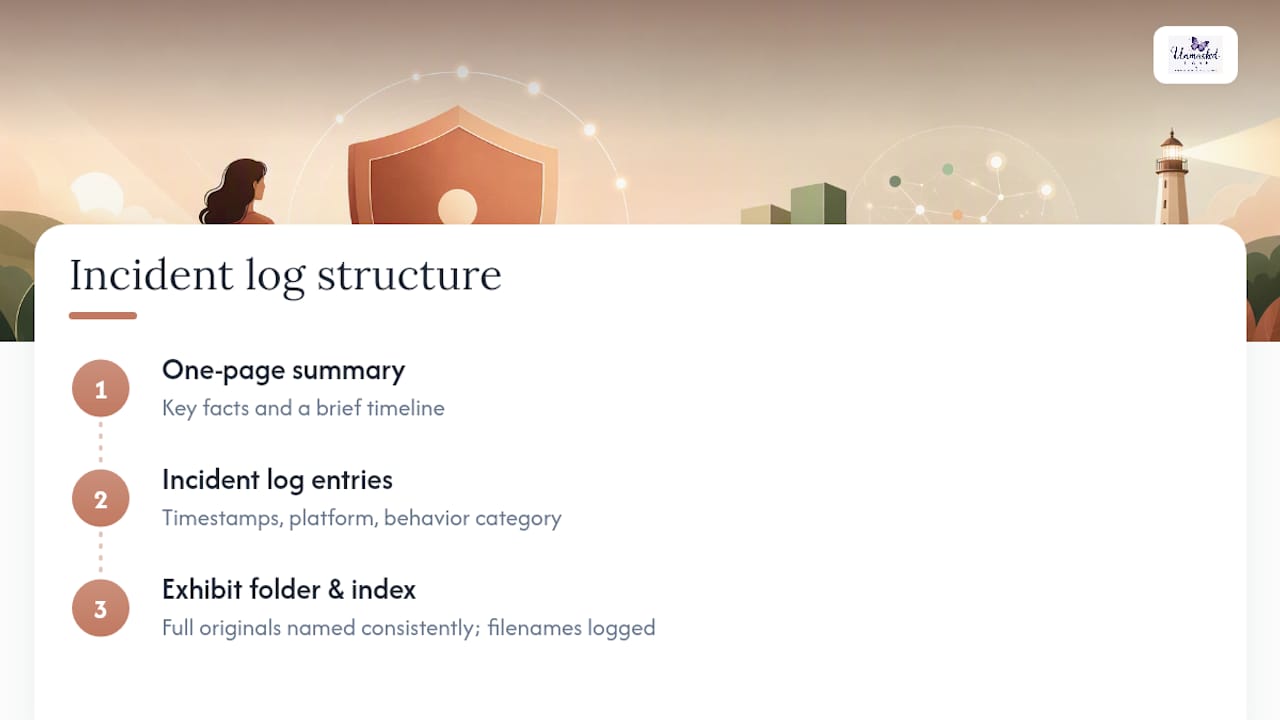
Back up files in a place the other person can’t reach: an encrypted cloud account only you know about, or a sealed copy with a trusted friend. Be mindful that files carry metadata, so a shared computer’s file history can still expose what you’ve saved.
Turning a Log Into a Pattern You Can See and Act On
A single incident rarely tells you much. A log of fifteen incidents over three months tells you almost everything.
Look at your entries along a few axes:
- Frequency. Are incidents getting closer together?
- Escalation. Is the intensity rising, or is it holding steady?
- Retaliation after boundaries. Do things get worse specifically after you say no or ask for space?
- Impact. Is this affecting your sleep, your work, your parenting, your friendships?
Regularly logging both difficult moments and calm stretches, not just the worst days, is what actually reveals frequency and pattern rather than a handful of isolated incidents. That consistency is what the National Domestic Violence Hotline recommends for anyone trying to see a relationship clearly over time.
Once you have enough entries, condense them into a one-page summary: a short timeline, the recurring behavior categories, and an index of your exhibits by filename. This approach aligns with examples of defense strategies for domestic violence that emphasize the importance of clear and consistent documentation, though you should always seek advice from local counsel. A behavior-impact-source structure like this is also what helps family court professionals assess a documented pattern efficiently, though any legal use should go through local counsel first, not the log alone.
Keep the summary factual. Note what was observed and what it affected, and let a therapist, advocate, or attorney draw conclusions about relevance. Your structured reflection on whether a pattern qualifies as emotional abuse is valid data, but the interpretation of what to do with it belongs to a professional.
A Copy-Ready Template and Pre-Entry Safety Checklist
Paste this into your private notes app and fill it in after each incident:
- Date/time:
- Platform/location:
- People present:
- Exact quotes:
- Behavior category:
- Facts (2 to 5 sentences):
- Impact:
- Witnesses:
- Evidence filenames:
- Follow-up:
Before you write anything, run a quick check: Is this device private? Does anyone else have access to it? Who holds the backup? Is it actually safe to write right now? If any answer is no, wait until it’s a yes, or skip the entry entirely and log it from memory later.
Once you’ve got several entries, pull the recurring behavior categories and dates into a single summary page. That’s your exhibit index, and it’s the version worth bringing to a therapy session or an advocate.
Why This Kind of Logging Matters Without Overreaching
This article is educational, not a diagnostic tool. Nothing here labels another person’s mental health, and nothing replaces a licensed therapist or advocate’s judgment. What structured logging does is turn scattered, hard-to-articulate experiences into something concrete enough to work with.
Unmaskedcare’s reflection tools and AI Decoder exist for exactly this gap between “something feels wrong” and having language for it. The privacy-focused evidence file feature was built around the same principle running through every source cited here: keep it factual, keep it private, keep it consistent.
If you’re in crisis, call 988 or 1-800-799-7233 right now.
Try a Private, Structured Way to Track What’s Happening
A notes app gets the job done, but it doesn’t help you see the pattern, name the behavior, or draft a response when you’re mid-argument and can’t think straight. Unmasked Care’s evidence file feature was built specifically for that gap: a privacy-minded space to log incidents with the same fields covered above, plus templates and a printable red-flags checklist you can keep alongside it.
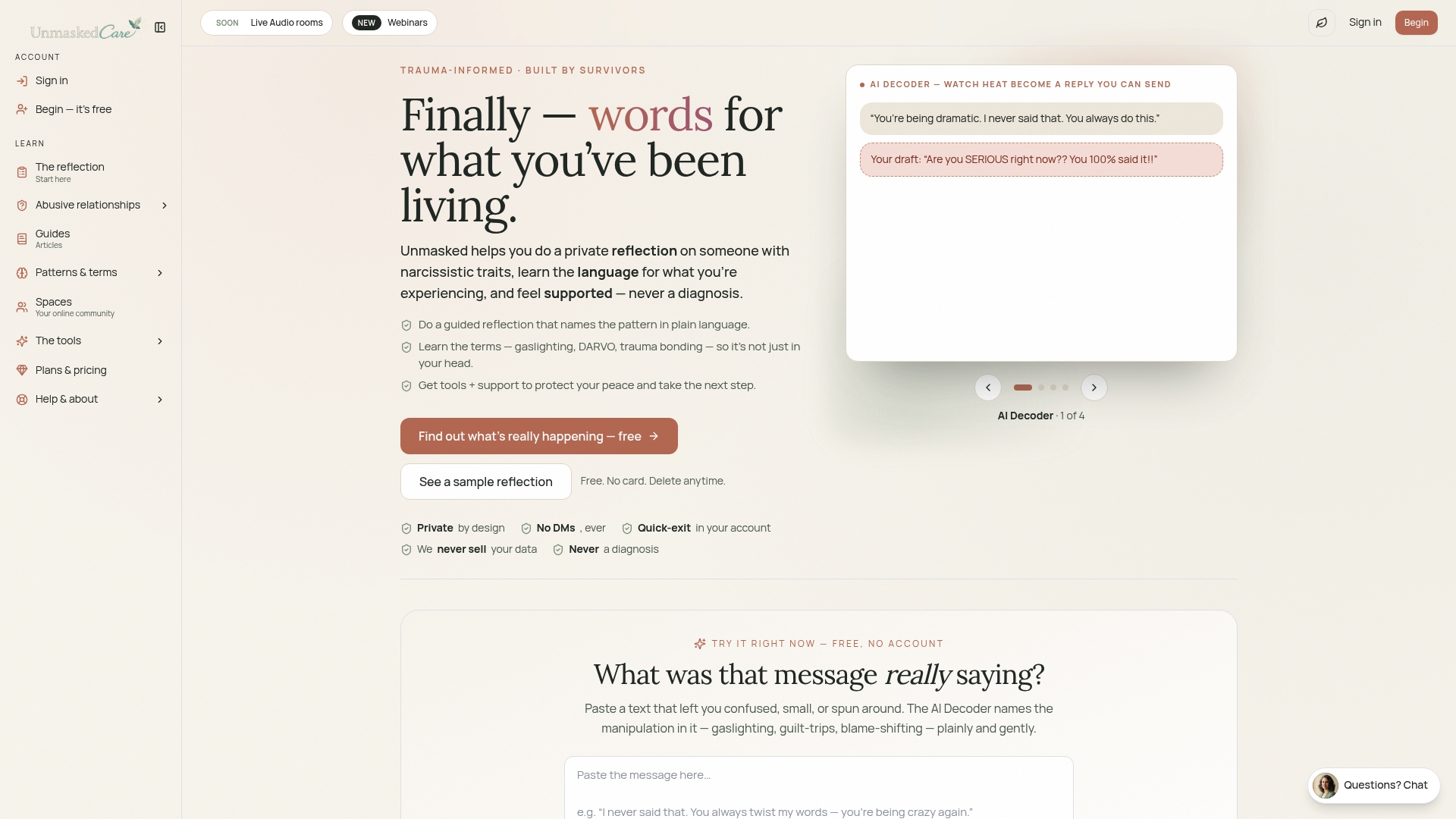
Where a plain log leaves you guessing at what a pattern means, Unmasked Care’s AI Decoder helps you name the manipulation tactic in a specific message, whether that’s gaslighting or DARVO, without diagnosing the person behind it. That’s the difference between a stack of screenshots and a document you can actually bring to a therapist. Visit the features page to see how the evidence file, templates, and AI Decoder work together.
Sources
- Documenting abuse | The National Domestic Violence Hotline
- Improving medical documentation for domestic violence (NIJ / OJP)
- The importance of documenting abuse (Document the Abuse)
For jurisdiction-specific questions, consult a local advocate or attorney rather than relying on general guidance alone.
This article is general information, not a substitute for advice from a qualified doctor. Consult a qualified healthcare professional about your own circumstances before acting on anything here.