
A relationship timeline exercise is a chronological log of specific incidents, quotes, and behaviors, most often used to document gaslighting, DARVO, and other manipulation patterns in an abusive relationship. It helps you stop relitigating the past in your head, spot patterns you might otherwise miss, and build a record that can support therapy, safety planning, or legal steps. If you are in immediate danger, call 988 (Suicide & Crisis Lifeline) or 1-800-799-7233 (National Domestic Violence Hotline).
TL;DR:
- A relationship timeline should be continuously updated with precise dates, locations, witnesses, quotes, behaviors, impacts, and evidence to record manipulation patterns accurately.
- Digital evidence must be backed up securely outside shared devices or accounts, with screenshots, voicemails, and chat exports preserved untouched.
- Review sessions of the timeline should be limited to 20–30 minutes and conducted with grounding techniques to prevent emotional distress or dissociation.
- Patterns such as escalation, timeline-rewriting, DARVO, triangulation, or cycle of love-bombing and devaluation reveal the true nature of the relationship.
- Sharing the timeline should be selective, primarily with trusted professionals, and used to prepare for therapy, legal action, or safety planning instead of confronting the abuser directly.
Table of Contents
- Building a Relationship Timeline: The One-Page Template
- How Do You Record Incidents Without Distorting Them?
- What Patterns Should You Look for Across Entries?
- Keeping the Timeline Safe, Private, and Usable Later
- Turning the Timeline Into Action
- What This Exercise Can and Cannot Do for You
- Start With the Template, Then Get Backup Built for This
- Sources
Building a Relationship Timeline: The One-Page Template
You do not need special software or a therapist’s referral to start a timeline of a relationship marked by manipulation. You need one page, a consistent set of fields, and the discipline to fill them in the same way every time. Advocacy guides recommend a “clean timeline” paired with a separate exhibits folder, so the narrative stays readable even as the evidence pile grows, according to guidance from Living Numb on documenting emotional abuse.
Use these fields for every incident row:
- Date and time (be as precise as you can, even if it is approximate)
- Platform or location (text message, in person at the apartment, phone call)
- People present (name witnesses if any, or note “no witnesses”)
- Exact quote (what was said, in quotation marks, marked “paraphrase” if you can’t recall word for word)
- Observable action (what happened, not how you interpreted it)
- Behavior category (gaslighting, threat, financial control, triangulation, etc.)
- Immediate impact (what you did or felt right after, kept factual: “left the room,” “canceled plans”)
- Exhibit reference (file name of any screenshot, voicemail, or photo tied to this row)
- Follow-up action (told a friend, saved a screenshot, nothing yet)
A single example row might read: March 3, 2026, 9:40 PM, text message, no witnesses. Quote: “I never said that, you’re remembering it wrong.” Observable action: partner denied a conversation that has a saved text thread contradicting the denial. Category: gaslighting, timeline-rewriting. Impact: reread old texts for 45 minutes to confirm own memory. Exhibit: 03_Exhibits/screenshots/2026-03-03_text.png. Follow-up: saved screenshot, told sister.
For storage, a simple three-folder structure keeps things presentable if you ever need to hand the material to someone: 01_One-Page-Summary, 02_Incident-Log, and 03_Exhibits with subfolders for screenshots, emails, and voicemails. Tying each exhibit’s file name to its incident row, as recommended in the same Living Numb documentation guide, means nothing gets lost or orphaned six months later when you actually need it.
How Do You Record Incidents Without Distorting Them?
The value of a relationship history tool collapses the moment entries blur fact with interpretation. An abuser who practices DARVO (deny, attack, reverse victim and offender) counts on your account sounding emotional and unreliable. A factual log denies them that opening.
Follow this sequence each time something happens:
- Write it down as soon as it’s safe. Memory degrades fast, and abusers often bank on you doubting your own recollection days later.
- Separate the fact from the feeling. Record what was said and done in one section; if you want to note your emotional response, put it in a clearly labeled separate line, not blended into the incident description.
- Use verbatim quotes whenever you can, and label anything else as paraphrase. “He said, ‘you’re too sensitive’” is stronger evidence than “he was dismissive.”
- Preserve digital evidence before it disappears. Screenshot messages with the timestamp visible on screen, save voicemails to a separate app or cloud account, and export chat threads rather than relying on a platform that lets the other person delete messages. Do not edit, crop out timestamps, or annotate the original file.
- Back up outside the device you share access on. If you and the other person use a shared computer, family plan, or synced cloud account, that is not safe storage.
The FACT incident-log method, which stands for Facts, Aftermath, Context, and Track, was built specifically for documenting gaslighting because it forces observable behavior into its own field, separate from how it made you feel. That separation is what makes the log hard to argue with, including by your own doubting inner voice at 2 AM.
Pro Tip: Keep a low-key backup, like a password-protected note synced only to your own private cloud account, in case you need to document covertly for safety reasons. If documenting itself feels dangerous, given your specific situation, pause and reach out to a trusted support person or 1-800-799-7233 before continuing.
What Patterns Should You Look for Across Entries?
A single incident tells you something happened. Ten incidents, laid end to end, tell you what kind of relationship you’re in. That shift, from isolated moment to visible pattern, is the actual point of a couples timeline activity built for abuse documentation rather than for logging fond memories.
Once you have a handful of entries, pull them into one chronological sheet and tag each row with the pattern it shows:
- Escalation — incidents growing more frequent, intense, or public over time
- Timeline-rewriting — the other person insisting events happened differently, or denying them outright
- DARVO — being accused of the very behavior you just described
- Triangulation — bringing in a third party to validate their version or undermine yours
- Love-bomb and devalue cycles — periods of intense affection followed by withdrawal or criticism
Connecting entries that show repetition is the actual mechanism that makes documentation useful against gaslighting specifically, since a pattern is far harder to explain away than any one moment in isolation, according to pattern-documentation guidance from Trauma Content. A glossary explanation of DARVO can help you name that tactic precisely instead of settling for a vaguer description when you tag a row.
Reviewing your own timeline can activate real distress, so cap review sessions at 20 to 30 minutes, and use a grounding strategy (naming five things you see, slow breathing) before and after. If a session leaves you shaking or dissociated, stop and treat that as information about your readiness, not a failure to push through.
Keeping the Timeline Safe, Private, and Usable Later
Documentation only helps if it survives long enough to be useful, and if creating it doesn’t put you at greater risk. Domestic violence advocates recommend recording dates, times, descriptions, and preserving message and voicemail evidence precisely because a contemporaneous record holds up better than memory alone, per The Hotline’s guidance on documenting abuse.
Storage options carry different tradeoffs:
- Encrypted local files on a device the other person cannot access, ideally password protected
- Cloud storage with two-factor authentication, using an account the other person has never seen
- Physical backups (printed copies, a notebook) stored outside the shared home if leaving is a live possibility
- Consider a covert backup (a trusted friend’s email, a locked box elsewhere) if you believe discovery would escalate risk
Share the finished timeline selectively: a therapist, a domestic violence advocate, or an attorney, not the person the timeline documents. Educational note: this exercise is a documentation and reflection tool, not a diagnostic instrument, and nothing here should be read as diagnosing another person’s mental health.
If a single incident involved sexual assault, preserve evidence before showering or changing clothes and seek medical attention, since that evidence window closes fast, per The Hotline’s guidance on immediate preservation after assault. If you are in danger right now, call 988 or 1-800-799-7233.
Turning the Timeline Into Action
A timeline that only sits in a folder has done half its job. The other half is using it to prepare for the conversations and decisions ahead.
- Build a one-page summary for a therapist, advocate, or attorney: the three to six most serious incidents, dates, a one-line description each, and the exhibit file names tied to them.
- Draft short, factual scripts for boundary-setting or de-escalation based on patterns you’ve logged, but never share the timeline itself with the person it documents.
- Map high-risk windows. If entries cluster around paydays, holidays, or after specific triggers, build your safety plan around those windows specifically rather than treating every day as equal risk.
- Bring the timeline into therapy gradually, not as unsupervised homework. Clinical trauma timelines that use a distress rating and are built collaboratively across sessions tend to work better than solo review, according to clinical guidance on trauma timeline worksheets.
- Stop documenting and seek immediate support if you’re in active crisis, if reviewing entries triggers thoughts of self-harm, or if the abuser discovers the log and safety changes suddenly.
A structured safety plan built from your own documented triggers will fit your situation more precisely than a generic checklist, and reviewing boundary-setting fundamentals alongside your scripts can sharpen the language you use when a boundary actually gets tested.
What This Exercise Can and Cannot Do for You

A timeline restores your sense of reality and reveals repetition, but it is not therapy and it is not a substitute for a trained clinician’s judgment. Documentation can be genuinely activating, which is why readiness and grounding skills matter before you dig into old incidents alone. This exercise is educational, not diagnostic, and nothing in it should be used to diagnose another person.
Unmasked Care built its structured reflection tools, AI Decoder, and private evidence file specifically because generic journaling apps were never designed for someone tracking gaslighting or DARVO. Use a licensed therapist or advocate for the parts a template genuinely cannot replace. If you’re in crisis, call 988 or 1-800-799-7233.
— Unmasked Care Team
Start With the Template, Then Get Backup Built for This
Unmasked Care gives you what a blank document or generic notes app can’t: fields built specifically for gaslighting and DARVO documentation, an AI Decoder that helps you name manipulation tactics in real messages before you respond, and a privacy-focused evidence file that keeps exhibits organized without living in a shared cloud account.
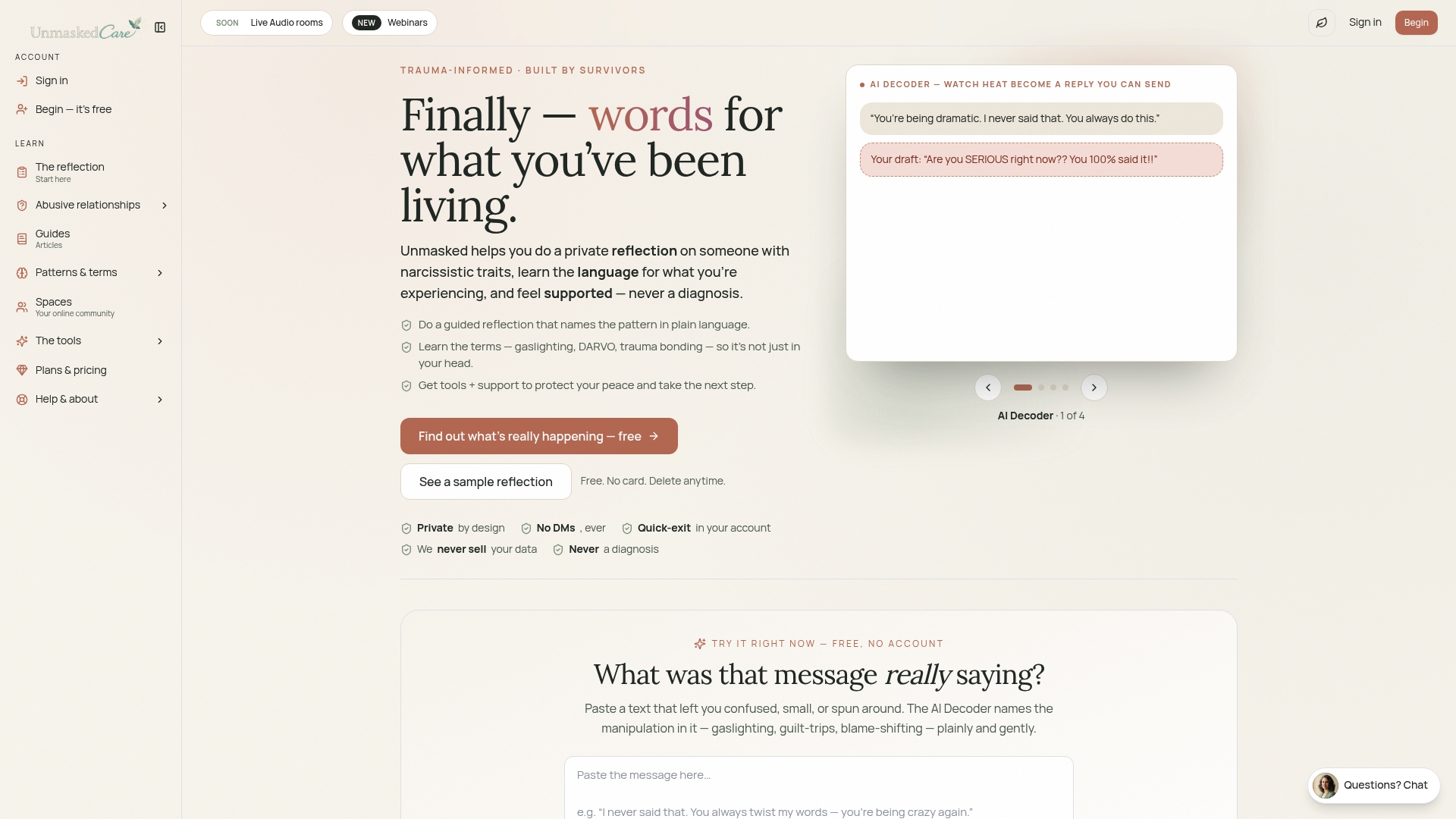
Start with the free one-page template and the gaslighting glossary entry to get your language precise. When you’re ready for guided reflection questions, pattern tracking across entries, and the AI Decoder to help draft a response before you send one, the paid tier unlocks all three without changing where your data lives. Try the free tools first, then decide if the deeper features fit what you’re building.
Sources
- Documenting Abuse - The Hotline
- Trauma timeline worksheet overview
- How to document emotional abuse for court or HR (Living Numb)