
Getting ready for a therapy session comes down to four things: confirm the logistics, write a one-line agenda, pack what you need, and give yourself two minutes to breathe before you walk in or log on. That’s the whole system. Everything else in this guide is detail on how to do each part well.
Here’s the short version you can act on right now:
- Logistics: Confirm the time, format (in person or video), and payment method the night before.
- Agenda: Write down one to three things you want to talk about, in plain language, no more than a sentence each.
- What to bring: Photo ID, insurance card, a medication list, and a notebook or notes app.
- Emotional prep: Do a 60 second breathing exercise beforehand and remind yourself that you don’t need a polished story to begin.
This article is educational and does not diagnose or treat any condition. If you are in crisis, contact the 988 Suicide & Crisis Lifeline by calling or texting 988, or reach the National Domestic Violence Hotline at 1-800-799-7233.
Key Takeaways
Preparing well for a therapy session means handling logistics in advance, arriving with a short written agenda, and giving yourself space to ground before and after the appointment.
| Point | Details |
|---|---|
| Confirm logistics early | Check appointment time, format, insurance, and payment the day before to avoid last-minute stress. |
| Write a one-line agenda | List one to three priorities in plain language so session time isn’t spent remembering what to say. |
| Pack the essentials | Bring ID, insurance card, a medication list, and brief notes to save time during intake. |
| Expect assessment, not resolution | The first session typically runs 45 to 50 minutes and focuses on background and goal-setting, per the American Psychological Association. |
| Use Unmasked Care tools to prepare | The AI Decoder and red-flags checklist help you organize specific examples and language to bring into session. |
Table of Contents
- Practical Logistics: Appointment, Paperwork, and What to Bring
- What Usually Happens in a First Therapy Session?
- How to Prepare Emotionally for a Therapy Session
- Teletherapy vs. In-Person Sessions: What to Check Beforehand
- Building a One-Page Agenda and Taking Useful Notes
- Questions to Ask Your Therapist
- How to Tell If a Therapist Is a Good Fit
- What to Do After a Therapy Session
- What the Evidence Says About Session Timing and Preparation
- How Unmasked Care Fits Into Therapy Preparation
- How Unmasked Care Can Help You Prepare Faster
- Sources
Practical Logistics: Appointment, Paperwork, and What to Bring
Most of the anxiety around a therapy session has nothing to do with therapy. It’s the parking lot you’ve never found, the insurance card you can’t locate, the video link that won’t load. Clearing those obstacles the day before means the actual session time gets spent on the work you came to do, not on logistics you could have handled at your kitchen table.
Start with the appointment itself. Confirm the exact time, the format, and whether it’s a first visit or a follow-up. If it’s teletherapy, test the video platform at least once before the actual appointment, not five minutes beforehand when a software update decides to run. If it’s in person, check the address against a map app the night before. Offices move, buildings get renumbered, and “easy to find” is a phrase only the person who works there believes.
Payment and insurance logistics deserve their own five minutes—check this practical checklist on how to prepare for divorce consultation effectively to see how preparing documents ahead can save time. Call or check your insurer’s portal to confirm the practice is in network, what your copay is, and whether a referral is required. Practical intake elements like a photo ID, insurance card, and a current medication list save real time during the appointment and give the clinician an accurate starting picture, according to guidance from the American Psychological Association.
Here’s a checklist worth keeping on your phone:
- Photo ID and insurance card (or payment method if paying out of pocket)
- A written or typed list of current medications, including dosages
- Brief notes on what you want to discuss, kept to a few lines
- Emergency contact information, especially for a first appointment
- Prior records or a summary of past treatment, if relevant and available
- Your calendar open, so you can book the next session before you leave
Many practices send intake forms electronically before the first visit. Filling those out in advance, rather than in the waiting room, gives you more room to think through your answers and less pressure to rush.
Pro Tip: If your practice allows it, email or upload your intake forms and medication list a day ahead. Therapists who receive this information beforehand often spend less of the first session on paperwork and more on actually talking with you.
What Usually Happens in a First Therapy Session?
The first session is an assessment, not a fix. Clinicians use it to build a picture of your background, your current concerns, and what you want out of treatment, not to solve the problem in fifty minutes. Knowing that going in takes pressure off the idea that you need to say everything perfectly the first time.
A standard psychotherapy appointment commonly functions as an intake or psychosocial assessment, and many clinicians schedule sessions around 45 to 50 minutes, using that time to gather history, explain confidentiality, and set early goals. Expect questions about your background, what brought you in now, prior treatment history, and what you hope changes as a result of therapy. None of this needs to come out polished. Clinicians are trained to ask follow-up questions and draw out the relevant pieces themselves.
Confidentiality gets addressed early, and it’s worth actually listening to this part rather than nodding along. Therapists explain what stays private and the specific, limited situations where they’re required to break that confidentiality, generally involving imminent risk of harm to yourself or someone else, or suspected abuse of a child or vulnerable adult. Ask for clarification if any of it is unclear. It’s not a legal document, but it’s a real agreement, and you should understand it before you start disclosing sensitive material.
A few things commonly happen in a first session:
- Review of intake paperwork and any screening questionnaires already completed
- A structured conversation covering background, presenting concerns, and history
- Discussion of confidentiality and its limits
- Early, tentative goal-setting rather than a finished treatment plan
- Scheduling the next appointment
Many practices also use brief screening tools, such as the PHQ-9 for depression symptoms or the GAD-7 for anxiety symptoms, as part of intake. These are questionnaires, not diagnostic verdicts, and answering them honestly gives the clinician a useful baseline to track over time.
How to Prepare Emotionally for a Therapy Session
Nerves before a first appointment are close to universal, and therapists expect them. Clinicians are trained to guide the conversation and are not waiting for you to arrive with a tidy, chronological account of your life, according to Psychology Today. You do not need a diagnosis, a script, or a polished narrative to begin.
A short grounding exercise right before the session helps more than most people expect. Try box breathing: inhale for four counts, hold for four, exhale for four, hold for four, and repeat that cycle four or five times. It’s simple enough to do in a car, a waiting room, or at your desk two minutes before a video call starts.

Setting realistic expectations matters just as much as calming your nerves. Therapy is collaborative and it unfolds over multiple sessions, not one. The first meeting establishes the relationship and the plan; the results tend to show up gradually, through consistent engagement over weeks and months, not from a single conversation.
Before the appointment, a short journaling exercise can sharpen what you actually want to say. Try answering three prompts:
- Why am I starting or continuing therapy right now, specifically?
- What is one thing that’s been on my mind this week that I want to mention?
- What would make this session feel worthwhile by the end of it?
You’re also allowed to set boundaries about what you discuss and when. If there’s a topic you’re not ready to open up about, you can say so directly. A therapist worth continuing with will respect that pace rather than push past it.
Pro Tip: Block out 30 to 60 minutes after your session for something low effort, a walk, tea, quiet music. First sessions in particular can be emotionally draining, closer to a workout for your nervous system than a casual conversation, so plan for recovery rather than jumping straight into a demanding task.
Teletherapy vs. In-Person Sessions: What to Check Beforehand
The format changes what you need to prepare. A video session and an office visit each carry their own friction points, and most of them are fixable with five minutes of planning.
For teletherapy, test your camera, microphone, and internet connection before the appointment, not during it. Find a private room where you won’t be interrupted, and use headphones if walls are thin or you share the space with others. Have a backup plan ready: a phone number to call if the video connection drops, so a technical glitch doesn’t turn into a lost session.
For in-person visits, build in an arrival buffer of ten to fifteen minutes to account for parking, transit delays, or a building layout you haven’t navigated before. If the waiting room causes anxiety, note that to yourself ahead of time; some practices offer separate entrances or flexible arrival timing if you ask.
Privacy concerns show up differently depending on format. In an office, the concern is usually who might see you in the waiting room. At home, it’s who might overhear the conversation. If you share a living space and can’t guarantee privacy, tell your therapist directly. They can adjust pacing around sensitive topics or suggest alternative times when the space is more secure.
| Factor | Teletherapy | In-Person |
|---|---|---|
| Environment | Private room, closed door, minimal background noise | Waiting room, then private office |
| Tech needs | Stable internet, working camera and microphone, headphones | None beyond a charged phone for directions |
| Interruption risk | Housemates, kids, notifications | Waiting room visibility, running late |
| What to pack | Notes, water, headphones | ID, insurance card, notes, payment |
Pro Tip: If you’re doing teletherapy from a shared space and can’t fully guarantee privacy, headphones plus a fan or white noise app running in the next room can mask your side of the conversation without needing to explain the situation to anyone.
Building a One-Page Agenda and Taking Useful Notes
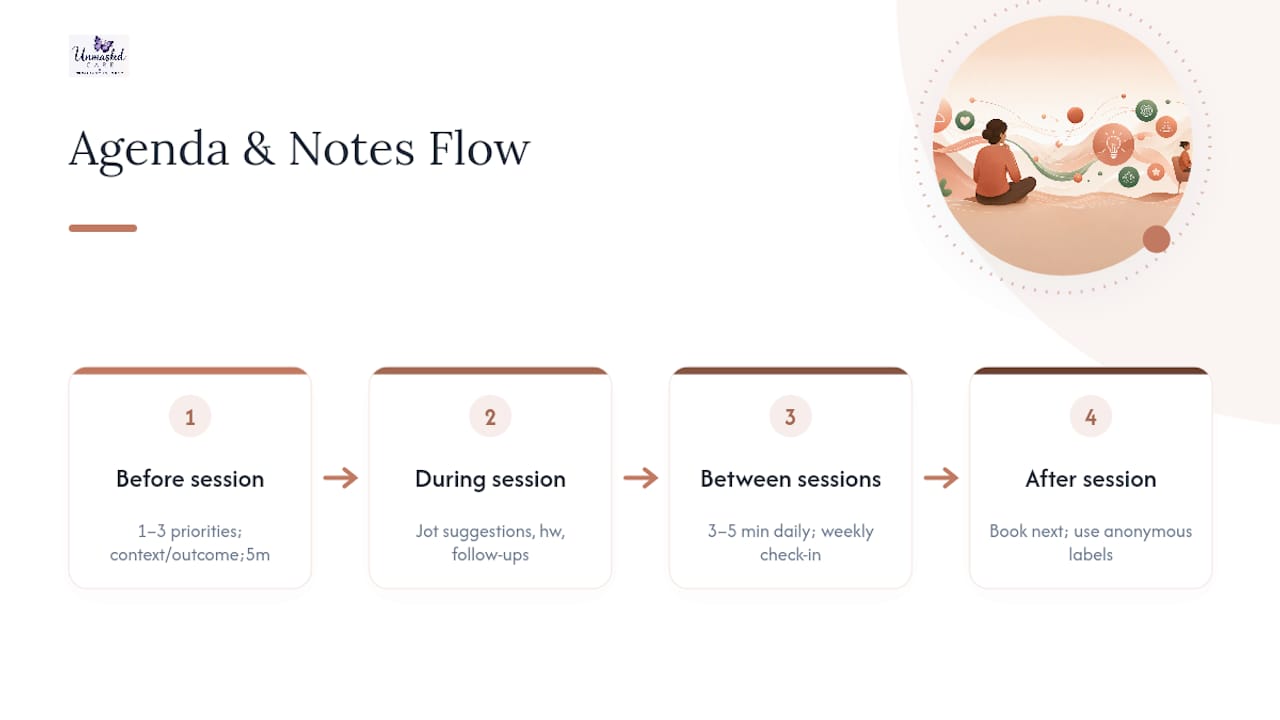
A one-page agenda takes five minutes to write and can save fifteen minutes of session time spent trying to remember what you meant to say. Keep it simple: one to three priorities, a sentence of context for each, and what you’d consider a useful outcome for that specific session. That’s the whole template. It doesn’t need headers or bullet points inside the therapy room, just a legible note on your phone or a scrap of paper.
During the session, jot down anything the therapist suggests, any homework assigned, and follow-up items you don’t want to lose track of. You don’t need a transcript. A few words per point is usually enough to jog your memory later: “breathing exercise before bed,” “journal about the argument with mom,” “ask about EMDR next time.”
Between sessions, a short daily or weekly reflection habit compounds over time. Client engagement and consistent between-session practice are among the most reliable, evidence-aligned factors in getting real value out of therapy, according to Simply Psychology. Three to five minutes a day, or a slightly longer weekly check-in, is enough to notice patterns worth bringing up next time.
The between-session work, not just the fifty minutes in the room, is often where the actual behavioral change takes root. A short daily note about what triggered a reaction, or what felt different, gives the next session something concrete to build on instead of starting from scratch.
Before you leave a session, or right after a video call ends, open your calendar and book the next appointment. It’s a small habit that prevents weeks of unintentional delay between sessions, which can stall momentum on whatever you’re working through.
If you’re worried about privacy on a shared device or a notes app others might see, use non-identifying labels. “Tuesday thoughts” works just as well as anything more specific, and it keeps sensitive material out of casual view.
Questions to Ask Your Therapist
Asking direct questions in the first few sessions isn’t a sign of distrust. It’s how you figure out whether the working relationship is going to hold up over time. Establishing a strong therapeutic rapport is one of the strongest predictors of therapy success, and using early sessions to ask about a therapist’s background, training, and approach is a legitimate part of that process, according to Harvard Health.
Here’s a working question bank:
- What is your training and licensure, and do you have experience with concerns like mine?
- What treatment approach do you use, and why does it fit what I’ve described?
- What does a typical course of treatment look like for something like this, in terms of pacing and length?
- What are your fees, do you accept my insurance, and what is your cancellation policy?
- How will we track whether therapy is actually working?
- Should I expect homework or exercises between sessions?
- What is your protocol if I’m in crisis outside of scheduled sessions?
If a short consultation call is offered before the first full session, emailing a few of these questions ahead of time can produce clearer, more thought-out answers than trying to cover everything live in a rushed ten-minute call.
Pay attention to how the answers land, not just what they say. A therapist who explains their reasoning clearly and adjusts their language when you look confused is showing you how they’ll handle harder conversations later. One who brushes off the question or gives a vague, generic answer is giving you useful information too.
How to Tell If a Therapist Is a Good Fit
Good fit tends to show up early and consistently: you feel respected, explanations make sense, goals get set collaboratively rather than dictated, and there’s a regular check-in about whether things are actually working. None of that requires a perfect first session. It requires a pattern you can notice over two or three visits.
A few non-clinical red flags are worth taking seriously. Watch for poor boundaries, such as running consistently over time without discussion, a lack of transparency about fees or billing surprises, a tendency to minimize what you bring up, or any suggestion that you should cut off other sources of support, like friends, family, or a support group, without a clear clinical rationale.
There’s no fixed number of sessions that tells you whether to stay or go. Instead, judge it against whether documented goals are moving, even slowly, and whether the working relationship feels collaborative. Research reviews and clinical guidance point to periodically checking progress and considering a second opinion if things have genuinely stalled, according to Harvard Health.
If fit seems off, you have options short of just disappearing:
- Raise the concern directly with the therapist; many issues are fixable with one honest conversation.
- Ask for a referral if the specialty or approach isn’t the right match.
- Pause sessions if you need time, rather than abandoning the process entirely.
A printable red-flags checklist can help you track patterns across sessions if you’re unsure whether what you’re noticing is a real concern or just an off day.
Pro Tip: Keep a running note titled “fit check” with one line per session: something that felt good, something that felt off. Patterns are much easier to spot in writing than in memory alone.
What to Do After a Therapy Session
What happens in the twenty minutes after a session matters more than most people plan for. A short, deliberate routine helps you actually retain what came up, instead of letting it blur into the rest of your day.
Start with something physical and low effort: a glass of water, a short walk, a few minutes of quiet before checking your phone. The first session in particular can be emotionally draining in a way that resembles physical fatigue, and giving yourself a buffer before jumping into other tasks helps you recover rather than push through, according to Psych Central.
Before the memory fades, jot down anything the therapist recommended or assigned, and confirm your next appointment if you haven’t already. A quick post-session checklist:
- Take a few minutes to ground yourself: water, a short walk, or quiet before re-engaging with your day
- Write down homework or recommendations while they’re fresh
- Note one thing that helped and one thing that felt hard
- Confirm your next appointment is on the calendar
A brief reflective note, just a sentence or two on what helped and what felt hard, makes the next session more productive because you’re not trying to reconstruct the last one from memory.
If a session brings up intense distress that doesn’t settle with grounding techniques, that’s worth taking seriously rather than waiting out. Contact the 988 Suicide & Crisis Lifeline by calling or texting 988, or reach the National Domestic Violence Hotline at 1-800-799-7233 if the distress involves safety concerns in a relationship.
What the Evidence Says About Session Timing and Preparation
The guidance in this article isn’t guesswork. A standard psychotherapy appointment commonly functions as an intake or psychosocial assessment, and clinicians typically schedule around 45 to 50 minutes for that first meeting, according to the American Psychological Association.
Client engagement and between-session practice, like brief homework or a short daily reflection, are among the most consistent, modifiable factors linked to better therapy outcomes across different treatment approaches. The fifty minutes in the room matter, but what happens between sessions often determines whether progress actually holds.
Establishing rapport early also carries real weight. Asking questions about a therapist’s training and approach in the first sessions is a valid, evidence-aligned way to check fit rather than a sign of impatience, according to Harvard Health.
This article is educational content, not a diagnostic tool or a substitute for professional care. If you are in crisis, call or text the 988 Suicide & Crisis Lifeline, or contact the National Domestic Violence Hotline at 1-800-799-7233.
How Unmasked Care Fits Into Therapy Preparation
For people navigating relationships marked by manipulation or emotional volatility, walking into therapy with clear language for what’s been happening changes the conversation. Instead of “things have been hard,” a session can start with specific patterns, specific incidents, specific questions, and that specificity tends to move the work forward faster.
Unmasked Care’s structured reflection tools help you name what you’ve experienced using precise, behavior-focused terminology, so you arrive at a session with clarity rather than a jumble of unsorted feelings. Tools like a red-flags checklist can help you organize examples worth raising with a therapist, and a searchable therapist directory can help you find a clinician experienced with these specific relationship dynamics.
None of this replaces clinical care, and none of it diagnoses anyone. It’s a way to organize your own observations and priorities so the time you spend in therapy goes further. Understanding a pattern like gaslighting, for instance, gives you language a therapist can work with immediately, rather than spending a session helping you find the words first.
How Unmasked Care Can Help You Prepare Faster
If you’ve been trying to sort through confusing messages or manipulative exchanges before deciding what to bring up in therapy, the Free AI Decoder analyzes specific messages and names the tactic at play, so you walk into your session with a concrete example instead of a vague feeling that “something was off.” It’s the difference between telling a therapist “he does this thing” and showing them exactly what happened, in specific language they can respond to right away.
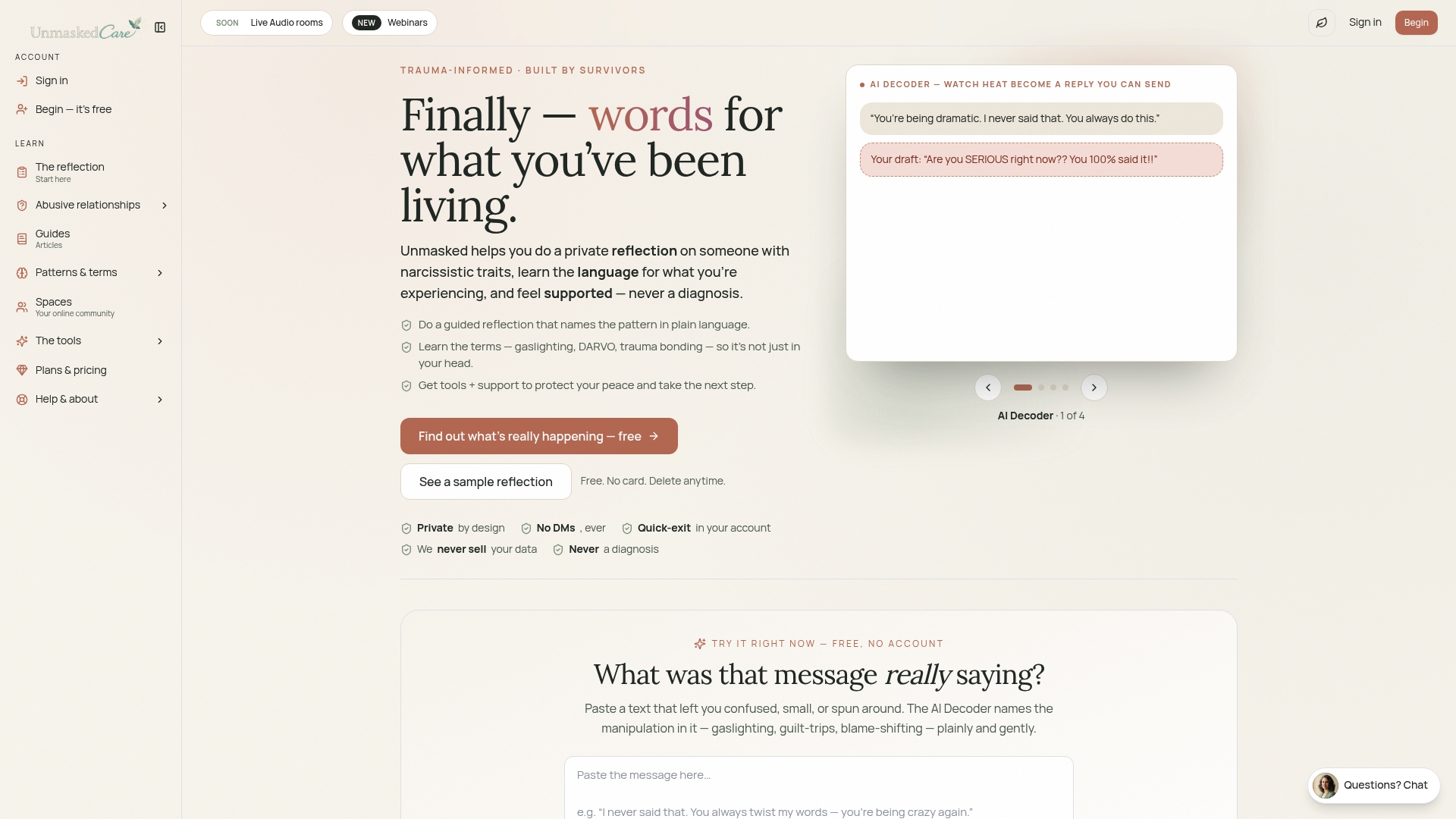
Beyond the decoder, Unmasked Care’s full feature set includes a printable red-flags checklist and a growing glossary of behavior patterns, both useful for building the one-page agenda covered earlier in this guide. If you’re not sure where to start, try running one recent conversation through the AI Decoder before your next appointment and bring what it surfaces with you.
Sources
The guidance in this article draws on published clinical guidance rather than anecdote, and it’s worth reading the originals if you want more depth on any specific point.
- How to prepare your first therapy session | Psychology Today
- 10 questions to ask when choosing a therapist | Harvard Health
- How to prepare for therapy: Maximizing your treatment outcomes | Simply Psychology
For tools to help organize your own reflections before a session, Unmasked Care’s question and answer library and red-flags checklist are available at no cost. This article is educational and does not diagnose or treat any condition. If you are in crisis, call or text 988 for the Suicide & Crisis Lifeline, or contact the National Domestic Violence Hotline at 1-800-799-7233.
This article is general information, not a substitute for advice from a qualified doctor. Consult a qualified healthcare professional about your own circumstances before acting on anything here.