
Low contact is a harm-reduction strategy: you keep a relationship technically alive while limiting how often, how long, and about what you engage with a difficult family member. It works when the relative causes real emotional harm but full estrangement isn’t necessary, safe, or wanted. No contact becomes the better option when there’s active abuse, threats, or ongoing danger. If you’re in immediate danger, call 988 (Suicide & Crisis Lifeline) or 1-800-799-7233 (National Domestic Violence Hotline) right now.
TL;DR:
- Low contact limits interaction frequency and topics to reduce emotional harm, making relationships manageable without total cutoff.
- The decision to maintain low contact or move to no contact depends primarily on harm severity, dependency, caregiving needs, and social support availability.
- Specific tactics like setting response time frames, restricting topics, and using automation help sustain boundary enforcement over time.
- Escalate boundaries gradually when tested, document incidents, and rely on calm, scripted responses to maintain control and safety.
- Guilt and grief are natural, but building routines to process these feelings supports recovery and reinforces boundaries’ legitimacy.
Table of Contents
- What Do Low Contact and No Contact Actually Mean?
- How Do You Decide Which Option Fits Your Situation?
- Concrete Low-Contact Tactics You Can Start Today
- Scripts and Tools That Keep Interactions Calm
- What Happens When Boundaries Get Tested
- Taking Care of Yourself Through the Process
- Why Harm Reduction, Not Moral Middle Ground
- Getting Help Putting This Into Words
- Sources
What Do Low Contact and No Contact Actually Mean?
Low contact means shrinking the size of the relationship, not ending it. In practice, that looks like replying to texts within a reasonable delay instead of immediately, reducing phone call frequency to a few times a month instead of daily check-ins, or limiting conversation to logistics and small talk while steering clear of politics, parenting choices, or old grievances. Low contact functions as a harm-reduction strategy that sets specific limits on frequency, duration, topic, and channel, and it holds up best when those limits are consistent rather than adjusted case by case.
No contact removes the relationship’s access points entirely: blocked numbers, no shared events, no digital trail through mutual friends or social media.
Between those two sits structured contact, often used for co-parenting or caregiving, where interactions happen through a script, a third party, or a scheduled setting rather than spontaneously. Think of it as a continuum:
- Full contact: no limits, no gray rock, no channel restrictions
- Structured contact: scheduled, supervised, or third-party mediated
- Low contact: reduced frequency, fixed topics, delayed responses
- No contact: full cutoff across every channel
A spectrum framework like this helps you match the strategy to your actual constraints, whether that’s a shared custody agreement, financial dependency, or simply not wanting to explain a permanent cutoff to extended family.
How Do You Decide Which Option Fits Your Situation?
Four factors should drive the decision, in roughly this order of weight:
- Severity of harm. Occasional rudeness calls for different tactics than manipulation, threats, or physical intimidation.
- Dependency and obligation. Shared finances, a will, a business, or living under the same roof narrow your options and often push toward low contact as the more realistic starting point.
- Children or caregiving roles. If custody, eldercare, or a shared child is involved, structured contact frequently works better than either extreme.
- Social support. Do you have at least one person who knows what’s happening and can check in with you regularly?
Safety overrides everything else on this list. If there’s a credible threat to your physical safety, skip straight to no contact and safety planning, no matter what the other three factors suggest. Clinicians note that going no contact can bring real relief but also grief and logistical fallout, so plan for both regardless of which option you pick. Before you act, write one sentence: “My goal with this relationship right now is ___.” That sentence becomes your test for every decision that follows.
Concrete Low-Contact Tactics You Can Start Today
Vague intentions collapse under pressure. Specific rules survive it.
Set channel and timing rules. Pick one channel (usually text or email) and retire the others. Give yourself a response window, such as replying within 24 to 48 hours instead of the moment a message lands. This single change removes most of the impulsive, emotionally loaded replies that undo weeks of boundary work.

Limit meeting time and location. If you see the person, make it public, time-boxed, and exit-ready. A coffee shop visit with a 45-minute cap and your own car in the lot beats a holiday dinner with no clear end time.
Restrict topics, not just time. Decide in advance which subjects are open (weather, logistics, shared grandkids) and which are closed (your relationship choices, past conflicts, money). When a closed topic comes up, redirect once and disengage if it continues.
Use physical micro-boundaries at home. If you share a house, that might mean eating meals separately, using headphones during shared time, or designating one room as neutral territory.

Automate what you can. Message filters, folder rules that sort a relative’s texts away from your main inbox, and batch-checking messages once a day all reduce the emotional load of constant monitoring. Moving boundary enforcement out of the crisis moment and into a repeatable system, rather than deciding fresh in every conversation, is what makes low contact sustainable past the first hard week.

Pro Tip: Draft your standard replies in a notes app ahead of time. When a message arrives that would normally spike your heart rate, you’re pasting a pre-written line instead of composing one under pressure.
If you need help figuring out what to say in the moment, Unmasked’s guidance on setting boundaries walks through specific phrasing for common pushback.
Scripts and Tools That Keep Interactions Calm
The right words, decided in advance, do more work than willpower in the moment.
Keep responses short, neutral, and repeatable:
- “I can’t talk about that right now. Let me know if you need help with anything logistical.”
- “I hear you, but I’m not going to discuss that. What time works for pickup?”
- “That doesn’t work for me. I’ll check in again next week.”
This is the gray rock approach in miniature: flat tone, minimal detail, no emotional bait taken. Pair it with the BIFF method (Brief, Informative, Friendly, Firm) for written messages, and the broken-record technique, where you repeat the same short line rather than escalating into a new argument each time. Both techniques help maintain boundaries without turning every exchange into a debate.
On tools: turn on Do Not Disturb during set hours, filter a difficult relative’s messages into a separate folder, and check in once a day at a fixed time rather than reactively. For co-parenting or shared-custody situations specifically, a family-management plan can formalize these rules so they don’t rely on memory or goodwill.
Pro Tip: If a message makes your stomach drop before you’ve even opened it fully, that’s your cue to gray rock, not to respond in kind. The flatter your reply, the less fuel you’re handing back.
What Happens When Boundaries Get Tested
Watch for these signs that someone is testing or ignoring your limits: sudden guilt-tripping calls after weeks of silence (hoovering), other relatives suddenly relaying messages on the person’s behalf (flying monkeys), or a shift from direct contact to reputation attacks among mutual family and friends.
When it happens, escalate in steps rather than reacting all at once:
- Restate the boundary once, calmly and briefly, using a BIFF-style reply.
- Exit the conversation if the boundary is ignored a second time.
- Reduce access further, tightening channels or response windows.
- Move to no contact if the behavior continues or safety is at risk.
Document incidents as they happen, dated and specific, even if you never plan to use them legally. Documentation and social support are among the factors that make boundary changes easier to sustain over time, and a written record matters if you ever need legal protection. Practical safety and boundary-setting techniques apply here too, especially if physical safety is a concern.
If at any point you feel unsafe, contact 988 or 1-800-799-7233. Those numbers work 24/7.
Taking Care of Yourself Through the Process
Guilt and grief are common reactions to reducing contact, even when the relationship was genuinely harmful. That doesn’t mean you made the wrong call. It often means you’re mourning the relationship you wished you’d had, not the one that existed.
Build a debrief routine after difficult exchanges: a short walk, a text to a trusted friend, five minutes of writing down what happened before you file it away. This gives your nervous system time to settle instead of staying on alert.
- Talk to at least one person who knows the full context, not a sanitized version
- Use a structured tool, such as Unmasked’s guided reflections, to process specific incidents rather than replaying them in your head
- Watch for signs you need more support than peer check-ins can offer, including persistent sleep loss, panic responses, or thoughts of self-harm
Reducing contact is educational and, behavioral guidance, not a diagnosis of anyone involved, and it’s not a substitute for individualized professional care when you need it.
Why Harm Reduction, Not Moral Middle Ground
Low contact gets dismissed sometimes as indecisive, a failure to commit to either forgiveness or a clean break. That framing misses what the strategy actually does. It’s not an attempt to fix or rehabilitate a difficult relative, and it’s not a waiting room before eventual no contact. It’s a deliberate way to keep exposure to harm low while preserving whatever the relationship still needs to serve, whether that’s shared custody, aging-parent logistics, or simply not wanting a total rupture.
This is educational content, not a diagnosis of any specific person or relationship. If you are in immediate danger, call 988 or 1-800-799-7233. Low contact is a legitimate, structured choice, not a consolation prize for people who couldn’t go all the way to estrangement.
— Unmasked Care Team
Getting Help Putting This Into Words
Deciding on a strategy is one thing. Finding the right words in the actual moment, when a difficult message lands and your hands are already shaking a little, is another. Unmasked’s AI Decoder breaks down a manipulative or guilt-loaded message and helps you draft a calm, BIFF-style reply instead of reacting on impulse.
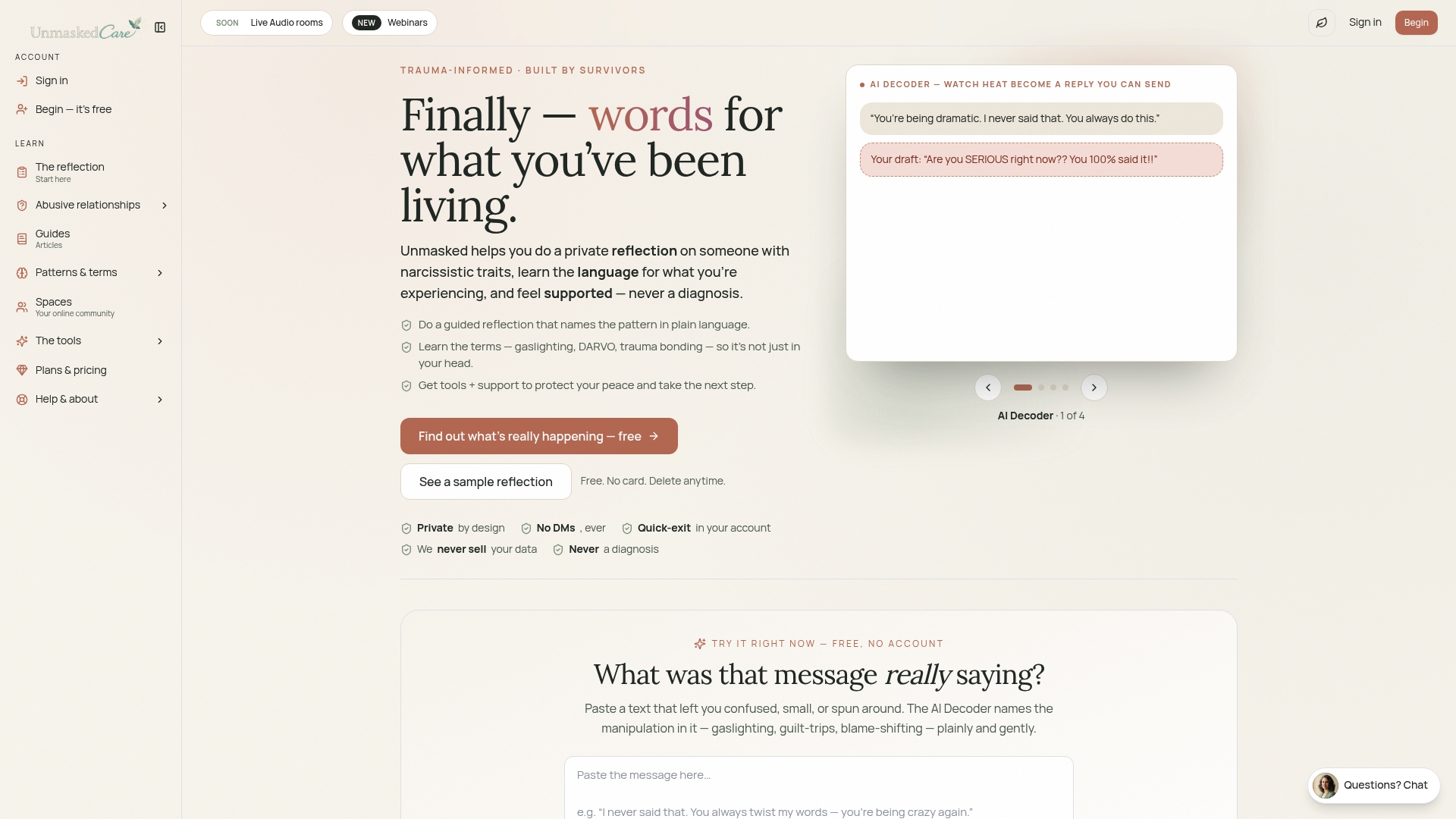
Guided reflections walk you through specific incidents step by step, so you’re building a clear record over time instead of relying on memory during an already stressful exchange. That record helps with the grief work too. Naming what happened, in plain language, is often what makes it easier to let go of guilt that was never yours to carry. If you’re ready to see how a decoded message or a guided reflection might work for your specific situation, start with the AI Decoder and see what a calmer reply actually looks like.
Sources
For deeper reading beyond this overview, the Cleveland Clinic’s guidance on going no contact covers grief and practical planning in more clinical detail. The Psychology Today piece on low contact lays out the harm-reduction framing this article builds on. For crisis support and practical tools, OASAS and the 988 Suicide & Crisis Lifeline are available around the clock. Unmasked’s curated abuse recovery resources round out the list for readers who want more.
- Going no-contact with parents (Cleveland Clinic)
- Low contact: A gentler path when estrangement feels too big (Psychology Today)
- OASAS guidance on crisis and practical tools (OASAS)