
A “favorite person” (FP) is someone a person with borderline personality disorder (BPD) leans on as their main source of comfort, validation, and stability. This is a lived-experience term, not a clinical diagnosis. If you feel unsafe right now, call or text 988 (Suicide & Crisis Lifeline), or call 1-800-799-7233 (National Domestic Violence Hotline).
- Feeling unsafe or in crisis: contact 988 or 1-800-799-7233 immediately.
- Feeling overwhelmed but not in danger: read the boundary steps below and consider Unmasked Care’s resources.
- Wanting to understand the dynamic first: keep reading for signs, mechanisms, and next steps for both people involved.
Key Takeaways
FP dynamics in BPD follow a predictable cycle of idealization, pressure, devaluation, and withdrawal, and both people need boundaries and outside support to break it.
| Point | Details |
|---|---|
| FP is not a diagnosis | The term describes a behavior pattern from lived-experience communities, not a clinical label. |
| Watch for the cycle | Idealization, pressure, devaluation, and withdrawal repeat unless addressed with treatment and boundaries. |
| Boundaries protect both people | Consistent limits and scripted responses reduce escalation without cutting off support. |
| DBT is the leading treatment | Dialectical behavior therapy targets the exact skills that make FP relationships volatile. |
| Unmasked Care offers structured tools | Guided reflections, an AI Decoder, and an education library help both people navigate this pattern alongside professional care. |
Table of Contents
- What Does “Favorite Person” Mean in BPD?
- What Are the Signs of an FP Dynamic in BPD?
- How Do You Know If You’re Someone’s Favorite Person?
- Why Does the FP Dynamic Happen? Attachment and Splitting
- What Is the Typical Cycle in an FP Relationship?
- When Should the Favorite Person Set Boundaries?
- What Can Each Person Actually Do About It?
- What Treatment Helps With FP Dynamics?
- What Does Research Say About Favorite Person Dynamics?
- FP Dynamics vs. Healthy Attachment: What’s the Difference?
- How Does an FP Dynamic Affect Family and Friends?
- What Are the Long-Term Outcomes of FP Dynamics?
- How Can Someone With BPD Build Healthier FP Attachments?
- How Can a Favorite Person Support Recovery Without Enabling?
- Publisher’s Note on This Guide
- Get Support for Navigating an FP Relationship
- Sources
What Does “Favorite Person” Mean in BPD?
The phrase surfaced in online BPD communities before it appeared in academic writing, and clinical researchers have since picked it up to describe a pattern many people recognize from lived experience. A favorite person typically becomes the primary source of emotional validation, a rescuer figure during distress, and something close to an identity anchor, according to a content analysis of social media posts examining how the term is used in practice.
- Intense, often exclusive emotional attachment to one person
- That person becomes the default source of comfort and reassurance
- A “rescuer” role during moments of distress or dysregulation
- Self-worth and identity partly organized around the relationship
This is educational information, not a diagnostic tool. Nobody should use it to diagnose themselves or someone else. If the behaviors below sound familiar, a licensed clinician is the right person to talk through what they mean for a specific relationship. The survivor’s guide to BPD covers the broader condition in plain language if you want more context first.
What Are the Signs of an FP Dynamic in BPD?
Not every close relationship involving someone with BPD becomes an FP dynamic, and not everyone shows every sign. Still, certain behaviors show up often enough to be worth naming, based on patterns described by Medical News Today.
- Frequent texting or calling, sometimes many times a day, with distress if replies are delayed
- Testing loyalty, directly or indirectly, to confirm the FP still cares
- Intense jealousy toward the FP’s other relationships, including friends and family
- Mirroring the FP’s interests, opinions, or habits to stay closely aligned with them
- Sharp mood shifts tied to how “available” the FP seemed that day
These are behaviors, not verdicts on someone’s character. Reacting with jealousy or panic over a slow text reply is often an automatic response to perceived rejection rather than a deliberate attempt to control anyone. Describing what is happening is more useful than assigning a label to it, especially since this pattern can also show up without a formal BPD diagnosis in the picture at all.
How Do You Know If You’re Someone’s Favorite Person?
Being someone’s FP can feel flattering at first. Constant attention and being treated as uniquely important is a strange kind of validation. The problem shows up when that attention turns into pressure.
- Feeling responsible for another person’s mood or safety at all times
- Walking on eggshells to avoid triggering a reaction
- Exhaustion from being expected to respond instantly, day or night
- Guilt when setting even small limits on your time or availability
Ask yourself a few honest questions: Do you feel free to say no? Do you have space for other relationships without conflict? Is your own emotional state affected by staying constantly “on call” for someone else? Normal closeness leaves room to breathe. An unhealthy version of this dynamic doesn’t.
Why Does the FP Dynamic Happen? Attachment and Splitting
The FP pattern usually traces back to an anxious-preoccupied attachment style, where a person feels safest when one relationship absorbs most of their emotional need. Concentrating that need in a single person creates a fragile system: one unanswered message can feel like abandonment.
Two other mechanisms drive the volatility. Splitting is the tendency to see the FP as entirely good one moment and entirely disappointing the next, with little middle ground. Hypermentalizing means over-reading small cues, like a delayed reply, as proof of rejection or anger that may not exist at all.
Individuals with BPD commonly form an intense, insecure attachment to a favorite person, and that dynamic can become mutually destructive, often driving worsening symptoms and eventual relationship breakdown.
That finding comes from peer-reviewed research on FP dynamics, and it’s worth reading in full if this pattern sounds familiar. Unmasked Care’s explainer on splitting breaks the idealize-devalue cycle down further.
What Is the Typical Cycle in an FP Relationship?
Research on these dynamics describes a recurring pattern rather than a single event, and recognizing the stages early can help both people intervene before things escalate.
- Idealization. The FP is treated as uniquely trustworthy, safe, and important.
- Pressure. Expectations build around constant availability and reassurance.
- Devaluation. Minor disappointments trigger splitting; the FP is suddenly seen as unreliable or uncaring.
- Withdrawal or loss. The FP pulls back to protect their own wellbeing, sometimes ending the relationship.
Both people pay a price. Common consequences include:
- Emotional exhaustion and burnout for the FP
- A identity crisis for the person with BPD, since so much self-worth was tied to the relationship
- Worsening symptoms as trust in the relationship erodes
- Eventual relationship breakdown, sometimes abrupt and sometimes gradual
Well-meaning caretaking can quietly reinforce the cycle. Rescuing someone every time they’re distressed feels supportive in the moment, but it teaches both people that dependence, not coping, is what keeps the relationship stable.
When Should the Favorite Person Set Boundaries?
Some warning signs mean boundaries aren’t optional anymore. Watch for threats of self-harm used to control your behavior, stalking or monitoring, an inability to function without your constant input, or coercive pressure disguised as need.
- Set specific availability windows and communicate them clearly in advance.
- Prepare scripted responses for high-pressure moments, so you’re not improvising under stress.
- Use short time-outs when a conversation escalates, and return to it once things calm down.
- Build a basic safety plan if threats or intimidation are involved, including who to call.
- Decide your limits before a crisis happens, not during one
- Involve a therapist or trusted third party in safety planning if needed
- Keep the crisis lines saved: 988 and 1-800-799-7233
Pro Tip: Write your boundary scripts down ahead of time. In the moment, reading a prepared line (“I care about you, and I need to step away for an hour”) is far easier than improvising one while your heart is racing.
Unmasked Care’s guide to setting boundaries has more scripted language that adapts well to FP dynamics too.
What Can Each Person Actually Do About It?
Recovery in an FP dynamic requires effort from both sides, not just the person labeled as difficult.
For the person with BPD:
- Practice grounding techniques (temperature change, naming five things you see) during spikes of anxiety.
- Use dialectical behavior therapy (DBT) skills like distress tolerance and opposite action.
- Actively build other relationships and supports, so no single person carries the full emotional load.
For the favorite person:
- Hold consistent, predictable limits instead of shifting them under pressure.
- Use calm, non-reactive language during conflict: “I hear that you’re upset. I’m still here, and I still need this boundary.”
- Avoid disappearing without explanation, since abrupt withdrawal tends to spike anxiety more than a clear, gradual one.
Self-care matters for both people here. Encourage professional support rather than trying to be the only source of stability. The healing resources hub has recovery-focused guidance for anyone stepping back from a caretaking role.
What Treatment Helps With FP Dynamics?
Dialectical behavior therapy (DBT) is the most commonly recommended treatment for BPD, and it directly targets the skills that make FP dynamics less volatile: distress tolerance, emotion regulation, and interpersonal effectiveness. Structured psychotherapy more broadly, along with peer support groups, also helps people build multiple sources of stability instead of relying on one relationship.
- DBT: teaches concrete coping skills for intense emotion and conflict.
- Individual psychotherapy: addresses underlying attachment patterns.
- Peer support: reduces isolation and reliance on a single relationship.
Seek professional help promptly if symptoms are worsening, if self-harm or suicidal thoughts appear, or if the relationship includes threats or coercion. NAMI’s overview of BPD is a solid starting point for treatment pathways. In a crisis, call or text 988, or call 1-800-799-7233 for domestic violence support.
What Does Research Say About Favorite Person Dynamics?
Peer-reviewed research and community content analysis largely agree on the shape of this pattern, even though it hasn’t been formally adopted as a diagnostic category.
- A PMC study frames the dynamic as mutually destructive when left unaddressed.
- Analysis published in Psychiatry Investigation documents the idealize-pressure-devalue-withdraw cycle in detail.
- A PsychArchives content analysis of social media posts confirms how consistently the term is used across lived-experience communities.
The term “favorite person” is widely used in peer communities but has not been formalized as a clinical diagnostic category, which creates useful shared language alongside real ambiguity for clinicians.
That gap matters. It means the pattern is real enough to study, but not yet standardized enough to diagnose from.
FP Dynamics vs. Healthy Attachment: What’s the Difference?
Healthy attachment and an FP dynamic can look similar from the outside. Both involve closeness, trust, and reliance on another person. The difference shows up in flexibility, not in the amount of affection involved.
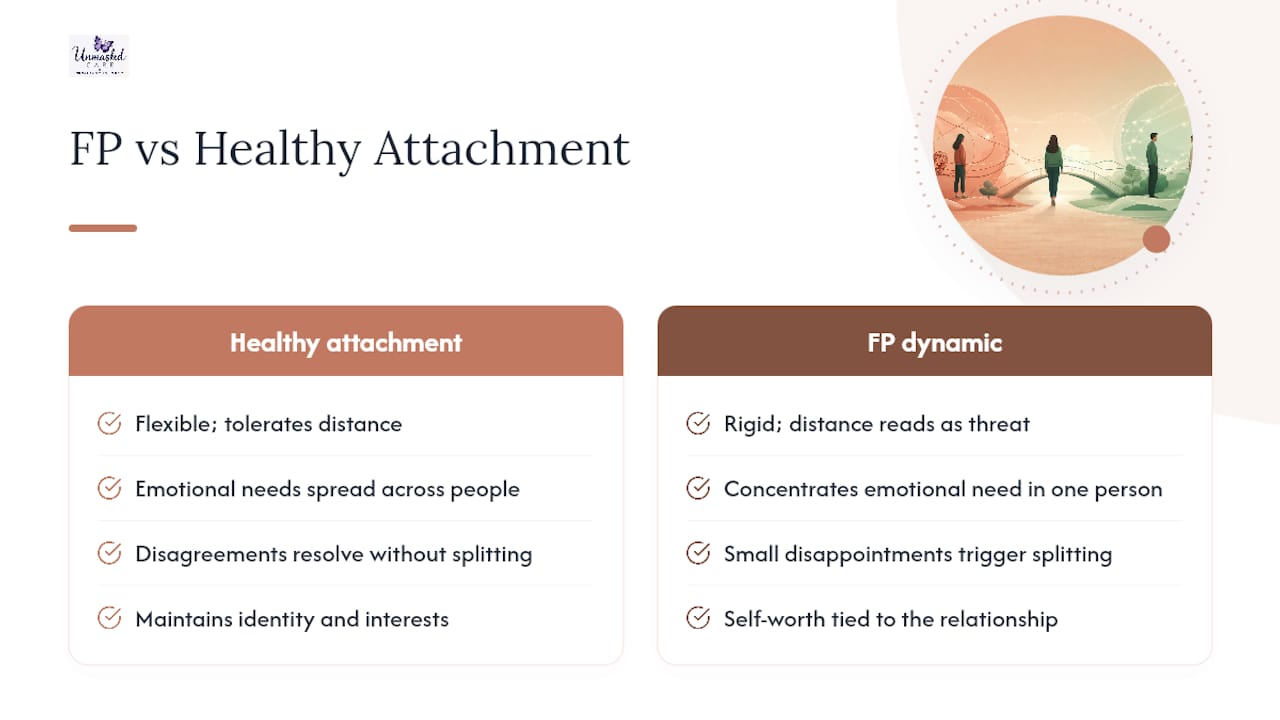
In a securely attached relationship, both people can tolerate distance without panic. A missed call doesn’t spiral into a belief that the relationship is over. Disagreements resolve without one person swinging between total idealization and total rejection of the other. Each person maintains other meaningful relationships, interests, and a sense of identity that doesn’t collapse if the relationship ends.
An FP dynamic tends to concentrate almost all emotional need into one relationship. Distance reads as threat. Small disappointments can trigger splitting, where the FP is suddenly seen as entirely unreliable rather than simply having a bad day. The relationship often becomes the main, sometimes only, source of self-worth and stability for the person with BPD.
This distinction isn’t about blame. Anxious-preoccupied attachment styles develop for real reasons, often rooted in early experiences with inconsistent caregiving. The goal isn’t to shame anyone for needing connection. It’s to recognize when a normal human need for closeness has narrowed down to a single, fragile point of support that can’t hold the weight it’s being asked to carry.
Unmasked Care’s guide on distinguishing BPD patterns from typical mood swings offers more detail on where ordinary emotional ups and downs end and a more concerning pattern begins.
How Does an FP Dynamic Affect Family and Friends?
An FP relationship rarely stays contained between two people. Family members and friends usually feel the ripple effects, even when they’re not the FP themselves.
Friends of the FP often notice the person becoming less available, canceling plans, or seeming distracted and drained. The emotional bandwidth required to manage an FP relationship doesn’t leave much left over for other people, and those other relationships can quietly erode over time. Some friends step back without understanding why, which can leave the FP more isolated at exactly the point they need outside support the most.
Family members of the person with BPD sometimes watch the FP role shift over time, from a parent or sibling early on to a romantic partner or close friend later. This can create tension, especially if family members feel replaced or worry about the intensity of the new dynamic. Parents in particular may struggle with guilt or helplessness watching someone they love pour so much need into one outside relationship.
The FP’s own family can also feel the strain secondhand. A partner or spouse of the FP may notice their loved one preoccupied, exhausted, or anxious about someone else’s wellbeing, which can create friction in that relationship too.
None of this means the wider network should be shut out. In fact, a broader circle of support tends to reduce pressure on any single relationship. Encouraging the person with BPD to build connections with multiple people, not just the FP, is one of the more effective ways to stabilize the whole system. Family and friends who understand the pattern, without diagnosing anyone, are often better equipped to offer steady, non-reactive support instead of stepping back entirely out of confusion or hurt.
What Are the Long-Term Outcomes of FP Dynamics?
The long-term picture depends heavily on whether the underlying pattern gets addressed, and how.
Left unaddressed, FP dynamics tend to repeat with new people. When one relationship ends in withdrawal or devaluation, the emotional need that drove it doesn’t disappear. It often transfers to someone new, sometimes quickly, restarting the same idealize-pressure-devalue cycle. This is exhausting for the person with BPD, who may start to notice a pattern of relationships ending the same way without understanding why.
Losing an FP can also trigger something closer to an identity crisis than an ordinary breakup, since so much self-worth may have been tied to that one relationship. This can show up as a period of destabilization: increased anxiety, low mood, or a return of urges to reach out repeatedly even after a relationship has clearly ended.
The more encouraging outcome shows up when the person with BPD engages in treatment, particularly dialectical behavior therapy, and works on building a wider support network. Over time, this tends to reduce the intensity of any single attachment and builds tolerance for distance and disagreement without panic. Skills learned in therapy, like distress tolerance and emotion regulation, directly target the mechanisms that make FP relationships volatile in the first place.
For the FP, long-term outcomes improve substantially with clear boundaries and outside support. Staying in a caretaking role without limits tends to lead to burnout and resentment, which eventually damages the relationship anyway. Stepping back with clarity, rather than guilt, tends to preserve the relationship in a healthier form, or at least protects the FP’s own wellbeing if the relationship doesn’t survive.
How Can Someone With BPD Build Healthier FP Attachments?
Working on FP attachment patterns doesn’t mean cutting off close relationships. It means widening the emotional foundation so no single person carries all the weight.
Start by naming the pattern honestly, ideally with a therapist. Recognizing “I tend to put all my emotional need into one person” is a useful first insight, and it’s the kind of pattern dialectical behavior therapy addresses directly through its focus on distress tolerance and interpersonal effectiveness.
Practical steps that tend to help include:
Building a wider circle deliberately. This might mean reconnecting with old friends, joining a peer support group, or simply making a habit of reaching out to more than one person during a hard day instead of defaulting to the FP every time.
Practicing tolerance for distance. Sitting with the anxiety of an unanswered text without immediately escalating, even briefly, builds capacity over time. This is uncomfortable at first and gets easier with practice and support.
Working directly on splitting. Noticing when a small disappointment triggers an all-or-nothing view of the FP, and pausing before reacting, interrupts the idealize-devalue cycle before it does damage.
Separating identity from the relationship. Rebuilding a sense of self that doesn’t depend entirely on how the FP is treating you that day takes time, but it’s one of the most protective factors against the extreme highs and lows the FP dynamic creates.
None of this happens overnight, and it isn’t meant to. The goal is a gradual shift toward relationships that can flex without breaking.
How Can a Favorite Person Support Recovery Without Enabling?
Supporting someone with BPD through this pattern is possible without becoming trapped in it. The line between support and enabling usually comes down to consistency and limits, not the amount of care involved.

Consistency matters more than constant availability. Being reliably present during your actual available hours does more good than being sporadically available around the clock and then disappearing when you’re depleted. Predictability reduces anxiety even when the answer is sometimes “not right now.”
Encourage professional support actively, rather than trying to fill that role yourself. Saying something like, “I want to support you, and I also think a therapist could help with this in a way I can’t” isn’t rejection. It’s redirecting need toward a resource built to hold it.
Avoid rescuing every crisis. Stepping in every time someone is distressed can unintentionally teach that distress is the fastest way to get attention. Responding calmly, without immediately dropping everything, models a steadier way of relating.
Hold boundaries even when they’re met with distress. A boundary that bends under pressure isn’t really a boundary, and inconsistency tends to intensify testing behavior over time rather than reducing it.
Watch your own capacity honestly; for more guidance on managing your well-being during challenging relationship breakdowns, see Maintaining Your Mental Health Throughout the New Hampshire Divorce Process - Naro Law. Burnout doesn’t help anyone, and an FP running on empty is far more likely to react in ways that reinforce splitting. Unmasked Care’s resource library on narcissistic and borderline abuse recovery has additional support material for people trying to hold this balance long term.
Publisher’s Note on This Guide
This guide is educational, not a diagnostic tool. Nothing here should be used to diagnose yourself or anyone else with BPD or any other condition. Unmasked Care’s reflection tools, AI Decoder, and learning library are built to help people put words to confusing relationship patterns and prepare for hard conversations, not to replace professional care. If you’re in crisis, call or text 988, or call 1-800-799-7233 for domestic violence support.
Get Support for Navigating an FP Relationship
If your relationship with an FP has left you exhausted, confused about which behaviors are worth naming, or unsure how to set a boundary without triggering a bigger crisis, Unmasked Care builds tools specifically for this kind of situation, not generic relationship advice.
The platform’s guided reflections walk you through structured questions that help you articulate exactly what’s happening, using precise language instead of vague frustration. Its AI Decoder helps you prepare thoughtful, calm responses before a difficult conversation instead of reacting in the moment. A private evidence file lets you track patterns over time, and the education library covers concepts like splitting and boundary-setting in plain language you can return to whenever you need it. None of this replaces therapy, but it gives you language and structure to bring into that work, or to lean on while you decide your next step. Start by visiting Unmasked Care’s guide on recognizing abusive relationship patterns to see whether what you’re experiencing needs more support than you’re currently getting.
Sources
- Understanding a Mutually Destructive Relationship Between Individuals With Borderline Personality Disorder and Their Favorite Person — PMC
- Understanding a Mutually Destructive Relationship Between Individuals With Borderline Personality Disorder and Their Favorite Person
- BPD favorite person — Medical News Today
- The “favorite person” in borderline personality disorder: A content analysis of social media posts — PsychArchives
- Borderline personality disorder — NAMI
This article is general information, not a substitute for advice from a qualified doctor. Consult a qualified healthcare professional about your own circumstances before acting on anything here.