
A BPD relationship self-assessment is a guided, non-diagnostic reflection tool that helps you identify recurring abusive or destabilizing behaviors, so you can plan safe, privacy-aware next steps. It works by naming patterns, not people, clarifying what you have lived through rather than labeling your partner. If you feel unsafe right now, contact the 988 Suicide & Crisis Lifeline or the National Domestic Violence Hotline at 1-800-799-7233.
TL;DR:
- Repeated patterns of gaslighting, boundary violations, or splitting occurring three or more times over a few weeks indicate a concerning relationship dynamic.
- Document incidents securely with dates, verbatim quotes, and context, using a separate and protected account or device to avoid partner discovery.
- Immediate help should be sought if there is physical danger, threats, or thoughts of self-harm, by calling 988 or the National Domestic Violence Hotline.
- Self-assessment tools do not diagnose but help identify specific behaviors to understand relationship impacts and plan safety steps.
- A clear, private record enables better memory recall and can support safety, boundaries, or legal actions when patterns persist.
Table of Contents
- What Is a BPD Relationship Self-Assessment, and What Are Its Limits?
- How Do You Run a Quick Self-Check for Patterns?
- What Should You Do With the Results?
- How Should You Document Incidents Without Increasing Risk?
- When Should You Call for Immediate Help?
- What Do People Get Wrong About BPD in Relationships?
- How Unmasked Helps You Reflect Privately and Decode Manipulation
- The Unmasked Care Team’s Perspective on Self-Assessment
- Sources
What Is a BPD Relationship Self-Assessment, and What Are Its Limits?
A structured self-assessment for BPD relationship dynamics is a set of behavior-based questions, not a psychiatric instrument. It does not diagnose your partner, and it cannot. Diagnosis requires a licensed clinician conducting a full evaluation over time. What this kind of tool does instead is help you notice and name specific behaviors as they show up across incidents, rather than treating each fight or apology as an isolated event.
The behaviors worth tracking typically include gaslighting (denying or distorting your reality), DARVO (Deny, Attack, Reverse Victim and Offender), boundary violations, splitting (sudden shifts between idealizing and devaluing you), and idealization followed by rapid devaluation. Behavior-focused tracking tends to serve recovery better than trying to reach a diagnosis from the outside, since the goal is matching support to the wound, whether that is rebuilding your sense of reality or your sense of self-worth, according to clinical commentary on covert narcissism versus BPD.
This is educational content, not a diagnosis, and it is not a substitute for a licensed mental health assessment. For background on how these patterns show up in relationships, the survivor’s guide to BPD covers the terminology in more depth.
How Do You Run a Quick Self-Check for Patterns?
A private, low-pressure checklist works best when you run it consistently rather than only during a crisis. Pick a recurring window, weekly works for most people, and score behaviors as you notice them rather than trying to reconstruct a month from memory.
Before you start:
- Choose where you will store your notes: a password-protected note app, not a shared device or synced family account.
- Set a recurring time, once a week is enough, to review the last several days.
- Score each item as “not present,” “happened once,” or “happened repeatedly,” rather than yes or no.
What to look for:
- Did your partner deny saying something you clearly remember them saying?
- Did they flip an argument so you ended up apologizing for their behavior (a DARVO pattern)?
- Did they ignore a stated limit, about your time, money, body, or privacy, after you named it?
- Did their view of you swing from “you’re perfect” to “you’re the problem” within the same day or conversation?
- Did the same conflict repeat in a familiar cycle, tension, blow-up, apology, calm, tension again?
Interpreting the results: One isolated incident is worth noting but not alarming on its own. A pattern, the same behavior showing up three or more times across a few weeks, is the signal that matters. Repeated splitting combined with boundary violations is a stronger indicator than either alone. If you’re weighing whether what you experienced counts as abuse, Am I overreacting, or is it emotional abuse? walks through that distinction directly, and the explanation of splitting in BPD breaks down that specific pattern in detail.
What Should You Do With the Results?
Once a pattern shows up on your checklist, the next question is what to do with that information, and that depends heavily on severity. Threats of harm, physical aggression, or escalating control call for prioritizing safety immediately over quiet monitoring. Verbal patterns like gaslighting or DARVO without physical danger often allow more room to observe, document, and plan before acting.
Boundary scripts work the best short and repeatable, since long explanations give a partner more material to twist:
- “I’m not going to discuss this if you raise your voice.”
- “That’s not what happened, and I’m not going to argue about my own memory.”
- “I need you to respect that decision without renegotiating it every time.”
Loop in a trusted friend, family member, or professional when the pattern is escalating, when you’re doubting your own perception repeatedly, or before making a major decision like moving out or filing for custody. Share only what you’re comfortable sharing, and consider what that person’s own privacy practices look like before sending anything sensitive.
Pro Tip: Write your boundary scripts down in advance and reread them before a hard conversation. In the moment, stress makes it easy to over-explain, which is exactly what DARVO exploits.

How Should You Document Incidents Without Increasing Risk?
Documentation gives you something concrete to return to when memory gets fuzzy or a partner insists an incident “never happened that way.” Keeping a secure, separate record, dates, verbatim quotes, screenshots, and context, helps you validate your own experience and can matter later even if you never plan to use it legally.
Store documentation somewhere a partner cannot access, which usually means a separate email account, a password-protected journal or notes app, and an offline backup. Shared devices, synced family accounts, and cloud photo libraries visible to a partner are common ways documentation gets discovered before you’re ready. loveisrespect’s documentation guidance recommends printing key screenshots and storing them somewhere physically separate as a backup to digital records.
When documenting, capture:
- The date and approximate time of the incident.
- Verbatim quotes where possible, in quotation marks, rather than a paraphrase.
- Brief context: what preceded it, who else was present.
- Screenshots or photos, saved with attention to metadata that could reveal your location or timing.
Before changing any passwords or account settings, think through the safety implications first. Sudden changes can tip off a partner that something is different, so safe documentation planning suggests making those changes only after you have a broader safety plan in place. Keep records concise rather than exhaustive. Overflowing documentation is harder to review later and can raise risk if discovered, a point design research on survivor evidence tools emphasizes directly. That same research notes that if you ever plan to use documentation legally, formatting and authenticity matter, and courts in different jurisdictions may require expert testimony to accept it, according to analysis from AEquitas and NIWRC.
Pro Tip: Before you rely on any document for legal purposes, talk to a domestic violence advocate or attorney about how it needs to be formatted to hold up. A legal guide on documentation and false accusation risk is a useful starting point if you’re worried about how records will be viewed in a legal proceeding.
When Should You Call for Immediate Help?
If you are in danger right now, or thinking about harming yourself, do not wait for the checklist to confirm a pattern. Reach out immediately:
- 988 (Suicide & Crisis Lifeline): call or text if you’re in emotional crisis or having thoughts of self-harm, any time, day or night.
- 1-800-799-7233 (National Domestic Violence Hotline): call if you’re experiencing or fear physical violence, threats, or escalating control, confidential support is available around the clock.
Both lines are staffed for confidential support and safety planning, not just crisis triage. If you’re calling from a shared home, consider timing the call for when you’re alone, or use text-based options where available, to protect your privacy during the contact itself. Review the guide on recognizing an abusive relationship for more on when a pattern has crossed into territory that needs immediate outside support.
What Do People Get Wrong About BPD in Relationships?
The biggest misconception is that noticing borderline traits in a partner’s behavior means you can, or should, diagnose them yourself. You can’t, and trying to usually backfires, either by giving the partner ammunition to dismiss your concerns (“you’re not a doctor”) or by pulling your focus away from the behaviors that are actually affecting you.
A second common myth is that splitting, the swing between idealizing and devaluing a partner, is just “normal relationship ups and downs.” It isn’t when the swing is sudden, extreme, and tied to how well you’re meeting the partner’s shifting expectations rather than to any real change in you.
People also assume BPD traits mean intentional cruelty. Often the behavior comes from fear of abandonment or an unstable sense of self, which doesn’t make the impact on you less real, but it does mean framing this as “he’s evil” or “she’s crazy” tends to be less useful than framing it around specific, observable behaviors. Finally, some assume that because a partner has never been formally diagnosed, the patterns don’t count. They do. You’re assessing dynamics and their effect on you, not building a case for a clinical label. For a broader look at how these traits differ from related patterns, Narcissist, Borderline, or Bipolar? breaks down the overlaps and distinctions.

How Unmasked Helps You Reflect Privately and Decode Manipulation
Unmasked gives you a structured, private way to do exactly what this article walks through, without guessing at what to look for or where to put your notes. The platform’s guided reflection questions help you work through specific incidents using precise terms like gaslighting and DARVO, so your notes describe what actually happened instead of vague frustration.
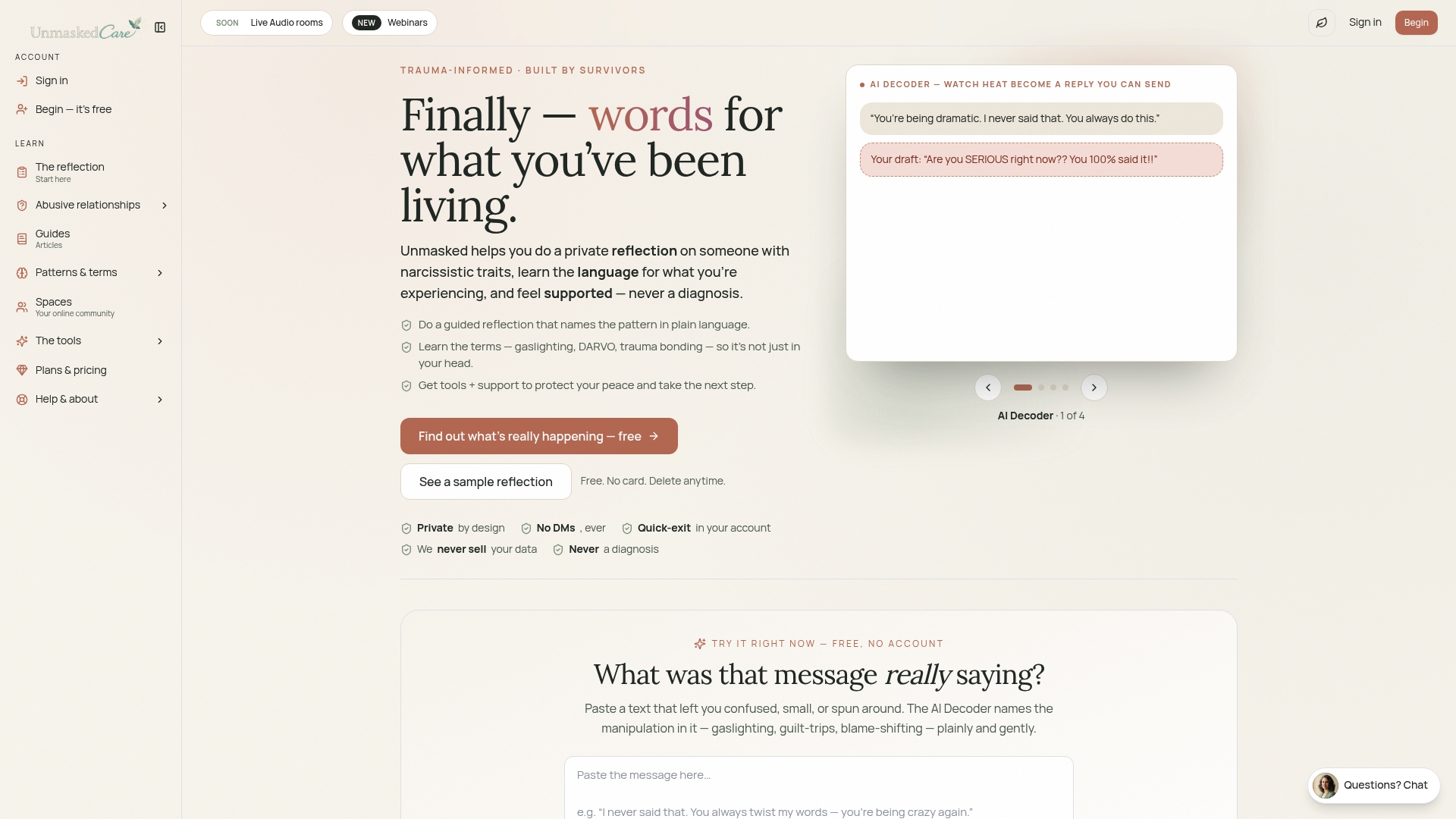
A practical flow looks like this: run the weekly checklist above, bring the notes into Unmasked’s guided reflections, then run any confusing texts or messages through the free AI Decoder to name the manipulation tactic at play before you respond. From there, Unmasked’s privacy-preserving evidence file lets you build a private timeline without relying on a shared device or synced account. The platform’s library of plain-language guides, including what gaslighting looks like in practice and why DARVO is so effective at flipping blame, gives you the vocabulary to describe patterns precisely instead of settling for “something feels off.” Start with the checklist, then bring what you find to Unmasked to turn scattered notes into a clear, private record you control.
The Unmasked Care Team’s Perspective on Self-Assessment
Too many people delay seeking clarity because they think a self-assessment needs to end in a diagnosis to be worth doing. It doesn’t. The value is in naming what’s happening, consistently, privately, and in your own words, so you stop second-guessing your own memory. This guide is educational, not a diagnostic tool, and it’s not a substitute for a licensed clinician’s evaluation when one is warranted. What a privacy-first reflection process can do is give you language and a record you control, which is often the missing piece for people caught in cycles of denial and blame.
— Unmasked Care Team
Sources
- Documenting abuse — The Hotline
- Sherloc: An Evidence-Collection Framework for Survivors of Technology-Facilitated Abuse
- Documenting abuse — loveisrespect
- Balancing victim privacy and accountability — AEquitas / NIWRC