
If you suspect attachment trauma from a narcissistic or borderline partner, your first step is to secure physical and emotional safety, document patterns, and test your memory against evidence. This guide gives you a checklist of signs, plain-language explanations of common manipulation tactics, a structured reflection template, short response scripts, digital-safety steps, and a clear path to professional support, including where Unmaskedcare tools can help.
This article is educational information, not a clinical diagnosis. It describes behaviors and patterns, not the mental health of any other person. If you are in immediate danger, call 988 (Suicide & Crisis Lifeline) or 1-800-799-7233 (National Domestic Violence Hotline) now.
Key Takeaways
Relational trauma from a narcissistic or borderline partner follows recognizable patterns, and naming those patterns is the first step toward restoring self-trust.
| Point | Details |
|---|---|
| Safety before everything | Secure physical safety and call 988 or 1-800-799-7233 before any other step. |
| Document with precision | Record dates, exact quotes, context, and your emotional response; preserve originals before replying. |
| Name the tactic, not the person | Gaslighting, DARVO, and love-bombing describe behaviors, not a clinical diagnosis of your partner. |
| Emotion regulation aids recovery | A 2026 Nature study found that strengthening emotion regulation and resilience can improve well-being after gaslighting exposure. |
| Unmaskedcare as a structured tool | The AI Decoder and evidence file give survivors a private, structured way to analyze messages and store documentation. |
Table of Contents
- What are the signs of attachment trauma in adults from a partner?
- How do common manipulation tactics actually work?
- How to do a structured self-assessment right now
- What response strategies actually help in difficult interactions?
- How to document safely and protect your digital privacy
- When should you seek professional help?
- What does recovery realistically look like?
- Unmasked Care’s perspective on relational trauma tools
- How Unmaskedcare supports your next step
- Sources
What are the signs of attachment trauma in adults from a partner?
Relational trauma from an intimate partner tends to show up in predictable ways. Check how many of these feel familiar:
- Loss of self-trust: You second-guess your own memory, feelings, and judgment constantly.
- Chronic self-blame: You assume most conflict is your fault, even when you cannot explain why.
- Walking on eggshells: You monitor your partner’s mood before speaking, and self-silencing predicted higher psychological distress in a 2026 study that also found gaslighting exposure partially mediated that relationship.
- Hypervigilance: You scan for signs of anger or withdrawal even in calm moments.
- Minimization of your memory: Your partner regularly tells you that what you remember did not happen, or that you are too sensitive.
- Isolation: Your social circle has quietly shrunk since the relationship began.
- Difficulty leaving: You feel attached despite repeated harm. Unmaskedcare’s red-flags checklist maps these signs to specific patterns and is free to download.
Pro Tip: If several items above apply, prioritize your physical safety first. Then begin documenting interactions, even brief notes with dates, before memory fades or gets challenged.
How do common manipulation tactics actually work?
Naming a tactic separates the behavior from your identity. These are patterns, not proof of any diagnosis in your partner.
| Tactic | What it looks like | Example you might recognize | Red flag to check |
|---|---|---|---|
| Gaslighting | Partner denies or distorts your reality | “That never happened. You’re imagining things.” | You feel confused after conversations you were clear about before |
| DARVO | Deny, then attack, then reverse victim and offender | You raise a concern; partner says you are abusive for raising it | You end up apologizing for bringing up your own pain |
| Love-bombing | Intense early affection used to create dependency | Constant texts, grand gestures, declarations of soulmate status within weeks | Affection feels conditional and disappears when you set a limit |
| Future-faking | Promises about a shared future that never materialize | “We’ll move somewhere better, I promise” — repeated for years | Promises reset after conflict but never progress |
| Triangulation | Third parties introduced to provoke jealousy or insecurity | Frequent references to an ex, comparisons to others | You feel you must compete for basic respect |
A qualitative study of 65 gaslighting survivors found that gaslighting is associated with a diminished sense of self and mistrust of one’s own perceptions. Describing these effects as predictable consequences of targeted manipulation, rather than personal weakness, tends to reduce self-blame.
DARVO shifts accountability from the person causing harm to the person raising it. Research linking socially aversive personality traits to acceptance of gaslighting tactics suggests these patterns are often deliberate rather than accidental misunderstandings, per a Springer study on Dark Tetrad traits.
Recognizing a tactic is not the same as diagnosing another person. These descriptions explain behavior patterns. They do not establish a clinical diagnosis for anyone involved.
How to do a structured self-assessment right now
Before you talk to anyone, gather your own evidence. This exercise takes 20 minutes and gives you something concrete to work from.
Safety note first: Store any records somewhere your partner cannot access. A separate email account, a private cloud folder, or Unmaskedcare’s private evidence file feature all work.
| What to document | Why it matters |
|---|---|
| Date and time of incident | Establishes a pattern over time, not a single bad day |
| Short direct quote (their words) | Exact language is harder to reframe than a summary |
| Context (what triggered it) | Helps distinguish escalation patterns from random conflict |
| Your emotional response at the time | Separates what happened from how you interpreted it |
| Any witness or contact who was present | Corroborates your account if needed later |
| Screenshots or message copies | Preserves original wording before it can be deleted |
Journaling prompts to separate memory from interpretation:
- “What did I observe? What did I hear, word for word?”
- “What did I tell myself it meant? Is there another explanation?”
- “How did I feel before the conversation, and how did I feel after?”
The Unmaskedcare AI Decoder lets you paste a message and get a plain-language breakdown of which manipulation patterns, if any, are present. It is a useful cross-check when your own reading of a message feels uncertain.
Pro Tip: Preserve originals before replying. Screenshot first, then respond. Edited or deleted messages are a common tactic once a partner realizes you are documenting.
What response strategies actually help in difficult interactions?
Safety comes before any script. If a situation feels physically dangerous, disengage without explanation and call 1-800-799-7233.
For lower-risk interactions, these approaches reduce escalation and protect your emotional state:
- Gray rock: Respond with minimal, neutral information. No emotional content, no elaboration. The goal is to be too boring to provoke. Learn more about the gray rock method and when to use it.
- Delayed reply: “I’ll get back to you on that.” Buys time to think without committing to a response under pressure.
- Boundary statement: “I’m not able to continue this conversation when voices are raised. I’ll talk with you when things are calm.”
- Deflect and document: Acknowledge without engaging. “I hear you.” Then write down what was said immediately after.
- Exit statement: “I need some time to think about this.” No JADE (Justify, Argue, Defend, Explain) required.
Dos: Keep responses short. Stay factual. Save copies of written exchanges before replying.
Don’ts: Avoid lengthy explanations of your reasoning. Do not apologize for setting a limit. Do not delete messages before saving them.
Pro Tip: Save every message before you reply. Once you respond, the other person may delete or edit their original. Originals are evidence; your reply alone is not.
How to document safely and protect your digital privacy
Documentation is only useful if it stays private. These steps reduce the risk of your records being found or used against you.

| Step | What to do |
|---|---|
| Separate device or account | Use a device your partner does not have access to, or create a new email account on a private browser |
| Change passwords | Update passwords on email, cloud storage, and any shared accounts from a secure device |
| Screenshot with timestamps | Most phones show date and time in the status bar; capture that in the screenshot |
| Back up to private cloud | Google Drive, iCloud, or Dropbox with a new account your partner does not know about |
| Avoid public posts | Do not post about the relationship on social media while still in contact |
| Use Unmaskedcare’s evidence file | The platform’s private evidence feature stores documentation securely within your account |
For readers considering legal steps, a family law resource like High Desert Family Law Group’s guide on emotional abuse and custody explains how documented patterns of emotional abuse can be relevant in custody proceedings.
If you are in immediate danger, stop documenting and call for help. 988 (Suicide & Crisis Lifeline) and 1-800-799-7233 (National Domestic Violence Hotline) are available 24 hours a day.
Pro Tip: Assume any device connected to a shared account or home network could be monitored. Use private browsing and a separate account for sensitive searches and storage.
When should you seek professional help?
The right level of support depends on your current safety and stability.
- Immediate danger: Call 988 or 1-800-799-7233 now. Do not wait for a therapy appointment.
- Safety planning needed: The National Domestic Violence Hotline (1-800-799-7233) offers safety planning by phone or chat, even if you are not ready to leave.
- Stable but struggling: Trauma-informed therapy is the next step. EMDR (Eye Movement Desensitization and Reprocessing) and IFS (Internal Family Systems) both target the nervous-system responses that relational abuse tends to produce, including hypervigilance, emotional numbing, and people-pleasing patterns that persist after the relationship ends.
- Community support: Peer support groups offer validation and practical help while you wait for therapy or decide on next steps.
Questions worth asking a potential therapist: Do you have experience with relational or narcissistic abuse? Which modalities do you use for trauma? How do you handle confidentiality? What does the first few sessions typically focus on?
A clinical explanation from Jennifer Leupp, LCSW describes how chronic relational abuse can create lasting trauma responses and recommends EMDR and IFS for nervous-system and parts-based healing. Unmaskedcare’s therapist directory is searchable by specialty if you want to find someone experienced in relational trauma.
What does recovery realistically look like?
Recovery from relational trauma is not linear, and timelines vary widely. A rough sequence that trauma-informed clinicians typically describe:
Stabilization comes first: physical safety, basic routines, reducing contact with the source of harm. Nervous-system work follows: learning to recognize and regulate hypervigilance, emotional flooding, and dissociation. Reflective processing comes next: making sense of what happened, separating your identity from the relationship’s narrative. Relational repair is the final stage: rebuilding trust in yourself and, eventually, in others.
A 2026 study found that emotion regulation and psychological resilience mediated the link between gaslighting exposure and mental well-being, suggesting that interventions targeting these capacities can improve outcomes. That is the clinical rationale behind EMDR and IFS.
Pro Tip: Stabilize first. Avoid committing to expensive long-term programs until your physical safety is secure and you have at least one trusted support person who knows your situation.
Unmasked Care’s perspective on relational trauma tools
Unmaskedcare was built specifically for people navigating relationships with narcissistic or borderline patterns. The platform’s structured reflection tools help survivors articulate what happened using precise language, gaslighting, DARVO, love-bombing, rather than vague distress. The AI Decoder analyzes specific messages and names the manipulation pattern present, which is useful when a survivor’s own reading of a message has been destabilized by repeated gaslighting.
The Unmasked Care Team authors the platform’s guides in plain language, grounded in clinical frameworks like traumatic narcissism theory, which describes a relational system where shame is used to keep partners dependent. The private evidence file feature stores documentation securely within the platform, separate from shared devices or accounts.
This article is educational content. It is not a clinical diagnosis of you or anyone else, and it does not replace professional mental health care.
How Unmaskedcare supports your next step
Unmaskedcare gives survivors something most self-help resources do not: tools built around the specific dynamics of narcissistic and borderline relational patterns, not generic stress management.
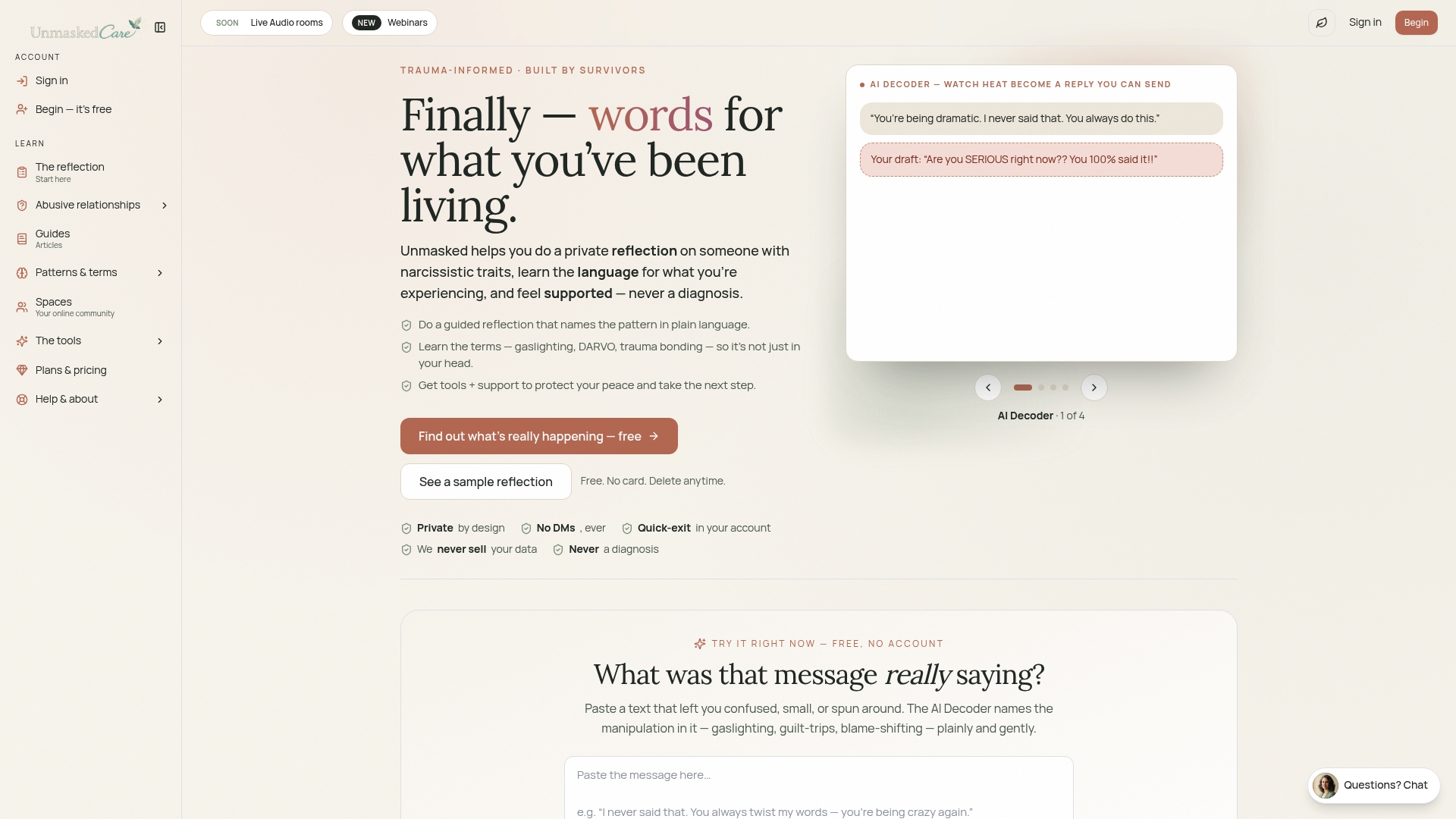
The most relevant tools for where you are right now:
- AI Decoder: Paste a message, get a plain-language breakdown of which manipulation tactics are present.
- Red-flags checklist: A printable checklist matched to the signs covered in this guide.
- Evidence file: Private, secure storage for your documentation, accessible only to you.
- Platform features: Full overview of reflection tools, community forums, live audio rooms, and healing resources.
Start with the free tier: guides, community access, and the checklist are available without a subscription. Upgrade when you are ready for personalized AI reflections and private evidence storage. If you are in immediate danger, call 988 or 1-800-799-7233 before using any platform.
Sources
Unmaskedcare resources:
- A qualitative analysis of gaslighting in romantic relationships
- DARVO — understanding a gaslighting strategy of reversing blame (counseling handout)
- Study on self-silencing, gaslighting exposure, and psychological distress (Nature)
- Study on emotion regulation, resilience, and gaslighting exposure (Nature)
External sources cited:
This article is educational information, not a clinical diagnosis. If you are in danger, seek professional help immediately.
This article is general information, not a substitute for advice from a qualified doctor. Consult a qualified healthcare professional about your own circumstances before acting on anything here.