
The window of tolerance is the range of nervous-system arousal in which you can think clearly, feel emotions without being overwhelmed, and respond to life rather than just react to it. Psychiatrist and clinical professor Dan Siegel coined the term, and trauma clinicians worldwide now use it as a core psychoeducation tool.
Two things you can do right now:
- 30-second self-check: Pause and notice your body. Is your heart racing, your jaw tight, your thoughts spinning? That’s the upper edge. Are you feeling numb, foggy, or disconnected? That’s the lower edge. Neither state is a character flaw — it’s your nervous system doing its job.
- Box breathing (one minute): Inhale for 4 counts, hold for 4, exhale for 4, hold for 4. Repeat three times. This activates the parasympathetic branch of your nervous system and can gently pull you back toward your regulated zone.
This article is educational and informational only. It is not a diagnosis, clinical assessment, or substitute for professional mental-health care. If you are in crisis, call or text 988 (Suicide & Crisis Lifeline) or 1-800-799-7233 (National Domestic Violence Hotline) now.
Table of Contents
- What is the window of tolerance, and where did it come from?
- Hyperarousal vs hypoarousal: how to spot which state you’re in
- How trauma and PTSD commonly narrow the window of tolerance
- Techniques to return to your window right now
- Longer-term strategies that widen the window over weeks and months
- Why safety must come before trauma processing
- When self-help isn’t enough: signals that professional support is needed
- Key Takeaways
- The part most guides leave out
- How Unmaskedcare supports your regulation and recovery work
- Authoritative sources for further reading
What is the window of tolerance, and where did it come from?
Dan Siegel introduced the window of tolerance concept to describe an optimal zone of nervous-system arousal — the bandwidth in which the brain’s prefrontal cortex stays online. When you’re inside that zone, you can process information, regulate emotions, make decisions, and connect with other people. Step outside it in either direction, and those capacities degrade fast.
The clinical rationale is grounded in how the autonomic nervous system works. Research published on PubMed links autonomic regulation directly to emotional processing capacity: a regulated nervous system supports the prefrontal functioning you need to integrate difficult experiences. When arousal climbs too high or drops too low, the brain shifts into survival mode, and the higher-order thinking required for healing becomes unavailable.
That’s why psychoeducation about this model matters so much. According to Psychology Tools, understanding the window helps normalize reactions that often feel shameful or confusing. Knowing that your shutdown or panic has a neurobiological explanation — not a moral one — changes how you relate to your own responses. For trauma survivors especially, that reframe can be the first crack of light in a very dark room.
Clinicians use the metaphor because it’s concrete. You can draw it on a whiteboard, plot yourself on it during a session, and use it to explain why some days feel manageable and others feel impossible. The model doesn’t require a diagnosis to be useful. Anyone navigating stress, grief, or relational difficulty can work with it.
Hyperarousal vs hypoarousal: how to spot which state you’re in
Crossing the upper boundary of your window produces hyperarousal. Crossing the lower boundary produces hypoarousal. According to Simply Psychology, both states pull you out of the zone where effective functioning is possible — they just feel completely different.
Signs of hyperarousal (above the window):
- Racing heart, shallow breathing, chest tightness
- Anxiety, panic, or a sense of dread you can’t explain
- Hypervigilance — scanning the room, startling easily, unable to relax
- Emotional flooding: rage, overwhelm, or crying that feels out of proportion
- Racing or intrusive thoughts, difficulty concentrating
- Impulsive urges to flee, fight, or freeze in place
- Physical restlessness, trembling, or feeling “wired”
Signs of hypoarousal (below the window):
- Numbness, emotional flatness, or feeling “nothing”
- Dissociation: feeling detached from your body or surroundings
- Mental fog, difficulty forming words or thoughts
- Extreme fatigue or heaviness that isn’t explained by sleep
- Withdrawal from people and activities
- Feeling invisible or unreal
- Collapse, shutdown, or an inability to move or respond
The behavioral examples matter here. Hyperarousal might look like snapping at someone over a minor comment, or re-reading the same paragraph five times because your mind won’t settle. Hypoarousal might look like staring at a screen for an hour without absorbing anything, or going through the motions of a conversation while feeling completely absent from it.
Pro Tip: Your earliest warning cues are your best intervention point. Most people have one or two physical signals that appear before the full state kicks in — a tightening in the throat, a shift in breathing, a sudden urge to check your phone. Learn yours. Catching the cue early means a 60-second regulation technique can work; catching it late means you may need 20 minutes.
One important note: these are descriptions of behavior and sensation, not diagnoses. Noticing these patterns in yourself is useful. Labeling another person’s behavior as a disorder based on this list is not what this model is for.
How trauma and PTSD commonly narrow the window of tolerance
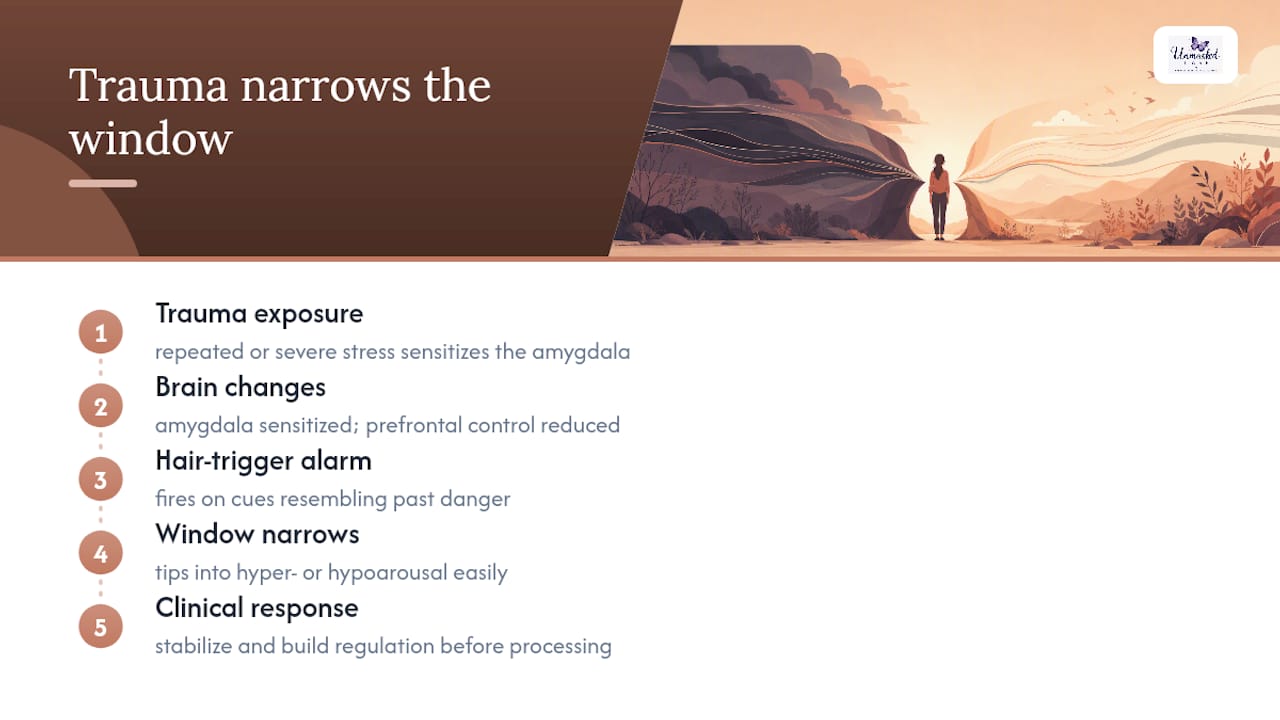
Trauma doesn’t just create painful memories. It recalibrates the nervous system’s threat-detection settings, often permanently shifting the baseline. As PTSD UK explains, people with PTSD commonly have a narrower window of tolerance and tip into hyper- or hypoarousal more easily than people without trauma histories.
The neurobiological explanation is fairly direct. Repeated or severe stress sensitizes the amygdala — the brain’s threat-detection center — while reducing the regulatory influence of the prefrontal cortex. The result is a hair-trigger alarm system that fires on cues that resemble past danger, even when the present situation is objectively safe. A raised voice, a particular smell, a shift in someone’s tone: any of these can push a trauma survivor outside their window before conscious thought has a chance to intervene.
Complex trauma (sometimes called C-PTSD) tends to produce the most unstable windows. When threat was chronic, relational, and unpredictable — as it often is in abusive relationships — the nervous system learns that no situation is truly safe. The window may become so narrow that ordinary daily stressors, a difficult email, a crowded grocery store, a moment of conflict, are enough to trigger full dysregulation. Emotional flashbacks are a particular feature of this pattern: sudden floods of shame, terror, or grief that feel present-tense even when the original event is years in the past.
For therapy, this has direct implications. Stabilization must come before trauma processing. A clinician who moves too quickly into memory work with a client whose window is very narrow risks retraumatization rather than healing. The standard clinical approach is to spend significant time building regulation skills and widening the window before any direct trauma exposure begins.
Techniques to return to your window right now
The goal of immediate regulation isn’t to feel happy. It’s to get your nervous system back into the zone where you can think and choose. The Pennsylvania trauma-informed care tip sheet identifies grounding, breathwork, and movement as first-line techniques for both directions of dysregulation.
Longer-term strategies that widen the window over weeks and months
Immediate regulation techniques manage the moment. Widening the window changes the baseline. According to IP Trauma, the therapeutic goals are to expand the window, build titrated processing capacity, and develop co-regulation skills — and that work happens over time, not in a single session.
Therapies with strong clinical support for this work:
- Somatic Experiencing (SE): Developed by Peter Levine, SE works with bodily sensation to discharge stored stress responses and gradually increase the nervous system’s capacity to tolerate activation without tipping into dysregulation. Research on sensorimotor and somatic approaches supports their effectiveness for expanding affect-processing capacity.
- Sensorimotor Psychotherapy: Developed by Pat Ogden, this approach explicitly trains clients to notice and work with bodily sensations, building the capacity to process intense affect without leaving the window.
- EMDR (Eye Movement Desensitization and Reprocessing): Uses bilateral stimulation to help the brain reprocess traumatic memories while keeping the client within a regulated state. Clinicians typically spend the early phases of EMDR building stabilization resources before any memory processing begins.
- Trauma-focused CBT (TF-CBT): Combines cognitive restructuring with gradual exposure, always within the client’s regulated zone.
- DBT (Dialectical Behavior Therapy): Offers a structured skills curriculum — distress tolerance, emotion regulation, mindfulness, and interpersonal effectiveness — that directly builds the capacities needed to stay inside the window under stress.
Daily practices that support nervous-system regulation:
- Consistent sleep schedule (irregular sleep destabilizes the autonomic nervous system more than most people realize)
- Moderate aerobic exercise, which supports vagal tone and reduces baseline arousal
- A daily breath practice of even five minutes — Mindful.org offers accessible entry points for building a sustainable mindfulness habit
- Paced exposure to mild stressors (not trauma material) to gradually build tolerance
- Social connection with people who feel safe — co-regulation through calm, attuned relationships is one of the most powerful nervous-system regulators available
One expectation worth setting clearly: the window doesn’t expand in a straight line. Stress, illness, poor sleep, and relational conflict all temporarily narrow it again. Progress is real even when it doesn’t feel linear. A week of regression after a difficult event doesn’t erase months of growth.
Why safety must come before trauma processing
The clinical rationale here is not just cautious — it’s neurobiological. When the nervous system is in hyperarousal or hypoarousal, the prefrontal cortex is functionally offline. Memory consolidation, narrative integration, and emotional meaning-making all require prefrontal engagement. Attempting to process traumatic material while outside the window means the brain is in survival mode and cannot do the integrative work that healing requires.
As Simply Psychology notes, practitioners consistently emphasize that attempting to process traumatic material while a client is outside the window is often ineffective and risks retraumatization. This isn’t a conservative preference — it’s a structural feature of how the brain processes experience.
Stop signs: pause processing and regulate first when you notice:
- Heart rate climbing sharply during a conversation or exercise
- Dissociation, zoning out, or feeling like you’re watching yourself from outside
- Emotional flooding that feels impossible to contain
- Intrusive images or sensations that feel present-tense rather than remembered
- A strong urge to escape, shut down, or end the session
- Physical symptoms: nausea, dizziness, difficulty breathing
- Feeling like you’re “losing the thread” of where you are or what’s happening
Co-regulation — the process of using another person’s calm nervous system to help regulate your own — is a standard clinical tool for exactly these moments. A therapist who slows their voice, maintains steady eye contact, and stays grounded is actively offering their regulated nervous system as a resource. This is why the therapeutic relationship itself is therapeutic, not just the techniques used within it.
Titration, the practice of approaching difficult material in small, manageable doses, is the other key safeguard. A well-paced session touches the edge of activation and then returns to safety, building tolerance incrementally rather than flooding the system.
When self-help isn’t enough: signals that professional support is needed
Self-regulation tools are genuinely useful. They’re also not sufficient for everyone, and knowing the difference matters. Reach out to a mental-health professional when:
- Dysregulation is sustained — you spend most of your time outside your window, regardless of what you try
- There’s a safety risk to yourself or others
- Functional impairment is significant — work, relationships, or basic self-care are consistently disrupted
- Emotional flashbacks are frequent, intense, or feel impossible to interrupt
- You’re using substances or other avoidance behaviors to manage your nervous system
- Trauma material is surfacing in ways that feel uncontrollable
What clinicians typically offer in this work: stabilization skills training (often before any trauma processing begins), titrated exposure to difficult material within the window, somatic tracking to help you notice and work with bodily cues, and co-regulation through the therapeutic relationship itself. Finding a therapist with specific training in trauma-informed approaches — somatic work, EMDR, DBT, or TF-CBT — makes a meaningful difference in how well-paced and safe the work feels.
For finding therapists experienced with narcissistic or borderline abuse patterns, Unmaskedcare’s therapist directory is a starting point worth bookmarking.
Crisis support is available now:
- 988 (Suicide & Crisis Lifeline) — call or text, 24/7
- 1-800-799-7233 (National Domestic Violence Hotline) — call or text, 24/7
Key Takeaways
The window of tolerance is the regulated nervous-system zone where thinking, feeling, and healing are all possible — and learning to recognize and return to it is the foundation of trauma recovery.
| Point | Details |
|---|---|
| Definition | The window of tolerance is the arousal zone where the brain can process emotions and function effectively. |
| Spot the state | Hyperarousal shows as panic, rage, or hypervigilance; hypoarousal shows as numbness, fog, or shutdown. |
| Regulate immediately | Extended exhale breathing and sensory grounding are first-line tools for both directions of dysregulation. |
| Safety before processing | Trauma memory work requires being inside the window; outside it, the brain is in survival mode. |
| Unmaskedcare next step | Use Unmaskedcare’s reflection tools and AI Decoder to track patterns and prepare for difficult conversations. |
The part most guides leave out
The window of tolerance model is taught as a diagram with two neat zones above and below a band of calm. That’s useful. What gets underemphasized is how relational the window actually is.
Your window isn’t a fixed personal trait. It shifts based on who you’re with. A person who feels chronically dysregulated in one relationship may have a wide, stable window in another. That’s not inconsistency — it’s the nervous system doing exactly what it evolved to do: reading the safety of the social environment and calibrating accordingly. For people recovering from narcissistic or borderline abuse patterns, this distinction matters enormously. The narrowing they experience isn’t a permanent feature of their neurology. It’s a learned response to a specific relational context.
The practical implication: if your window feels impossibly narrow right now, the first question worth asking isn’t “what’s wrong with my nervous system?” It’s “what environment is my nervous system responding to?” That reframe doesn’t minimize the work ahead. It does clarify where to start.
Progress in this work is rarely linear, and the goal isn’t a permanently wide window. It’s a window wide enough to choose your response rather than just survive it. That’s a meaningful, achievable target — and it’s worth pursuing.
This article is educational information, not a clinical diagnosis or professional advice. Please consult a qualified mental-health professional for guidance specific to your situation.
How Unmaskedcare supports your regulation and recovery work
The self-check chart and regulation techniques in this guide work best when you have a structured place to record what you notice. Unmaskedcare’s reflection and tracking tools are built for exactly this: guided questions that help you articulate what happened, how your body responded, and what patterns are emerging over time. The AI Decoder goes further — when a message or conversation has left you dysregulated and you can’t quite name why, it helps you identify the specific manipulation pattern at work, so you’re responding to what actually happened rather than a fog of confusion.
Privacy is built in. If you’re on a shared device or in an unsafe living situation, Unmaskedcare’s evidence file and session tools are designed with that reality in mind.
The infographics library includes printable visual resources that complement the self-check chart above — useful for anyone who processes information better visually or wants a quick reference during a hard moment.
Start with the free tools. If the reflection questions and community resources feel useful, the paid tier unlocks the full AI analysis and personalized reports. Visit Unmaskedcare’s features page to see what’s available at each level.
Authoritative sources for further reading
The table below lists the sources cited throughout this guide, with a note on what each one adds.
| Source | Focus | Practical use |
|---|---|---|
| Simply Psychology | Definition, hyperarousal/hypoarousal signs, safety-first rationale | Core reference for understanding the model and its clinical basis |
| IP Trauma | Therapeutic goals, titration, co-regulation | Clinical guidance on expanding the window and safe processing |
| Psychology Tools | Psychoeducation handout language | Plain-language explanation useful for self-study |
| Johns Hopkins Counseling Center (2022) | “Moving toward” worksheet | Self-check template and incremental regulation planning |
| Pennsylvania DHS tip sheet (2024) | Grounding, breathwork, movement strategies | First-line regulation techniques for both arousal states |
| PTSD UK | PTSD and window narrowing | Accessible explanation of trauma’s effect on the window |
| PubMed (23544677) | Autonomic regulation and stress response | Neurobiological basis for the model |
| PMC3217222 | Sensorimotor and somatic therapy | Evidence base for somatic approaches to widening the window |
| Mindful.org | Daily mindfulness practices | Accessible entry point for building a sustainable practice |
If you are in crisis right now, please reach out: 988 (Suicide & Crisis Lifeline) or 1-800-799-7233 (National Domestic Violence Hotline). Both lines are available 24/7.