
Stonewalling is usually an involuntary shutdown caused by physiological flooding. The silent treatment is typically a deliberate, punitive withholding of communication. If you feel unsafe or coerced right now, call 988 (Suicide & Crisis Lifeline) or 1-800-799-7233 (National Domestic Violence Hotline).
The distinction matters because the response is different for each one. A partner who is flooded needs a short, announced break and a return. A partner using silence as a weapon needs a boundary, not patience.
- If you’re not in immediate danger, try a script: “I need 20 minutes to calm down. I’ll come back at 7:15 to keep talking.” That single sentence separates a healthy time-out from a shutdown that never ends.
- If the silence has lasted for days, comes with conditions (“I’ll talk when you apologize”), or repeats a pattern you’ve seen before, treat it as a boundary issue, not a mood.
Quick fact: Gottman Institute research identifies stonewalling as one of the “Four Horsemen” that predict relationship breakdown, and ties it directly to physiological flooding rather than deliberate cruelty.
This article is educational, not a diagnostic tool. It doesn’t label any specific person’s behavior as a disorder or abuse. Only a licensed professional can assess an individual relationship.
Key Takeaways
Stonewalling stems from involuntary physiological flooding, while the silent treatment is a deliberate, often conditional withholding of communication used to control or punish.
| Point | Details |
|---|---|
| Check intent first | Ask whether the silence is an overwhelmed shutdown or a deliberate punishment before reacting. |
| Announce time-outs | A healthy break names a return time; stonewalling and punitive silence both lack that promise. |
| Watch for conditions | Silence that only ends after an apology or concession signals control, not overwhelm. |
| Use scripts, not silence | Respond with direct language instead of matching silence with more silence. |
| Escalate when patterns repeat | Chronic punitive silence calls for firm boundaries, documentation, and outside support. |
Table of Contents
- Silent Treatment vs. Stonewalling: What Separates the Two
- The Silent Treatment as a Pattern of Control
- How Do You Tell Stonewalling and the Silent Treatment Apart?
- Why Silence Happens: Flooding, Attachment, and the Rule That Separates Healthy Breaks From Harm
- How to Respond to the Silent Treatment or Stonewalling Right Now
- When Does Silence Cross Into Emotional Abuse?
- How Unmasked Care Helps You Name What You’re Facing
- Intent, Not Volume, Is the Real Diagnostic Tool
- Sources
Silent Treatment vs. Stonewalling: What Separates the Two
Stonewalling and the silent treatment can look identical from the outside. Someone stops talking, turns away, and leaves you standing in a room with no answers. The difference is what’s happening inside them.
Stonewalling is what the Gottman Institute describes as an involuntary nervous system response to conflict that has become too intense to process. The silent treatment, by contrast, is a chosen strategy. One person’s brain has hit a wall. The other person has picked up a weapon.
- Stonewalling comes with physical signs: rising heart rate, shallow breathing, a blank or frozen face, sudden withdrawal mid-sentence.
- The silent treatment comes with conditions attached: “I’ll talk when you say sorry,” or silence that stretches on with no explanation and no end date.
- Stonewalling usually happens in the heat of an argument. The silent treatment can start calmly and last for days.
Fast fact: Gottman’s research on flooding shows that once heart rate and stress hormones spike past a certain point, the brain’s capacity for calm reasoning drops sharply, which is why stonewalling often looks like someone simply checking out.
The Silent Treatment as a Pattern of Control
The silent treatment usually isn’t a single bad moment. It’s a repeated tactic, and the intent behind it is what turns silence into control.
Watch for silence that comes with strings attached: a partner who ignores you until you apologize first, who refuses basic acknowledgment as a form of punishment, or who uses silence to end an argument on their terms rather than resolve it. This is different from someone needing a breather. It’s silence used as leverage.
- Silence that only lifts once you grovel, apologize, or give in on the original issue.
- Silence paired with cold body language on purpose, like eye-rolling or exaggerated sighing, meant to communicate contempt without words.
- A pattern that repeats over time, always following the same script.
When this becomes the default response to any disagreement, Verywell Health’s clinical framing describes it as a recognized form of emotional abuse, particularly when it’s used to control or punish rather than to self-regulate. If that pattern sounds familiar, Unmasked Care’s guide on why narcissists give the silent treatment walks through the motives behind it in more depth. The immediate response matters: don’t chase, don’t grovel, and don’t mirror the silence back as your own punishment.
How Do You Tell Stonewalling and the Silent Treatment Apart?
The fastest way to tell them apart in the moment is to check five things: intent, cause, whether a return was announced, how long it lasts, and what actually helps.
| Signal | Stonewalling | Silent treatment |
|---|---|---|
| Intent | Unintentional shutdown | Deliberate withholding |
| Cause | Physiological flooding | Desire to control or punish |
| Announced return | Often none, or vague | Rarely offered, sometimes conditional |
| Typical duration | Minutes to a few hours | Hours to days, sometimes longer |
| What helps | A calm pause with a stated return time | A direct boundary and consequence |
Here’s what each one sounds like in real conversation.
- The flooded partner: “I can’t do this right now, I need to step outside.” They leave abruptly, avoid eye contact, and seem almost dazed. This is closer to a nervous system overload than a decision.
- The punishing partner: “You’ll figure out what you did wrong.” Then nothing. No explanation, no timeline, just silence that continues until you cave.
- The healthy version of both: “I’m getting overwhelmed. Give me 20 minutes and I’ll come back so we can finish this.” That one sentence is the difference between regulation and shutdown.
Both patterns can hurt a relationship, even when only one is intentional. A partner who stonewalls without ever circling back still leaves the other person feeling dismissed, even if flooding, not malice, caused it. Recognizing which one you’re dealing with changes your next move: patience and a scheduled check-in for flooding, a firm boundary for punitive silence.
Why Silence Happens: Flooding, Attachment, and the Rule That Separates Healthy Breaks From Harm
Flooding is the physiological state Gottman researchers point to when explaining most stonewalling. Heart rate climbs, attention narrows, and the body shifts into a fight-or-flight response that makes calm conversation nearly impossible.
Signs of flooding, a racing heart, tunnel vision, shallow breathing, reliably predict impaired prefrontal function, according to peer-reviewed research on stress physiology, which is exactly why a time-out works better than pushing through the conversation.
Attachment history plays a role too. Someone who grew up in a household where conflict meant danger may withdraw automatically, not to punish a partner, but because their body learned that silence equals safety. That doesn’t excuse repeated shutdown with no attempt to repair it, but it explains why the behavior can persist even when someone genuinely wants to change.
Key threshold: Gottman practitioner guidance recommends a self-soothing break of roughly 20 to 30 minutes, enough time for cardiovascular arousal to drop back down, paired with an explicit promise to return.
That return is the entire test. A time-out that’s announced, kept short, and followed by an actual conversation is regulation. A time-out with no stated end, no return, and no follow-up is stonewalling that’s calcified into something closer to the silent treatment, whether or not that was the original intent.

How to Respond to the Silent Treatment or Stonewalling Right Now
The right response depends on what you’re facing, but a few steps apply either way.
- Check for safety first. If you feel threatened, coerced, or unsafe in any way, call 988 (Suicide & Crisis Lifeline) or 1-800-799-7233 (National Domestic Violence Hotline) before doing anything else.
- Ask, don’t assume. Try: “Are you overwhelmed and need a break, or are you upset with me?” This single question often reveals which pattern you’re dealing with.
- If it’s flooding, offer a structured pause. Say or text: “Let’s both take 20 minutes. I’ll come back at [specific time] so we can finish this.” Naming a time removes the ambiguity that turns a break into abandonment.
- If it’s punitive, name the pattern out loud. Try: “I notice you go quiet until I apologize. I’m not going to chase you this time. I’m here when you’re ready to talk like adults.” Then follow through, calmly, without escalating.
- Practice self-soothing while you wait. Slow breathing, a short walk, or writing down your side of the argument keeps your own nervous system from flooding while the other person regulates.
- Set a real boundary for repeat patterns. If punitive silence happens again and again, a boundary might sound like: “If you go silent instead of talking, I’ll step away from the conversation until you’re ready to engage directly.”
- Bring in outside support when it’s chronic. Couples therapy can help when both partners want to change the pattern. Individual support matters when one partner keeps using silence as leverage no matter what boundary is set.
Pro Tip: Text the time-out request instead of saying it out loud if tempers are already high. Reading a calm, specific message (“back in 20, promise”) lands differently than hearing a shaky voice mid-argument.
If you’re navigating a pattern with a co-parent specifically, ReplyCalmly’s guide to co-parenting boundaries offers scripted language for exactly this kind of standoff.
When Does Silence Cross Into Emotional Abuse?
A single flooded shutdown during one hard conversation isn’t abuse. A pattern that repeats, escalates, and always ends the same way, with you apologizing first regardless of who was actually wrong, is a different story.
Signs the pattern has moved past normal conflict avoidance:
- The silence always resolves on the same terms: you give in, apologize, or over-explain yourself before communication resumes.
- Silence is used strategically, timed to specific disagreements rather than genuine overwhelm.
- You’ve started walking on eggshells, changing your behavior specifically to avoid triggering another silent stretch.
- The silence is paired with other controlling behaviors, like monitoring, guilt-tripping, or withholding affection as leverage.
If that sounds familiar, start documenting dates and patterns, not to build a legal case necessarily, but to see the shape of it clearly instead of relying on memory alone. Unmasked Care’s guide on whether you’re overreacting or facing real emotional abuse can help clarify what you’re seeing. Setting a firm boundary and seeking outside support, whether that’s a therapist or a trusted third party, matters more than trying to fix the pattern alone. If you feel unsafe, call 988 or 1-800-799-7233.
How Unmasked Care Helps You Name What You’re Facing
Recognizing the difference between flooding and punishment is hard in real time, especially when you’re the one being shut out. Unmasked Care builds tools specifically for that gap.
- The AI Decoder helps you analyze a message or a pattern of silence and draft a calm, clear response instead of reacting in the moment. Try the free AI Decoder the next time you’re staring at your phone trying to figure out what to say.
- Guided reflections walk you through structured questions to articulate what’s happening, using precise language instead of vague frustration.
- The evidence file feature lets you privately document recurring patterns of silence or withdrawal, which matters if you ever need to show a clear timeline to a therapist or support person.
- A searchable therapist directory connects you with professionals experienced in relationship dynamics involving control and withdrawal.
The clearest signal that silence has crossed from regulation into control is the absence of a return: no announced break, no timeline, no follow-up conversation once things calm down.
These tools won’t tell you what your partner’s diagnosis is. What they can do is help you put language to your own experience and prepare a response you feel steady saying out loud.
Intent, Not Volume, Is the Real Diagnostic Tool
Most advice on this topic focuses on how long the silence lasts, as if a stopwatch could settle the question. It can’t. A four-hour stonewalling episode caused by genuine flooding is a different event than a four-hour punitive silence timed to make someone squirm, even though both take the same amount of time.
The more useful question isn’t “how long” but “is there a return.” That single criterion, an announced break followed by an actual conversation, cuts through most of the ambiguity that keeps people stuck arguing about whether they’re overreacting. If there’s no return and no explanation, treat it as a pattern worth naming out loud, not a mood to wait out.
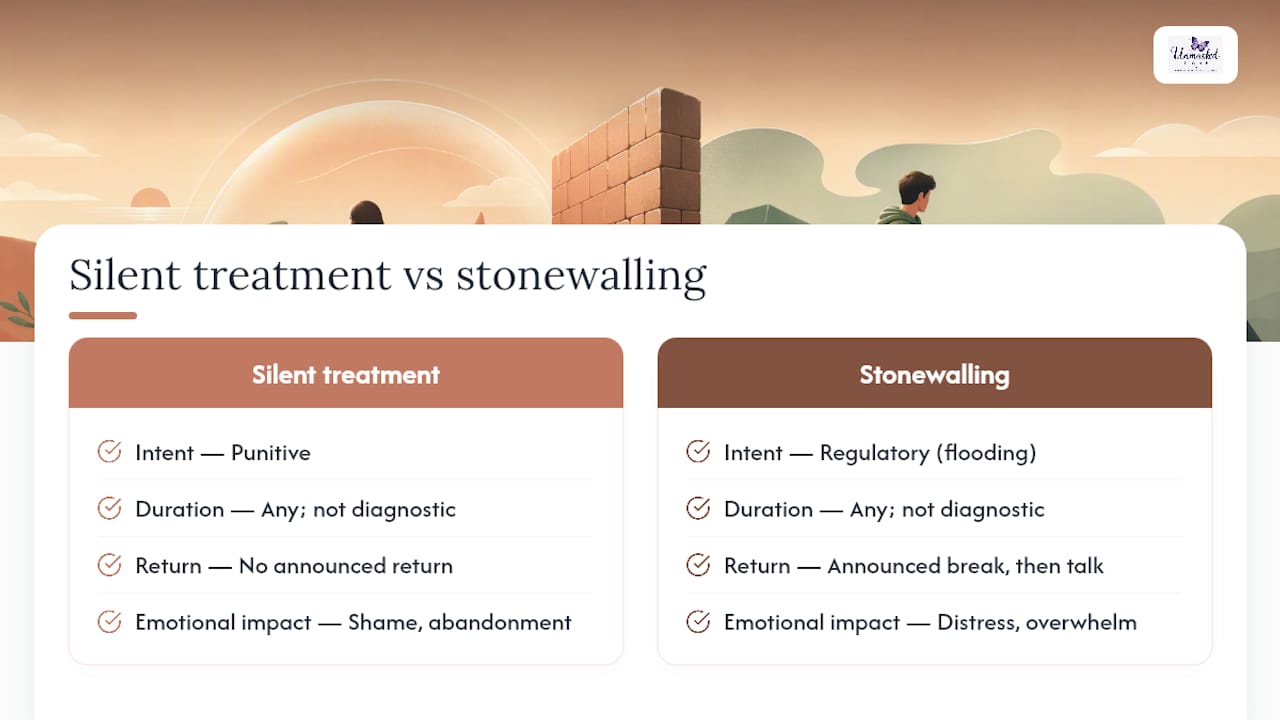
Conventional advice often tells the receiving partner to “just give them space” without ever circling back to check whether that space had an expiration date. Space without a return isn’t regulation. It’s abandonment with better branding. Readers should prioritize naming the pattern early, using a script rather than silence of their own, and treating repeated punitive silence as a boundary issue rather than a personality quirk to manage around.
This article is general information, not a substitute for advice from a qualified doctor. Consult a qualified healthcare professional about your own circumstances before acting on anything here.
Sources
- The Four Horsemen: Stonewalling (Gottman Institute)
- Silent Treatment Emotional Abuse: Recognition and Resolution (Verywell Health)
- Peer-reviewed article on stress physiology and cognitive load (NCBI PMC)