
The fastest way to lower a heated moment is a calm voice, a brief validating statement, and a short, named pause if things keep climbing. This is educational information, not a diagnosis of anyone. If safety is a concern right now, call or text 988 (Suicide & Crisis Lifeline) or 1-800-799-7233 (National Domestic Violence Hotline). The steps below break this down into exact phrasing and a decision plan you can use tonight.
TL;DR:
- Pausing and returning to the conversation as promised significantly reduces escalation by preventing abandonment fears and maintaining a sense of safety.
- Validating emotional pain early on lowers defensiveness and restores emotional safety, but it must be distinguished from agreement to avoid misunderstandings.
- Managing your own physiological responses with breathing exercises and grounding techniques helps maintain a calm tone that prevents unintentionally escalating the situation.
- Establishing clear, non-threatening boundaries protects safety and prevents further triggering, especially when communicated plainly and enforced consistently.
- Having a pre-made crisis plan with emergency contacts and documented incidents ensures quick action and better support during severe episodes.
Table of Contents
- What Actually De-Escalates a Partner With BPD Traits?
- Why Validation Calms Intensity Faster Than Logic
- Grounding and Breathing: Keeping Your Own Nervous System Steady
- Setting Boundaries Without Triggering More Escalation
- When Conflict Becomes a Crisis: Safety Planning That Works
- Therapy and Skill-Building That Reduce Future Escalation
- How Trauma History and Attachment Style Shape Escalation
- Taking Care of Yourself Outside the Hard Moments
- What This Article Gets Right (And What Most Advice Misses)
- Prepare Before the Next Hard Conversation
- Sources
What Actually De-Escalates a Partner With BPD Traits?
Six moves matter more than any long explanation, and they work in a specific order. Skipping straight to problem-solving before validation is the single most common mistake, and it almost always backfires because the other person is still flooded and can’t process logic yet.
Here’s the sequence therapists recommend, adapted for real conversations that are already heating up:
- Pause the clock, not the relationship. Say, “I want to keep talking about this. Can we take 20 minutes and come back?” Naming a return time is the part people skip, and it’s the part that matters most.
- Drop your volume before you drop the topic. A quieter voice signals safety to a nervous system that’s already scanning for threat. This works even mid-sentence.
- Validate before you explain yourself. Try, “That sounds really painful,” or “I can see why you’d feel hurt by that.” You are naming the feeling, not agreeing with the accusation behind it.
- Use a grounding cue if your own heart rate spikes. A slow exhale, a hand on a cold surface, or naming three things you can see buys you a few seconds before you say something you’ll regret.
- State one safety boundary plainly if needed. “I’m not going to keep talking if there’s yelling. I still want to work this out.” Flat, not cold.
- Follow through on the return. If you said 20 minutes, come back in 20 minutes. Silence past the promised time reads as abandonment, not calm.
Pausing with an agreed timer and returning as promised is one of the most consistently recommended tactics in couples-therapy guidance on de-escalating arguments, precisely because it interrupts the spiral without triggering the fear that you’re leaving for good.
Pro Tip: Set a visible timer on your phone and say the number out loud: “I’ll be back in fifteen minutes.” A vague pause reads as rejection. A timed one reads as a promise.
Continue talking if the volume stays manageable and both of you can track what’s being said. Pause the moment either of you starts repeating the same point louder, or if either person brings up something unrelated from months ago. That’s flooding, and no amount of logic works until it passes.
Why Validation Calms Intensity Faster Than Logic
Validation works because it targets the fear driving the reaction, not the content of the argument. When someone with borderline traits perceives distance, criticism, or rejection, even mistakenly, the emotional response can arrive faster and stronger than in most people, and it often takes longer to settle. That’s affect dysregulation, not manipulation, and understanding the difference changes how you respond.
A short validating statement made early, before things escalate further, has been described as one of the single most reliable de-escalation moves in therapist-reviewed guidance on fighting fair with a partner who has BPD. It reduces defensiveness and restores a sense of emotional safety, which is the actual prerequisite for any real conversation.
Validation is not the same as agreement, and confusing the two is where a lot of partners get stuck.
- Validation: “I hear that you felt left out when I didn’t text back right away.”
- Agreement: “You’re right, I shouldn’t have gone out at all.”
- Validation acknowledges the feeling is real without confirming the story attached to it.
- Agreement concedes the interpretation, which you may not actually believe.
- You can validate the emotion and still hold your own version of events.
Fear of abandonment sits underneath a lot of what looks like overreaction from the outside. A canceled plan, a delayed text, or a change in tone can register as evidence of being left, and the clinical literature on managing BPD crises is clear that dismissing that fear, even accidentally, tends to intensify the response rather than calm it.
Learning to spot early signs of this pattern, sometimes described as splitting when someone shifts between viewing a partner as entirely good or entirely bad, lets you recognize the shift before it fully takes hold. Catching the moment a partner starts talking in absolutes (“You never,” “You always”) is often the earliest signal that validation, not explanation, is what’s needed next.
Grounding and Breathing: Keeping Your Own Nervous System Steady
You can’t de-escalate someone else while you’re flooded yourself. Partners often focus entirely on managing the other person’s reaction and forget that their own physiology is part of the equation. A racing heart rate and a tight jaw on your end will leak into your tone no matter how calm your words are.

Box breathing is the fastest reset available, and it works because it’s mechanical, not emotional. Inhale for four counts, hold for four, exhale for four, hold for four. Repeat it three or four times before you respond to anything.
The 5-4-3-2-1 method works well when your mind is racing rather than your heart. Name five things you can see, four you can touch, three you can hear, two you can smell, one you can taste. It sounds almost too simple, but it forces your attention out of the argument and into the room.
- Notice flooding before you’re fully in it: a hot face, a clenched jaw, or the urge to interrupt are early signals.
- Use a soft start if you’re the one raising a topic: “Can I share something that’s been bothering me?” lands differently than walking in already annoyed.
- Step away for sixty seconds if you feel your own volume rising, even before your partner’s does.
- Practice these exercises when you’re calm, not for the first time mid-argument, so they’re automatic when you need them.
Pro Tip: Practice box breathing during a boring commercial break or while waiting for coffee to brew. The exercise only works under pressure if your body already knows the pattern.
Your own regulation matters beyond just personal comfort. Calm tends to spread the same way tension does, a kind of behavioral contagion, and a partner who stays visibly steady during a rising conflict often gives the other person something to match rather than escalate against.
Setting Boundaries Without Triggering More Escalation
Boundaries protect safety, and they don’t have to sound like punishment. The tone matters as much as the content, and a boundary delivered as a threat almost always gets treated like one.
Three types of boundaries come up most often for partners:
- Safety boundaries are non-negotiable: “I won’t stay in the room if something gets thrown.” No debate, no exceptions.
- Time-limited pauses buy space without ending the conversation: “I need thirty minutes before we keep going.”
- Conversational lines protect the topic itself: “I’ll talk about tonight, but I’m not relitigating last year.”
Script it plainly and skip the justification. “I’m going to step outside for ten minutes. I’ll come back and we’ll keep talking,” said once, calmly, does more than the same line repeated five times with rising frustration. If the boundary gets crossed, follow through on the stated consequence rather than issuing a new threat in the moment. If you said you’d leave the room, leave the room.
Managing your own reactions and establishing firm limits are described as core strategies for shifting relationship dynamics over time, not just surviving a single fight. Boundaries held consistently, even small ones, tend to do more long-term work than a single big confrontation ever does.
Watch for the trap of becoming the only person managing every conflict. A boundary that only ever bends one direction, yours, isn’t a boundary anymore. It’s worth naming out loud sometimes: “I need us to figure out a way to disagree that doesn’t require me to manage both of our feelings every time.”
When Conflict Becomes a Crisis: Safety Planning That Works
Some moments are not about de-escalation technique at all. If there is talk of self-harm, suicidal thoughts, threats of violence, or you feel physically unsafe, the priority shifts immediately from calming the conversation to getting help.
Call or text 988 for the Suicide & Crisis Lifeline if there is any mention of suicide, self-harm, or a wish to not be alive. Call or text 1-800-799-7233 for the National Domestic Violence Hotline if you feel physically unsafe or if the situation has included threats. Call 911 if there is immediate danger to anyone in the home. None of this requires you to have a diagnosis or a clinical label for what’s happening. This section is educational, not a substitute for professional or emergency assessment.
Use these decision rules to figure out which call to make:
- If someone says they want to die or describes a plan to hurt themselves, call 988 immediately, even if you’re not sure how serious it is.
- If you feel physically threatened or unsafe in your own space, call 1-800-799-7233 or leave and call 911 if you’re in immediate danger.
- If the crisis has passed but was severe, contact whatever professional support your partner already has, a therapist or psychiatrist, as soon as possible afterward.
- If there is no existing provider, a crisis line can also connect you with local resources and next steps.
- After any serious incident, write down what happened, what was said, and what helped, while it’s fresh. This isn’t about building a case against anyone, it’s about noticing patterns.
Clinical guidance on managing BPD-related crises recommends a calm, non-threatening approach from anyone present, avoiding indefinite use of short-term medication without follow-up review, and updating the crisis plan after each episode rather than treating it as a one-time document. A crisis plan built ahead of time, ideally with input from a therapist and created when things are calm, gives everyone a script to follow instead of improvising during the worst moment.
The same clinical source notes that responsibility for managing a crisis should never rest solely on a partner’s shoulders. A documented plan, shared with a treatment provider where possible, distributes that weight instead of leaving one person to carry it alone every time.
Keeping a private, dated record of incidents (what triggered it, what was said, what de-escalated it) helps both of you spot patterns over time and gives any treatment provider real information to work with, rather than a foggy memory of “it’s been bad lately.”
Therapy and Skill-Building That Reduce Future Escalation
De-escalation in the moment only goes so far if nothing changes between arguments. Dialectical behavior therapy, commonly known as DBT, is the most established framework for building the underlying skills that reduce how often crises happen in the first place, and it’s built around four skill areas that translate surprisingly well to partners, too.
- Distress tolerance teaches how to survive an intense moment without making it worse, which is essentially what a timed pause accomplishes.
- Emotion regulation focuses on naming and adjusting emotional intensity before it peaks, not after.
- Mindfulness builds the ability to notice a rising feeling early enough to act on it differently.
- Interpersonal effectiveness covers how to ask for something, say no, or set a limit without destroying the relationship.
A partner doesn’t need to be in DBT to benefit from learning a parallel version of these skills. Recognizing your own rising distress, naming it out loud, and asking for what you need directly are transferable in either direction.
Couples therapy adds another layer, particularly approaches built around a soft start-up (raising an issue gently rather than with criticism), structured repair attempts mid-conflict, and regular check-ins scheduled outside of any argument. Building stronger daily communication habits between conflicts, not just during them, tends to lower the baseline tension that makes any single disagreement more combustible.
Look specifically for a clinician with BPD-aware training rather than general couples counseling. The difference in approach, especially around validation and crisis planning, is significant enough to matter. A directory built for finding therapists experienced with these dynamics can shorten that search considerably.
A shared crisis plan reviewed together every few months, paired with consistent skill practice rather than only reactive damage control, is what actually lowers how often things reach a boiling point at all.
How Trauma History and Attachment Style Shape Escalation
Escalation rarely starts from nothing. A partner’s earlier attachment experiences, particularly inconsistent caregiving or past relational trauma, often shape how quickly a nervous system moves from calm to alarmed, and how much evidence it takes to trigger that shift. Someone with an anxious attachment style may interpret a delayed reply or a quiet mood as proof of abandonment long before any actual rejection occurs.
This isn’t a character flaw. It’s a learned prediction system, built from earlier experience, that’s firing based on old data even when the current situation doesn’t match. Recognizing that the intensity of a reaction often reflects history more than the present moment changes how a partner can respond. A calm, consistent reaction over time, rather than a single perfect conversation, is what slowly recalibrates that prediction system.
Your own attachment style matters here too. A partner with an avoidant style might respond to conflict by withdrawing completely, which can read as confirmation of abandonment fears and intensify the exact reaction it was meant to avoid. Understanding your own pattern, not just your partner’s, is part of what makes de-escalation sustainable rather than a one-sided performance.
Taking Care of Yourself Outside the Hard Moments
De-escalation skills matter, but they aren’t sustainable if a partner is running on empty. Supporting someone through emotional intensity is genuinely demanding, and pretending otherwise leads to burnout that eventually shows up as reduced patience during the exact moments that need it most.

Maintaining relationships and interests outside the relationship isn’t disloyalty. It’s what keeps you regulated enough to be useful when things get hard. The same applies to therapy for yourself, not because anything is wrong with you, but because having a space to process your own reactions makes you steadier in the relationship.
Watch for signs you’re carrying more than your share: constant vigilance about your partner’s mood, canceling your own plans out of anticipation rather than an actual request, or feeling responsible for preventing every possible escalation before it starts. None of that is required of you, and all of it is reversible with support.
Keeping a private log of what’s working and what isn’t, separate from crisis documentation, helps you notice your own patterns over time rather than just reacting to the latest incident.
What This Article Gets Right (And What Most Advice Misses)
Most articles on this topic treat de-escalation as a script to memorize and recite. That’s incomplete. The actual skill is timing: knowing when validation works and when it’s already too late, when a pause helps and when it reads as abandonment, when a boundary needs to be held and when it needs to bend.
The conventional advice oversells calm as a fix-all. Calm without a real safety plan is just delay. A partner who masters every de-escalation phrase in this article but has no crisis plan, no therapist referral ready, and no record of past incidents is still under-prepared for the moment that actually matters.
Prioritize the crisis plan first, before the phrasing. Get the emergency numbers memorized, get a BPD-aware therapist identified even if you’re not calling yet, and start writing things down. The scripts get easier once the safety net exists. Without it, every technique in this piece is just a delay tactic against something bigger than a single argument.
— Unmasked Care Team
Prepare Before the Next Hard Conversation
Most partners walk into a heated moment without a script, relying on whatever comes out in the heat of it, which is exactly when validation is hardest to find. Unmasked Care’s free AI Decoder lets you paste in a difficult message or describe a recent exchange and get help naming what’s actually happening and drafting a calm, validating response before you send anything.
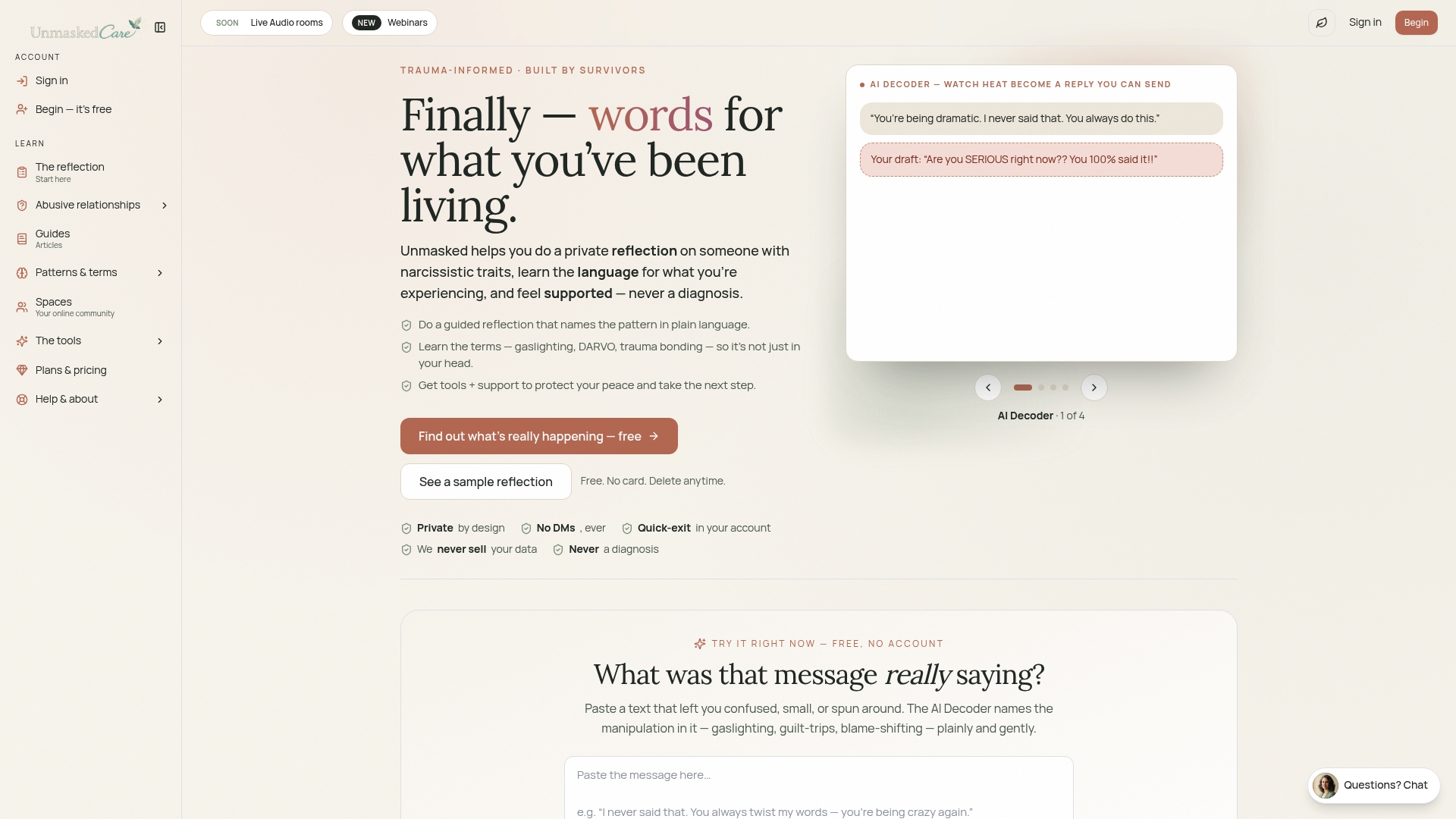
Guided reflections on the platform walk you through structured questions about a specific incident, helping you separate the feeling from the story attached to it, which is the same skill validation depends on. If you want to understand the broader pattern behind moments like these before your next conversation, the BPD survivor’s guide breaks down triggers, boundaries, and communication in plain language. Try the decoder on your next difficult text before you hit send.
Sources
- MANAGEMENT OF CRISES - Borderline Personality Disorder (NCBI Bookshelf)
- Dealing with BPD in relationships tips (HelpGuide)
- How to de-escalate a heated argument before it gets worse (Lumina Counseling)